
Finding Success Without a Plan
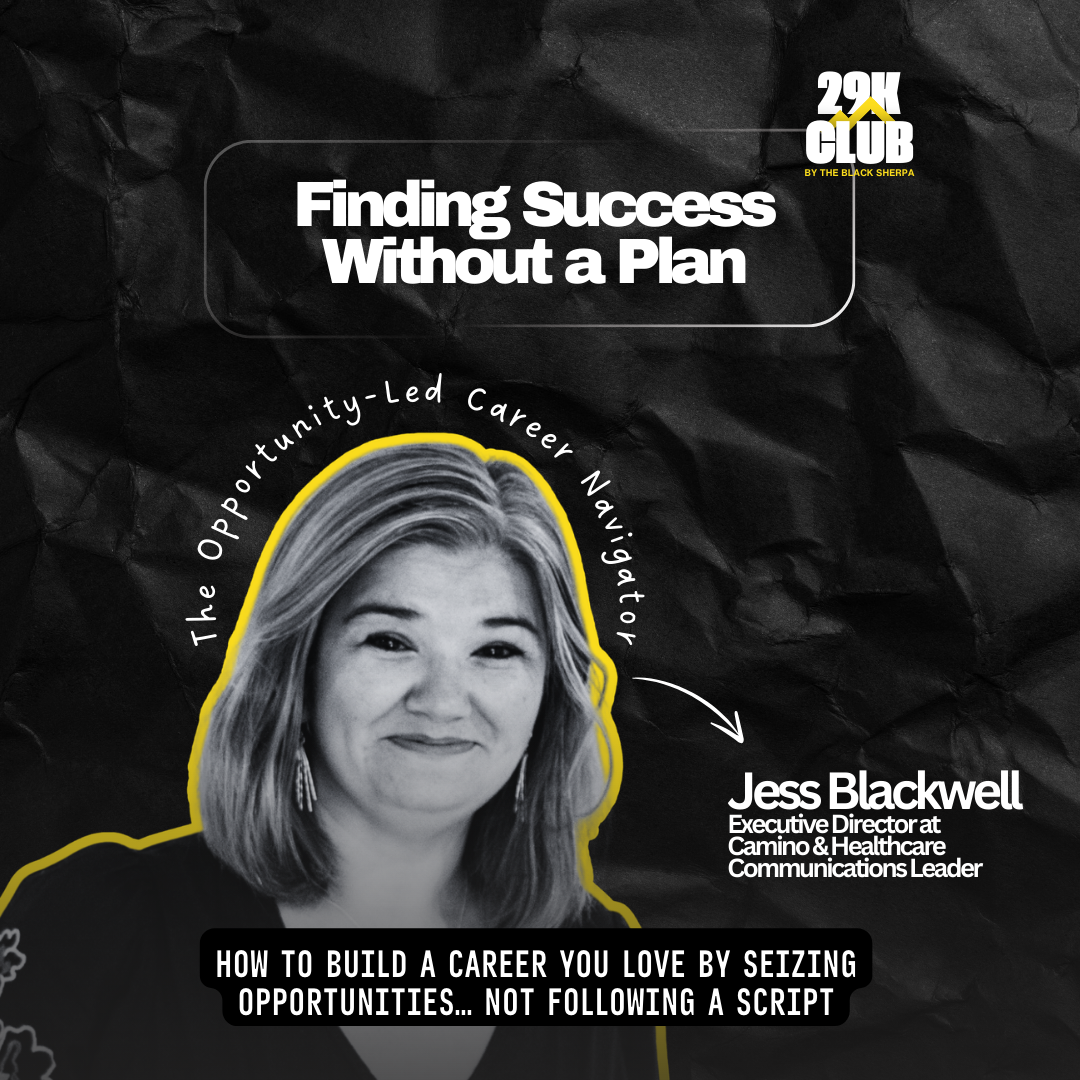
A Black Sherpa 29k Club Masterclass with Jess Blackwell
Not having a five-year plan isn’t a failure of ambition… it’s often a response to reality
“You can still be successful without a five-year plan.”
“My answer for most of my career was probably 0.5.”
“Give me an opportunity and I’ll make it happen.”
That’s how this masterclass landed.
Not with a neat framework.
Not with a perfect roadmap.
But with a collective exhale.
Because for a lot of ambitious, capable people in the room, this was the unspoken question humming beneath their working lives:
What if I don’t actually have a plan?
Am I falling behind… or just being honest?
This week’s Black Sherpa 29k Club masterclass with Jess Blackwell didn’t just answer that question… it dismantled the assumption underneath it.
And what surprised many wasn’t the advice itself.
It was the relief that followed.
People weren’t failing to plan.
They were navigating complexity honestly… often while being judged by career models that no longer reflect how work actually moves.
This wasn’t an argument against planning.
It was an argument against over-identifying with plans in environments that no longer behave predictably.
Why this conversation mattered
Most workplaces still reward certainty.
Clear answers.
Clean narratives.
Five-year career plans that suggest linear progress in a world that’s anything but linear.
But many of us are living a different reality.
Roles evolve faster than job descriptions.
Industries shift before skills can settle.
Technology, restructures, and changing expectations constantly reshape what “progress” even means.
During the session, several participants named this openly:
Plans written to satisfy a boss
A three-year plan “collecting dust”
Direction that made sense on paper, but not in practice
If you’ve ever been asked where you see yourself in five years and felt a quiet panic rather than inspiration, you weren’t alone in this room.
Some people shared that they had a plan… but it no longer matched their energy, their values, or the direction their organisation was heading. Others admitted they were deeply ambitious, but increasingly sceptical that long-term career certainty was realistic at all.
In a world of constant change, the pressure to “have it all figured out” can feel less like guidance and more like performance.
When Jess named that gap… between what we’re told we should have and what we actually feel… you could feel the room relax.
The issue wasn’t lack of ambition.
It was lack of permission.
A career built without a master plan
Jess didn’t arrive with theory.
She arrived with stories.
From falling into early roles without fully understanding them, to learning through repetition and stretch, to saying yes before she felt ready… and, crucially, learning when saying yes stopped serving her.
Her approach wasn’t accidental, but it wasn’t linear either.
“It’s not like no plan meant no ambition.”
Instead of anchoring herself to a distant end point, Jess described working with short horizons:
What’s the next opportunity?
What can I learn here?
Does this give me energy and add value?
That mindset allowed her to move… and to notice.
Opportunities didn’t always show up as promotions or shiny job titles. Sometimes they appeared as gaps. Needs. Moments where someone had to step in and figure something out.
And when Jess stepped in, she didn’t frame it as “this is what I want.”
She framed it as “this is what the business needs.”
“Opportunity was right for me… but I had to make it something the business needed.”
That distinction landed powerfully, particularly for those used to either waiting quietly or over-selling themselves to be seen.
It’s also worth naming that not everyone has the same margin for risk or freedom to say yes. Context, timing, and support systems matter as much as courage… which is why opportunity-spotting is most powerful when paired with awareness of your environment, not blind optimism.
When effort isn’t enough
One of the most emotionally resonant moments came when Jess shared being told she “wasn’t doing enough”.
This was despite:
working long hours
delivering consistently
running one of the largest revenue streams in the business
What leadership meant was breadth… more visibility, more impact beyond a single lane.
What Jess heard, in her mid-20s, was failure.
That disconnect… between intention and impact… is one many high performers recognise.
It wasn’t a lack of capability.
It was a lack of exposure.
That moment became a turning point. Not away from effort, but towards understanding how progression really works in complex organisations: effort matters, but profile, breadth, and context matter too.
A piece of advice worth carrying forward
One of the most valuable career insights Jess shared was this:
Stop focusing on the level directly above you… and start looking two levels ahead.
That shift changes how you think about progression. Instead of obsessing over the next title or role, it encourages you to pay attention to the skills, behaviours, relationships, and ways of working that matter further down the line.
It moves the focus from ticking boxes to building capability.
And it restores agency… reminding us that growth isn’t just about being promoted, but about preparing yourself for the kind of impact you want to have next.
Some advice is worth holding onto simply because it works.
Saying yes… and knowing when it costs too much
Saying yes featured heavily in the session… both as a growth strategy and a cautionary tale.
Early in her career, saying yes helped Jess build momentum, visibility, and trust. It positioned her as someone who delivered and could be relied upon when things mattered.
But later, that same instinct led to overload.
Jess described taking on two major roles at once… effectively doing two jobs badly instead of one job well. The work that didn’t give her joy drained her energy far faster than the work she loved.
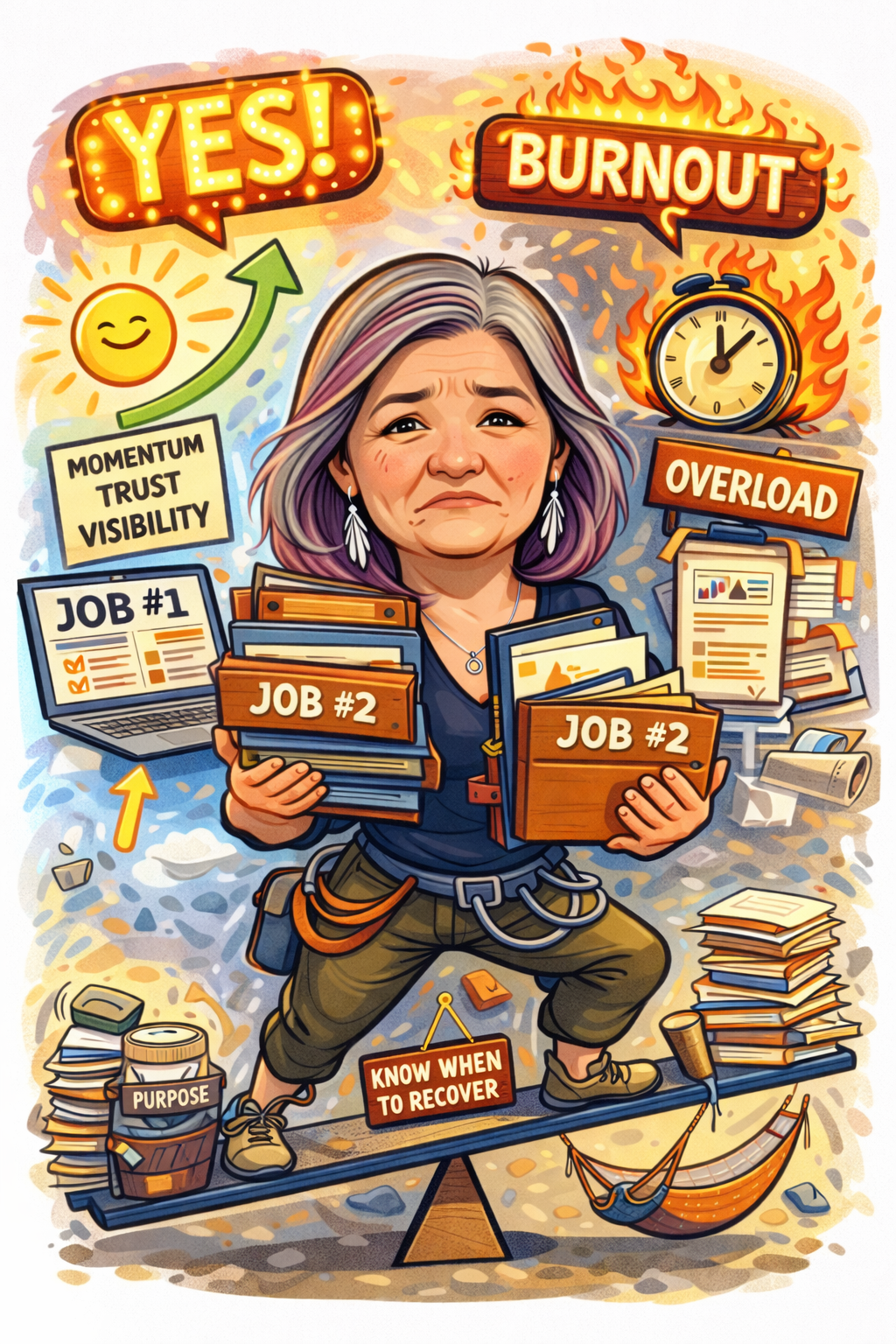
Burnout vs balance: the juggling act
That distinction mattered.
Effort is easier to sustain when it’s connected to purpose.
Burnout arrives faster when it isn’t.
Saying yes works best when it’s paired with visibility, agency, and the ability to say no later… without penalty. Without those conditions, “yes” can quietly turn from strategy into sacrifice.
This opened a wider conversation about seasons of effort… and the myth of balance. There will be intense periods. The real skill is knowing when to recover, and having the agency to do so.
The gendered edge of reliability
Lucy raised a question that shifted the room.
What happens when being dependable, capable, and willing becomes gendered?
Jess acknowledged the tension without retreating from pride in her work. Working hard wasn’t the problem. Invisibility and imbalance were.
The danger isn’t saying yes.
It’s when saying yes becomes expected, unrecognised, and unevenly distributed.
Naming that dynamic helped people separate effort from obligation… and success from silent sacrifice.
Success, reward… and losing agency
One of the more nuanced moments in the session came when Jess reflected on being offered incentives that, on the surface, signalled success.
On paper, they looked like recognition.
A reward.
A marker that things were going well.
But underneath that, something else surfaced.
A narrowing.
A subtle loss of optionality.
What might have been expected to feel motivating instead prompted a deeper question:
Do I actually want the future this incentive nudges me towards?
That reflection… often left unspoken in career conversations… became an important catalyst. It highlighted a truth many people quietly experience: when rewards begin to reduce freedom or choice, success can start to feel misaligned.
And that misalignment matters. Because progress that limits agency rarely sustains fulfilment for long.
Career progression as a climbing wall
Jess introduced a metaphor that stuck with people long after the session ended.
Your career isn’t a ladder.
It’s a climbing wall.
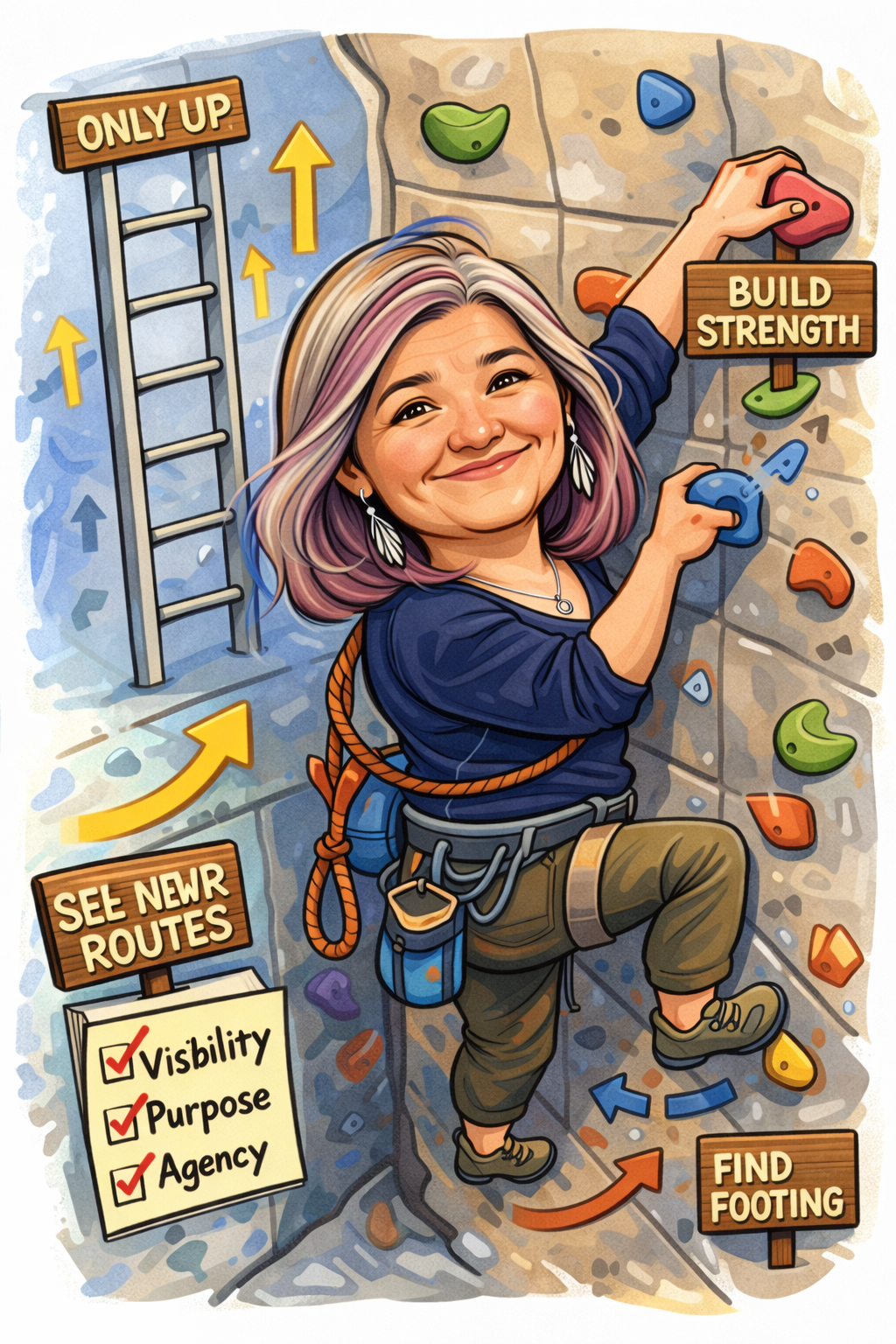
Climbing to new heights
On a ladder, sideways movement looks like failure. On a climbing wall, it’s often how you find better footing, build strength, and see new routes.
Sometimes you move up.
Sometimes you move across.
Occasionally, you step down to reach a stronger path forward.
This reframing matters for anyone navigating career change, leadership development, or growth without a clear next title. Progress isn’t always visible… but it’s still real.
Key insights and practical strategies
Here’s what participants took away… grounded, usable, and human:
No plan doesn’t mean no ambition.
It may mean you’re navigating career uncertainty honestly.Clarity often comes after movement.
Movement doesn’t always mean dramatic action… sometimes it’s a conversation, a pilot, or a small test that creates information.Say yes early — but plan your exit.
Try things. Learn quickly. Transition cleanly if it’s not the right fit.Translate desire into value.
Opportunity opens faster when framed as business need.Visibility isn’t ego… it’s access.
Being known for delivery creates future options.Careers move like climbing walls, not ladders.
Sideways and diagonal moves still build strength.Look two levels ahead.
Focus on skills, behaviours, and relationships… not just titles.Manage seasons, not balance.
Push when it matters. Recover deliberately.
Why this matters for leaders and organisations
This wasn’t just a career conversation… it was a leadership one.
When people are forced to perform certainty they don’t feel, organisations pay the price:
brittle plans
disengagement
talented people who look stable but feel stuck
Leaders are increasingly expected to create clarity in environments where certainty no longer exists. That pressure often pushes people towards control, polish, or overconfidence.
Jess offered a different model: leadership built on momentum rather than certainty, trust rather than control, and consistency rather than having all the answers.
This applies whether you manage a team, influence laterally, or are learning to lead yourself through uncertainty.
When space is created for honest conversations about uncertainty, something shifts.
People don’t disengage.
They lean in.
They stop pretending… and start contributing.
Who this session was for
This masterclass resonated most strongly with:
high-performing professionals questioning their direction
leaders navigating growth without a clear map
ambitious people unconvinced by traditional career advice
It spoke to those who don’t lack motivation or capability… but who are looking for a more honest, sustainable way to build success in a complex world.
The Black Sherpa 29k Club difference
This session was a perfect expression of why the 29k Club exists.
Not to hand out generic advice.
But to build clarity, confidence, and community for underrepresented professionals navigating systems that weren’t designed with them in mind.
Real people.
Real experiences.
Conversations that meet you where you are… not where a framework says you should be.
A closing leadership challenge
As you reflect, ask yourself:
Where am I waiting for certainty before I move?
What opportunity might I be overlooking because it doesn’t fit a neat plan?
If I took one small step this month, what clarity might follow?
You don’t need the full map.
You need direction, movement, and the courage to adjust as you climb.
Climb steady 🖤
About Jess Blackwell
Jess Blackwell is an Executive Director at Camino and an experienced healthcare communications leader, specialising in omni-channel scientific journeys… ensuring the right content reaches the right audiences, in the right format, at the right time.
Known for her honesty, curiosity, and human-centred approach, Jess champions opportunity-led career growth and helps professionals navigate uncertainty without needing a perfect plan… just the confidence to notice what’s in front of them and act with intent.
Through her leadership at Camino, Jess is helping shape how good AI practice is being adopted across life sciences… rooted in real teams, real challenges, and real human impact.
That work comes to life through Adventures in Pharma 2.0 a live industry gathering taking place in London on 30 April 2026, focused on moving beyond hype to explore how people and AI can work better together in practice. It reflects the same belief we share at Black Sherpa: meaningful change happens through people, proximity, and community… by creating the right rooms.
I’ll be there. If this masterclass resonated, it’s a very good room to be in too.
I’m Yam – Founder of The Black Sherpa
Founder | Strategist | Speaker | Host of The Black Sherpa Podcast
I founded The Black Sherpa to create a world where talent rises on merit and no one’s potential is held back by bias or barriers.
Through bold strategy, storytelling, and our flagship community, The 29k Club - I help professionals grow with confidence and support leaders to build cultures that truly live their values.
Let’s connect and build a future where inclusion powers performance, and leadership reflects the world we serve.