
How to Ask for What You Want at Work: Why Career Courage Is Built Before the Yes

A Black Sherpa 29k Club masterclass with Joanna Briggs, HR leader and career coach, helping professionals speak up, self-advocate and progress with confidence
Sometimes the person getting ahead isn’t smarter than you.
They just asked.
That was the uncomfortable truth sitting underneath Joanna Briggs’ 29k Club masterclass on career courage, confidence and advocating for yourself at work.
Not the Instagram version of confidence.
Not the “just believe in yourself” version.
Not the polished leadership quote that looks good on a slide.
The real version.
The one that asks:
Why didn’t you put yourself forward?
Why didn’t you challenge the decision?
Why didn’t you ask for the promotion, the opportunity, the pay rise, the flexibility, the support, the room, the seat, the straw?
Because as Joanna reminded us:
“Their response isn’t in your control.”
But your ask is.
And for many professionals, especially those navigating invisible barriers, that is where the real work begins.
Why This Conversation About Career Courage Matters
Most conversations about career progression focus on performance.
Work harder.
Build your skills.
Deliver results.
Be excellent.
All useful.
But incomplete.
Because in many workplaces, great work does not automatically translate into visibility, opportunity or progression. Someone still has to notice. Someone still has to understand your value. Someone still has to connect your contribution to what matters.
And often, that someone has to be you.
That is why learning how to ask for what you want at work is not a soft skill. It is a career skill.
Joanna shared a stat that should stop every leader in their tracks: around half of employees choose to stay silent at work.
That silence has consequences.
It means missed opportunities.
Unchallenged decisions.
Invisible ambition.
Unspoken needs.
Talent quietly waiting to be discovered while more practised or more socially rewarded voices shape the room.
For organisations, this is not just a confidence problem. It is a culture problem.
For individuals, it is even more personal.
Because when you repeatedly talk yourself out of asking, you do not just miss the opportunity in front of you. You train yourself to expect less.
As Joanna put it:
“Do not fan the fire of fear.”
That line matters because fear rarely arrives alone. It brings stories with it.
They’ll say no.
They’ll think I’m difficult.
I’m not ready.
I don’t have the right background.
Someone else deserves it more.
Who am I to ask?
But the real danger is not always rejection.
Sometimes the real danger is making the decision on someone else’s behalf before they have even had the chance to respond.
Meet Joanna Briggs: HR Leader, Career Strategist and Courage Builder
Joanna Briggs brings a rare combination of credibility, humour and practical workplace insight.
By day, she works in HR and recruitment, currently as Head of Recruitment within Legal Group at HMRC, where she sees the mechanics of hiring, progression and organisational decision-making from the inside.
By passion and practice, she is a career strategist, content creator and columnist with Brains magazine, using her platform to make complex workplace dynamics feel accessible, honest and actionable.
Her work sits at the intersection of:
career development
HR insight
workplace confidence
personal advocacy
professional storytelling
equity and access
What makes Joanna’s perspective powerful is that she does not speak about career courage as theory.
She has lived the difference between waiting to be chosen and choosing to put herself forward.
And she helps others do the same.
Joanna’s strength is her ability to make people laugh, then realise the joke is sitting on top of something serious. She can talk about asking for a straw in a restaurant and, within minutes, make you see how that same pattern might be shaping your pay rise conversation, promotion strategy or willingness to speak up in a meeting.
That is not just content.
That is career strategy made human.
The Penny Drop: Other People Are Asking While You Are Accepting
Joanna opened with a story from university.
She had received a 2:1 on an assignment and accepted it. That was the grade. That was the decision. That was that.
Then her friend Phoebe told her she had received a 2:1 too.
But Phoebe went to the lecturer, challenged the mark, explained why it should be adjusted, and got it changed to a first.
Joanna was stunned.
Not because Phoebe had done anything wrong.
But because the possibility had never occurred to her.
That moment revealed something bigger than grades.
Some people are taught, explicitly or implicitly, that decisions can be questioned.
Others are taught to accept what they are given.
Some people enter rooms assuming negotiation is part of the process.
Others enter assuming the process is fixed.
That is one of the hidden rules of career progression.
The system may look the same for everyone, but people are not always playing with the same blueprint.

Same system, different blueprint… career courage starts when you realise the rules can be questioned
For individuals, the lesson is clear: before assuming something is final, ask whether there is room to challenge, clarify or negotiate.
For leaders, the challenge is deeper: who in your team has been conditioned to accept quietly? Who needs permission, encouragement or modelling before they realise asking is allowed?
For organisations, the question is uncomfortable: how much talent is being lost because only certain people know how to challenge the system?
Workplaces are designed to extract value from people’s labour. That is not automatically bad. But it does mean professionals need to be intentional about what they are building, learning, earning and asking for in return.
Stop Rejecting Yourself Before the System Does
One of the most valuable moments in the session came from Jaden, a recent graduate.
He shared the hesitation many early-career professionals know well: seeing a job opportunity, recognising that you meet much of the criteria, then stopping yourself because of one missing requirement.
Maybe it asks for a master’s.
Maybe it mentions a PhD.
Maybe the experience level feels slightly out of reach.
So you do not apply.
Not because they said no.
Because you did.
Joanna’s response, wearing her recruitment hat, was direct:
If you can do enough of the job, apply.
She explained that hiring teams often consider candidates who do not meet every single requirement, particularly when they can demonstrate relevant experience, transferable skills or strong potential.
The job description is not always a locked gate.
Sometimes it is a conversation starter.
But if you screen yourself out before applying, there is no conversation to be had.
That is one of the most practical lessons in workplace self-advocacy:
Do not make the hiring decision on their behalf.

Don’t count yourself out before the opportunity has had a chance to count you in
This matters even more in a job market increasingly shaped by applicant tracking systems, structured scoring and, in some cases, AI-enabled screening. Human conversations still matter. Speaking to people close to the role can help you understand the language, priorities and evidence that will strengthen your application.
In a more automated job market, conversations are still a career advantage.
Career Courage Is Not an Early-Career Problem
Another revealing moment came when Jaden, a recent graduate, and Carl, a more experienced professional, described almost the same fear from different points in their careers.
Jaden was asking:
How do I approach job opportunities without looking awkward or underqualified?
Carl was asking:
How do I ask for a promotion when I have never had that conversation before?
Different career stages.
Same hidden barrier.
That moment mattered because it exposed something we do not say enough: career courage is not something you complete in your twenties.
You may need it when applying for your first role.
You may need it when asking for your first promotion.
You may need it when moving into leadership.
You may need it when changing industries.
You may need it when returning after illness, parental leave, redundancy or burnout.
You may need it when you finally admit that the role you are in no longer fits the life you want.
The ask changes.
The fear often stays familiar.
That is why Joanna’s message landed so strongly. She was not telling people to become fearless. She was showing them how to build evidence that fear does not have to be in charge.
Confidence at Work Is Not a Personality Trait. It Is a Practice
One of Joanna’s most important points was this:
Confidence is not something you are simply born with.
It is something you practise.
This matters because many professionals disqualify themselves from speaking up by saying:
“I’m not confident enough.”
“I’m too introverted.”
“That’s not really my personality.”
“I’m not the sort of person who asks.”
But Joanna challenged that directly.
Extroverts may open doors quickly. Introverts may build deeper, more thoughtful relationships. Both can advocate for themselves. Both can ask. Both can build workplace confidence.
The issue is not personality.
The issue is practice.
Joanna described confidence as something built through repeated action:
Acknowledge the desire.
Follow through on the request.
Repeat the interaction.
Learn from shared experiences.
That is the confidence loop.
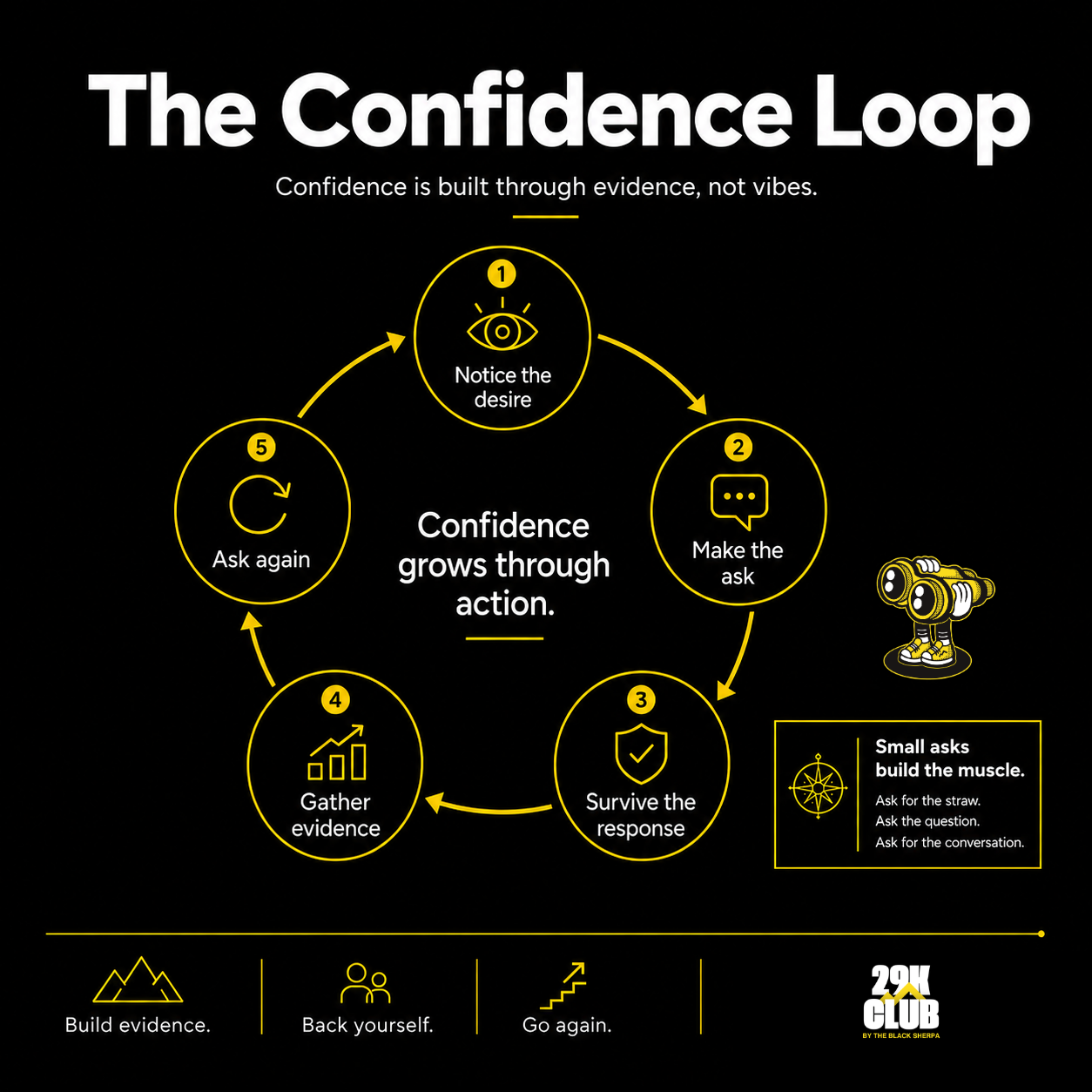
Confidence grows when you make the ask, survive the response and gather the evidence to go again
You do not become confident by waiting until fear disappears.
You become confident by proving to yourself that fear does not have to make the decision.
As Joanna said:
“You cannot cheat the process.”
This is why small asks matter.
Ask for the straw in the restaurant.
Ask for the extra sauce.
Ask for the equipment you need at work.
Ask the question in the meeting.
Ask for clarification.
Ask for the conversation.
Not because the straw changes your career.
Because the muscle does.
This is not about shaming people for finding small asks difficult. For some, anxiety, previous experiences, neurodivergence, cultural conditioning or workplace dynamics can make even low-risk requests feel loaded. The point is that low-risk moments can become practice grounds for bigger moments.
If you cannot ask for the straw, the sauce, the seat change or the support you need in a low-risk moment, of course the promotion conversation may feel enormous.
The workplace ask is rarely the first ask.
It is usually the latest expression of a pattern.
Practise Asking Before Life Forces You To
One of the most human moments in the room came from Mariah.
She shared that after being diagnosed with a medical condition, asking for support was no longer optional. She had been forced into self-advocacy because there was no other choice.
Her reflection landed heavily:
It is better to practise these things before life forces you to.
That is the thing about advocating for yourself at work and in life.
You do not want to learn it only in crisis.
You do not want the first time you clearly express your needs to be when your health, wellbeing or livelihood depends on it.
Small asks are not small because they are easy.
They are small because they prepare you.
They teach your body that asking does not automatically mean danger.
They teach your mind that your needs deserve language.
They teach your relationships that you are allowed to have requirements, not just responsibilities.
As Joanna put it:
“Your desires deserve a platform.”
That sentence deserves to sit with people for a while.
Because many professionals, especially those used to being useful, reliable and low-maintenance, have practised making their desires disappear.
The Fear Behind the Ask: Culture, Consequences and Power
When Joanna asked the room to reflect on why they had talked themselves out of asking for something they wanted, the responses were honest.
Fear of being perceived badly.
Fear of not meeting the criteria.
Fear of asking too directly.
Fear of not having the skills yet.
Fear of rejection.
Fear of getting it wrong.
Joanna grouped much of this into three forces.
Cultural conditioning
Many people have grown up in households, cultures or systems where challenging authority was discouraged or even punished.
Patricia brought this to life powerfully when she reflected on how some people are taught from a young age to be quiet when adults are talking.
That does not disappear when they enter the workplace.
It follows them into meetings, interviews, performance reviews and promotion conversations.
Some people are socialised in environments where questioning, negotiating and debating with authority figures is encouraged.
Others are socialised to see those same behaviours as rude, risky or disrespectful.
Then people with very different social training enter the same workplace, where speaking up is quietly rewarded, and we pretend everyone had the same preparation.
That is the unwritten curriculum.
Negative consequences
People worry that speaking up will make them look difficult, greedy, entitled or ungrateful.
This is especially true for people who already feel watched, judged or stereotyped differently.
The fear is not irrational. But it can become limiting when it prevents any action at all.
Power dynamics
Asking your manager, senior leader or hiring manager for something can feel risky because they appear to hold the keys.
But as Joanna reminded us, silence does not protect you from disappointment.
It often guarantees it.
Underrepresented professionals may carry additional calculations around visibility, perception and consequence when deciding whether to speak up. The problem is not a lack of ambition. Often, it is a very accurate reading of how unevenly confidence is received.
That means organisations cannot simply tell people to speak up.
They also have to examine what happens when they do.
The Three-Conversation Promotion Framework
One of the strongest moments in the session came when Carl asked a practical question:
How do you actually ask for a promotion when you have never had that conversation before?
Joanna’s answer became a full playbook.
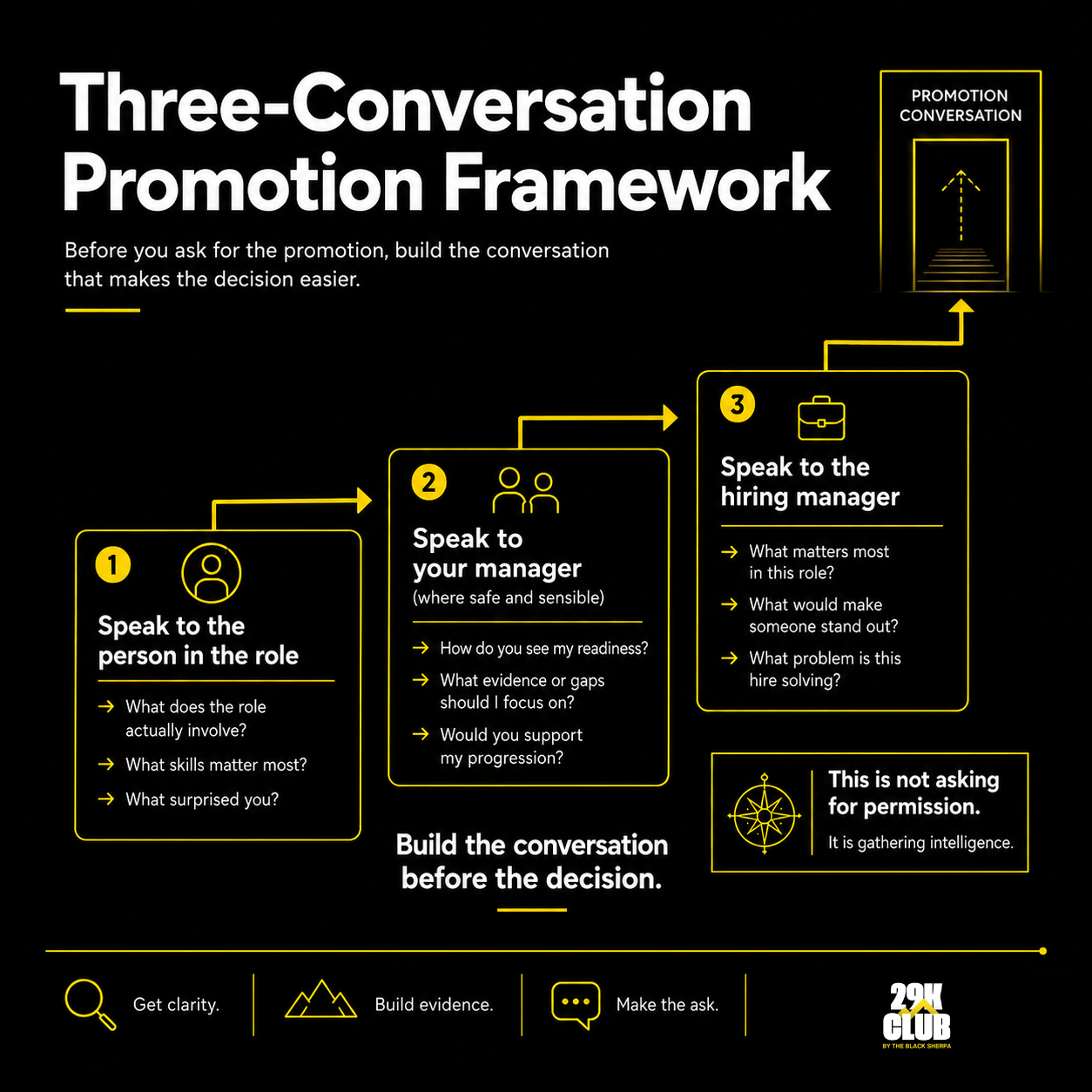
Build the right conversations before you make the big ask
Before asking for a promotion or applying for a role, she recommended having three conversations where possible.
1. Speak to the person currently in the role
Job descriptions rarely tell the whole truth.
They tell you the polished version. The ideal version. The version the organisation thinks it needs.
The person in the role can tell you the reality.
What does the role actually involve?
What surprised them?
What skills matter most?
What does success really look like?
What would they have known before applying?
This conversation gives you practical insight and helps you decide whether the opportunity is genuinely right for you.
2. Speak to your manager, where it is safe and sensible to do so
This is especially important if you are trying to progress within your current team or function.
The goal is not simply to ask for permission.
The goal is to understand how they see you, whether they would support you, what evidence they think you need, and what gaps may need closing.
It also helps you understand whether they are likely to advocate for you or quietly resist your move.
That information is useful either way.
Of course, not every manager is safe, supportive or secure enough to handle ambition well. In those cases, timing and judgement matter. The principle is not to disclose everything blindly. The principle is to gather the information you need without putting yourself at unnecessary risk.
3. Speak to the hiring manager
This is where many professionals hesitate, but it can be one of the most powerful moves.
You are not asking them to give you the job.
You are asking them to help you understand what they are looking for.
What matters most in this role?
What kind of person thrives in this team?
What are the biggest priorities?
What problem is this hire expected to solve?
What would make someone stand out?
This is not cheating.
This is preparation.
It helps you write a stronger application, prepare better examples and understand the language of the decision-maker.
The lesson is simple:
Build the conversation before the decision.
The Intelligence-Gathering Ask
Not every ask is a request for approval.
Some asks are designed to gather intelligence.
This was one of the most sophisticated parts of Joanna’s advice.
When discussing how to pitch a big idea at work, especially something that may feel ambitious, new or disruptive, she encouraged members to ask questions before trying to sell the solution.
Ask:
What has been tried before?
Why didn’t it work?
Where do you think we are falling short?
What would make this difficult to implement?
Who else should I speak to?
What would need to be true for this to work?
Joanna said something that captured this beautifully:
“I ask questions I know the answers to, but I ask them to different people because people are going to give me different perspectives.”
That is not manipulation.
That is strategic listening.
Yam added another layer:
Sometimes the answer coming in somebody else’s voice is more powerful than the answer coming from yours.
You may already know the problem. You may already see the gap. You may already understand the opportunity.
But when a stakeholder names it in their own words, they begin to own it.
That is how influence works.
Not by forcing your insight into the room.
But by asking questions that help the room recognise what has been sitting there all along.
Your Network Is Closer Than You Think
Another powerful insight from Joanna was this:
Your network is not far-fetched.
It is not always some distant group of senior people you need to impress. It is not only the person with the biggest title or the largest following.
Your network is often the people around you right now.
The people in the room.
The people in your community.
The people you have worked with before.
The people one introduction away.
The people who know someone who knows someone.
The people who would help if they knew what you were trying to do.
But that final part matters.
If nobody knows what you want, they cannot help you find it.
This is one of the hidden costs of silence.
It does not just keep your ask unspoken.
It keeps your ambition invisible.
Do Not Become Someone Else’s Shortcut Around Courage
Yousef asked a brilliant question near the end of the session.
What do you do when people ask you to ask on their behalf?
You have given them the advice.
You have shown them the next step.
You have explained what to say.
But they still want you to do it for them.
Joanna’s answer added important nuance.
Supporting someone does not always mean carrying their courage for them.
Sometimes the most generous thing you can do is give them the words, help them prepare, and then allow them to experience the discomfort of acting for themselves.
If you keep stepping in, you may rob them of the opportunity to build the confidence they need.
That is an important leadership lesson.
For managers.
For mentors.
For sponsors.
For friends.
For community builders.
Help people prepare.
Do not always rescue them from the ask.
Courage Without Self-Awareness Can Become Entitlement
Towards the end of the session, Yam asked an important question:
Is there a line between being courageous and becoming difficult?
Joanna’s answer was rooted in self-awareness.
You need to understand your why.
Are you asking because it aligns with your growth, contribution and value?
Or because you have a chip on your shoulder?
Are you challenging to improve something?
Or simply because someone else got something and you feel you should too?
The point is not to make people second-guess every ask.
It is to make sure the ask is grounded in contribution, clarity and respect.
This is where Joanna offered one of the most memorable lines of the session:
“Make sure your roots are as strong and healthy as your fruits.”
In other words, your external confidence needs internal grounding.
The fruit is what people see: the ask, the challenge, the courage, the visible ambition.
The roots are what shape it: self-awareness, values, preparation, emotional maturity and integrity.
Without strong roots, confidence can become performance.
With strong roots, courage becomes leadership.
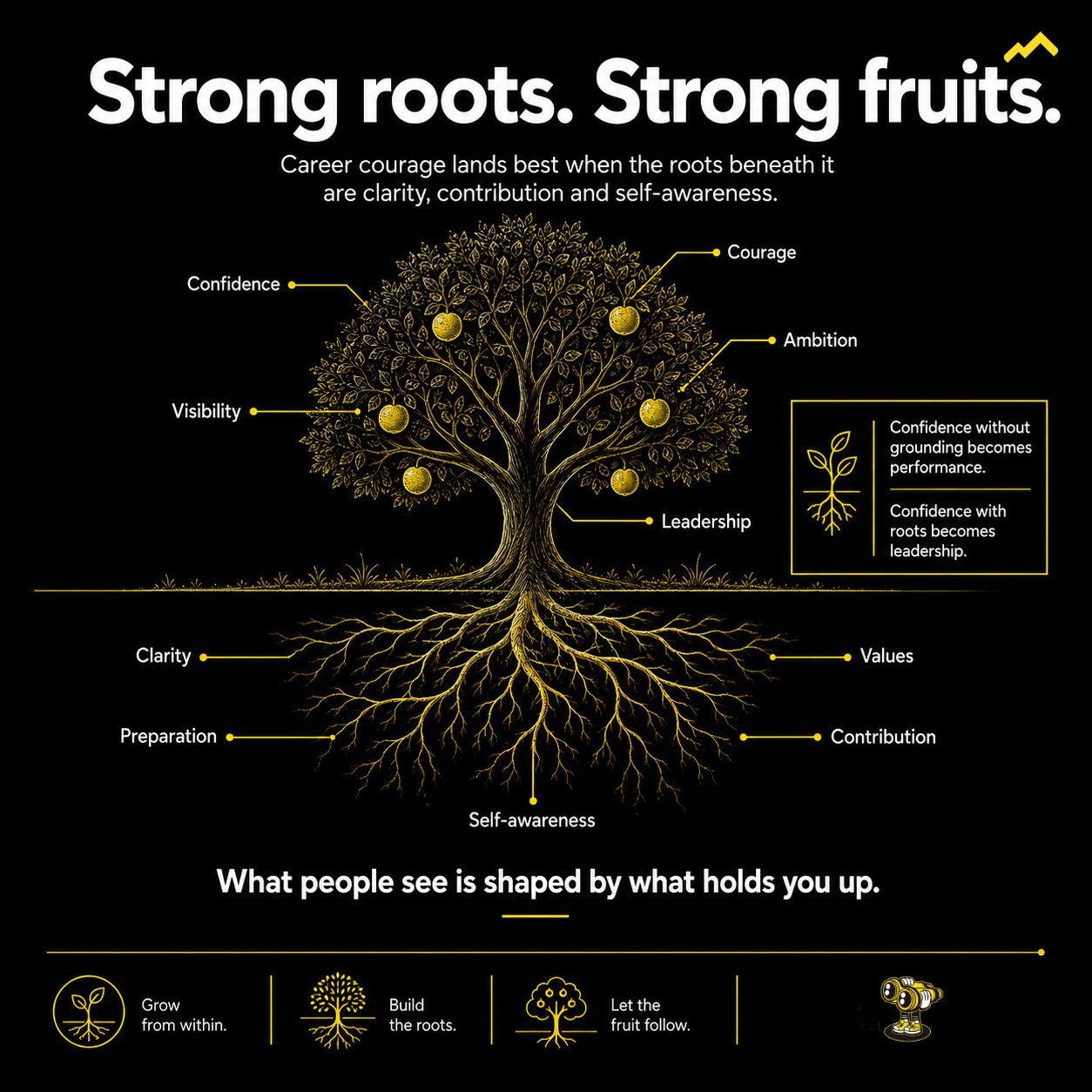
Visible confidence is stronger when it is rooted in clarity, contribution and self-awareness
Key Insights to Save
Confidence is built through evidence, not positive thinking. Every small ask gives you proof that fear does not have to make the decision.
Do not reject yourself before the system does. The job description is not always a locked gate; sometimes it is a conversation starter.
Career courage is not an early-career issue. The ask changes over time, but the fear can follow you.
Practise asking before life forces you to. Low-risk asks prepare you for the moments when self-advocacy really matters.
Not every ask is about approval. Some asks are about gathering intelligence, testing assumptions and understanding the room.
Do not delegate your decisions to other people’s fears. Advice is useful, but your career choices are yours to live with.
Your roots need to be as strong as your fruits. Courage lands best when it is grounded in clarity, contribution and self-awareness.
Why This Matters for Career Progression and Workplace Culture
Ignoring this topic has a cost.
Individuals stay stuck in roles they have outgrown.
Managers miss signals from ambitious talent.
Organisations reward those who know how to navigate invisible rules.
People who face additional scrutiny around visibility, perception or consequence may continue to self-edit in rooms where their contribution is needed.
But when people learn how to ask for what they want at work, something shifts.
They become more active in their career.
They build confidence through evidence.
They stop waiting to be discovered.
They understand the system without being consumed by it.
They learn to advocate with clarity instead of apology.
And when leaders create environments where asking, challenging and speaking up are genuinely welcomed, the whole culture changes.
Because the best ideas are not always in the most practised voice.
Sometimes they are sitting quietly in someone who was never taught the room was theirs to shape.
Why This Conversation Belongs in the 29k Club
This is exactly why the 29k Club exists.
Not to offer generic career advice.
Not to tell ambitious professionals to “just be more confident.”
Not to pretend the workplace is fair, simple or easy to navigate.
The 29k Club creates space for the conversations that often get missed in traditional professional development.
The unwritten rules.
The hidden dynamics.
The confidence gaps.
The cultural conditioning.
The questions people are thinking but do not always feel able to ask.
And this session showed what happens when the room is trusted enough to go there.
A recent graduate asked how to approach job opportunities.
A more experienced professional asked how to start a promotion conversation.
A member shared how a medical diagnosis forced her to self-advocate.
Another connected workplace silence to childhood conditioning and culture.
Someone else asked how to support others without becoming their voice.
That is not just a masterclass.
That is peer intelligence in motion.
Through masterclasses, mentoring circles and community conversations, members build clarity, confidence and community in real time.
Not as theory.
As practice.
Because career progression is not just about knowing what to do. It is about being in rooms where people help you find the words, test the ask, understand the system and take the next step.
Connect With Joanna Briggs
If you are an organisation, community, network or leader thinking seriously about career confidence, workplace advocacy, recruitment, inclusion or professional development, Joanna Briggs is someone worth knowing.
She helps people understand the real barriers behind silence, hesitation and missed opportunity, then gives them practical tools to act differently.
Her work is especially valuable for:
early-career professionals
underrepresented talent
employee networks
HR and talent teams
leadership development programmes
organisations serious about progression and inclusion
Follow Joanna. Book her. Collaborate with her.
Because career courage is not a nice-to-have topic.
It is one of the missing conversations shaping who gets seen, heard and promoted.
Final Reflection
Where are you accepting something that you could challenge?
What ask have you been rehearsing in your head but avoiding in real life?
And what would change if you treated confidence at work as a practice, not a personality trait?
Start small.
Ask anyway.
That is how the mountain moves.
Climb steady 🖤
I’m Yam – Founder of The Black Sherpa
Founder | Strategist | Speaker | Host of The Black Sherpa Podcast
I founded The Black Sherpa to create a world where talent rises on merit and no one’s potential is held back by bias or barriers.
Through bold strategy, storytelling, and our flagship community, The 29k Club - I help professionals grow with confidence and support leaders to build cultures that truly live their values.
Let’s connect and build a future where inclusion powers performance, and leadership reflects the world we serve.