
Why Your First 90 Days in a New Job Aren’t About Proving How Good You Are
Your first 90 days: why good science gets ignored and what to do about it. Paul Trusty explores how scientists can move beyond excellent but invisible work, build credibility and translate their expertise into value the wider organisation understands
You can be technically brilliant and still become professionally invisible
And the most dangerous version of career stagnation rarely looks like failure.
You still deliver.
People still describe you as dependable.
Nobody questions whether you know your stuff.
You just notice the bigger project went somewhere else.
The important meeting happened without you.
Someone else presented the work.
And when the next opportunity came up, another name surfaced first.
That tension sat underneath Paul’s recent 29k Club masterclass on the first 90 days in a new job.
Early in his move from academia into industry, Paul did what many highly capable people do when they feel out of their depth.
He worked harder.
He researched more.
He generated more data.
Then, after months of careful scientific work, he presented his findings to his boss.
The response?
“So what?”
Brutal.
Also fair.
Because Paul had answered the technical question without answering the question the business actually cared about.
That moment would shape how he approached the next 25 years of his career… and eventually lead him to identify six recurring behavioural patterns that can quietly hold scientists back at work.
The masterclass explored several of them.
And if your technical performance is strong but your career sometimes feels harder than it should, one may feel uncomfortably familiar.
Your first job is to understand the organisation nobody drew for you
Most onboarding advice focuses on learning systems, meeting the team and getting some early wins.
Useful.
But incomplete.
Because underneath every organisation sits another organisation.
There is the official version:
Reporting lines.
Job descriptions.
Governance.
Processes.
Then there is the organisation people actually experience:
Who gets listened to.
Who gets ignored.
Who has influence without the title.
Where decisions really happen.
Which relationships make things move.
Which issues everybody knows about but nobody puts on a slide.
Paul’s argument was that the early stages of your first 90 days in a new job should involve far more observation and intelligence gathering than many ambitious people allow themselves.
“The most useful thing you can do in week one is not to deliver anything at all,” he told the room.
Instead, map the ecosystem.
Who talks to whom?
Who avoids whom?
Who does everybody seek out when they need an answer?
Where are decisions really made?
What keeps the people around you awake at night?
That matters particularly for people making the transition from academia to industry, but the lesson travels much further.
Whether you are a scientist, strategist, clinician, marketer or leader, your expertise is entering a system that existed before you arrived.
Understanding that system is part of the job.
And Paul offered a useful sentence for anyone worried that admitting they are new will undermine their credibility:
“I don’t know much about this yet, but this is what I’ve seen.”
That is not weakness.
It is fresh-eyed confidence.
Meet Paul… the scientist studying what holds scientists back
Paul is a materials scientist with more than 25 years of experience across aerospace, food and pharmaceuticals.
He moved from ceramic composites to ice cream, then later into pharmaceutical science.
Each transition forced him to confront the same deceptively difficult question:
How do you establish credibility when your expertise is real, but the context around it has changed?
And Paul notices patterns.
Ask him his favourite ice cream and somehow you end up in a conversation about manufacturing variability, materials science and why apparently simple products are often more complex than they look.
That tells you something about how his mind works.
Over time, he began noticing recurring patterns in scientists too.
He has now identified six behavioural patterns that can limit scientists’ impact and career progression.
The session explored several:
The Trust Threshold: when technical credibility has not yet become organisational trust
The Silent CV: when good work remains disconnected from relationships, visibility and advocacy
The Unstated Question: when scientists answer what a stakeholder literally asks rather than what they really need to know
The Authority Reset: when previous credibility does not automatically transfer into a new organisational environment
Paul has also built a free five-minute diagnostic to help scientists identify which of the six patterns may be holding them back right now… and one practical thing they can do about it.
That matters.
These are not personality labels.
They are patterns of behaviour.
And behaviour can change.
Technical expertise gets you hired. Translation builds trust
Paul’s ice-cream story is funny until you recognise yourself in it.
New to Unilever and conscious that he knew material science but very little about ice cream, he retreated into what felt safe.
The science.
He spent months developing and proving an important insight into ice-cream texture.
Scientifically, the work was valuable.
His boss listened.
Then asked:
“So what?”
Because industry does not only reward what you know.
It rewards your ability to explain what somebody can do because you know it.
Could the insight improve the product?
Create an innovation?
Reduce risk?
Increase sales?
Generate intellectual property?
Support better decisions?
Accelerate development?
In life sciences especially, business relevance is not just about money.
It can mean better evidence.
Lower risk.
Faster development.
Improved quality.
Stronger regulatory decisions.
Better outcomes.
Paul had produced knowledge.
The organisation needed consequence.
When he eventually learned to connect his scientific work to those wider questions, something shifted.
He described crossing a Trust Threshold.
More confidence.
More resource.
Bigger projects.
Greater influence.
The lesson is simple:
Being right is not the same as being useful.
Your expertise has to travel.
Senior stakeholders don’t want the journey. They want the punchline
Scientific training often encourages a logical sequence:
Aim → Method → Results → Conclusion
Paul compared it to telling a long joke.
You build the story.
You finally reach the punchline.
There is just one problem.
Senior stakeholders interrupt the joke.
By slide two, somebody wants the answer sitting on slide ten.
Another jumps straight to risk.
Someone else asks about money.
Before long, the carefully constructed narrative is dead.
Paul’s solution for communicating science to non-scientists was beautifully simple:
Tell them the punchline first.
If the project saved £2 million, start there.
If your recommendation is to stop something, say it.
If there is a material risk, surface it.
Give people the destination before you explain the route.
This is not “dumbing down” the science.
The science does not change.
The communication does.
A scientific peer may want the table.
The stakeholder probably wants to know what the table means.
Keep the detail.
Put it in the appendix.
Put the decision on the slide.
The question you hear is not always the question you need to answer
One of Paul’s strongest mental models is the Unstated Question.
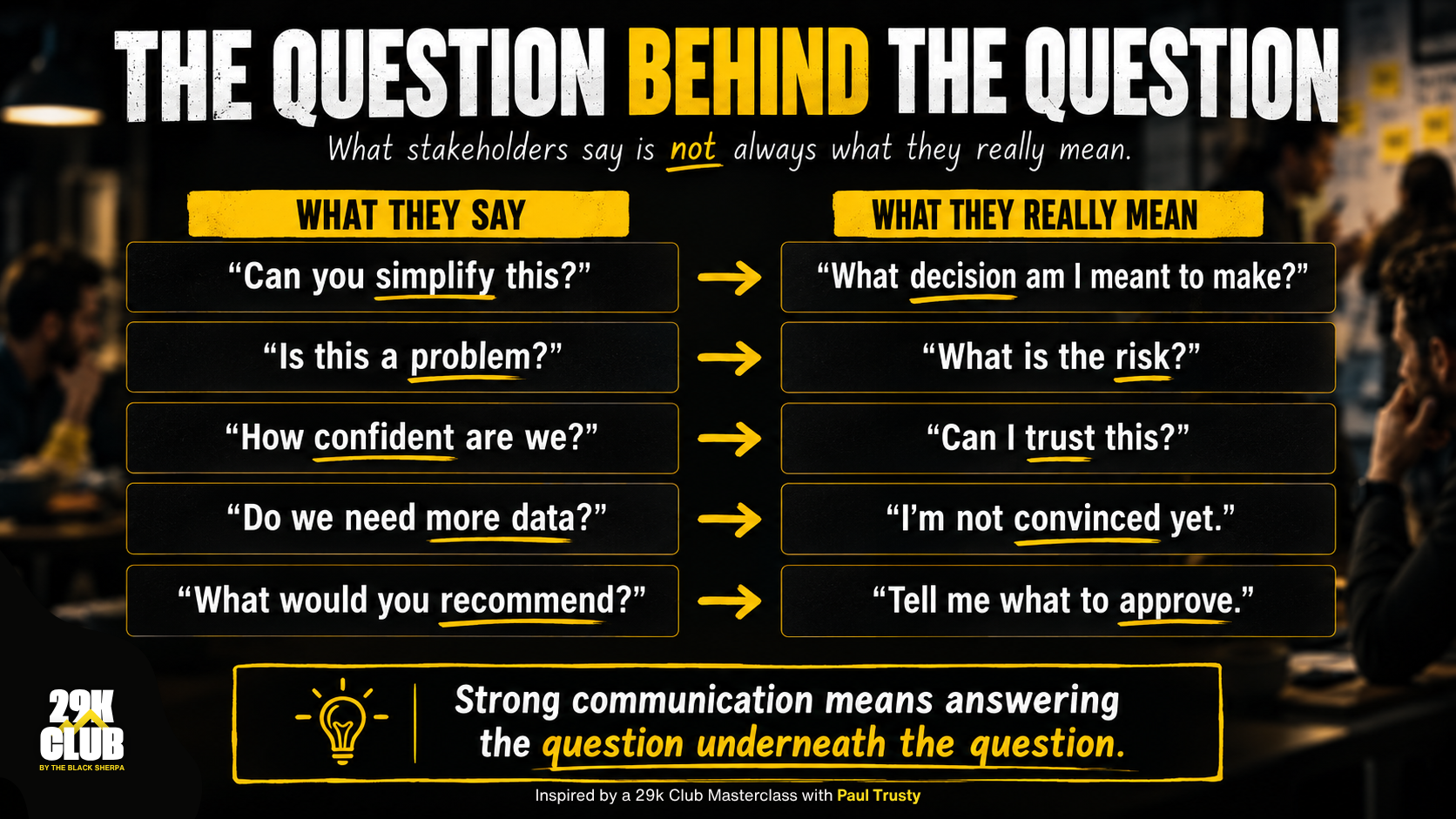
Strong communication means answering the question underneath the question. Paul’s framework helps translate common stakeholder questions into the decision, risk, confidence or recommendation they may actually be looking for
Senior stakeholders often ask one thing while trying to establish something else.
“Can you make this simpler?”
May really mean:
I cannot see what decision I am supposed to make.
“Is this a problem?”
May mean:
How much risk am I carrying?
“How confident are we?”
Could mean:
If this goes wrong, can I trust you to manage it?
“Do we need more data?”
May mean:
You haven’t convinced me yet.
And:
“What would you recommend?”
Often means:
Tell me what you want me to approve.
Strong stakeholder communication requires you to hear both questions.
The one spoken aloud.
And the one underneath it.
Your Silent CV may matter as much as your actual CV
There is a comforting belief in technical professions:
My work will speak for itself.
Sometimes it does.
Usually somebody else has to speak about it too.
Paul calls this the Silent CV… the reputation being built through conversations, relationships and what people understand about you when you are not in the room.
Why have that coffee?
Why talk to somebody with no obvious agenda?
Why spend time building relationships outside your immediate work?
Because careers do not progress entirely through formal processes.
Managers ask who is ready.
Colleagues recommend names.
People decide whose judgement they trust.
Opportunities are discussed when you are somewhere else.
That requires advocates.
And advocacy starts with people actually knowing you.
One member made the point beautifully.
The important “green dot” in your organisation may not be the senior person you first imagine.
It could be a PA.
A business manager.
A long-serving specialist.
Or, in one member’s NHS example, the person controlling staff car-park permits.
It sounds trivial.
It wasn’t.
That person had the ability to make everyday working life significantly easier.
The lesson?
Influence follows usefulness, access and trust far more often than it follows hierarchy.
And Maya, another scientist in the room, pushed the idea further.
She reflected on the culture of letting your work speak for you, before realising that relationships across teams and levels became people she could return to when she needed context, knowledge or help solving something.
That gives us a better definition of networking.
Your network is not simply a collection of people who might give you your next job.
It is part of your problem-solving infrastructure.
Your expertise travels with you. Your internal credibility has to be rebuilt
This is the Authority Reset.
Paul could be a recognised expert in academia.
The publications still existed.
The knowledge had not disappeared.
But when he entered a new organisation, someone with less technical depth could initially carry more influence because people already knew them, trusted them and understood how their judgement connected to the business.
That does not make the other person less capable.
It means they may already be stronger in a different set of capabilities:
Organisational judgement.
Stakeholder management.
Context.
Communication.
Trust.
If Paul said yes and a familiar colleague said no, the organisation might initially side with the familiar voice.
That is a painful career truth.
Your expertise travels with you. Your internal credibility has to be rebuilt.
Through relevance.
Relationships.
Judgement.
Communication.
And repeated evidence that you understand not only your discipline, but the environment around it.
A practical first 90 days plan: Visitor → Contributor → Trusted Insider
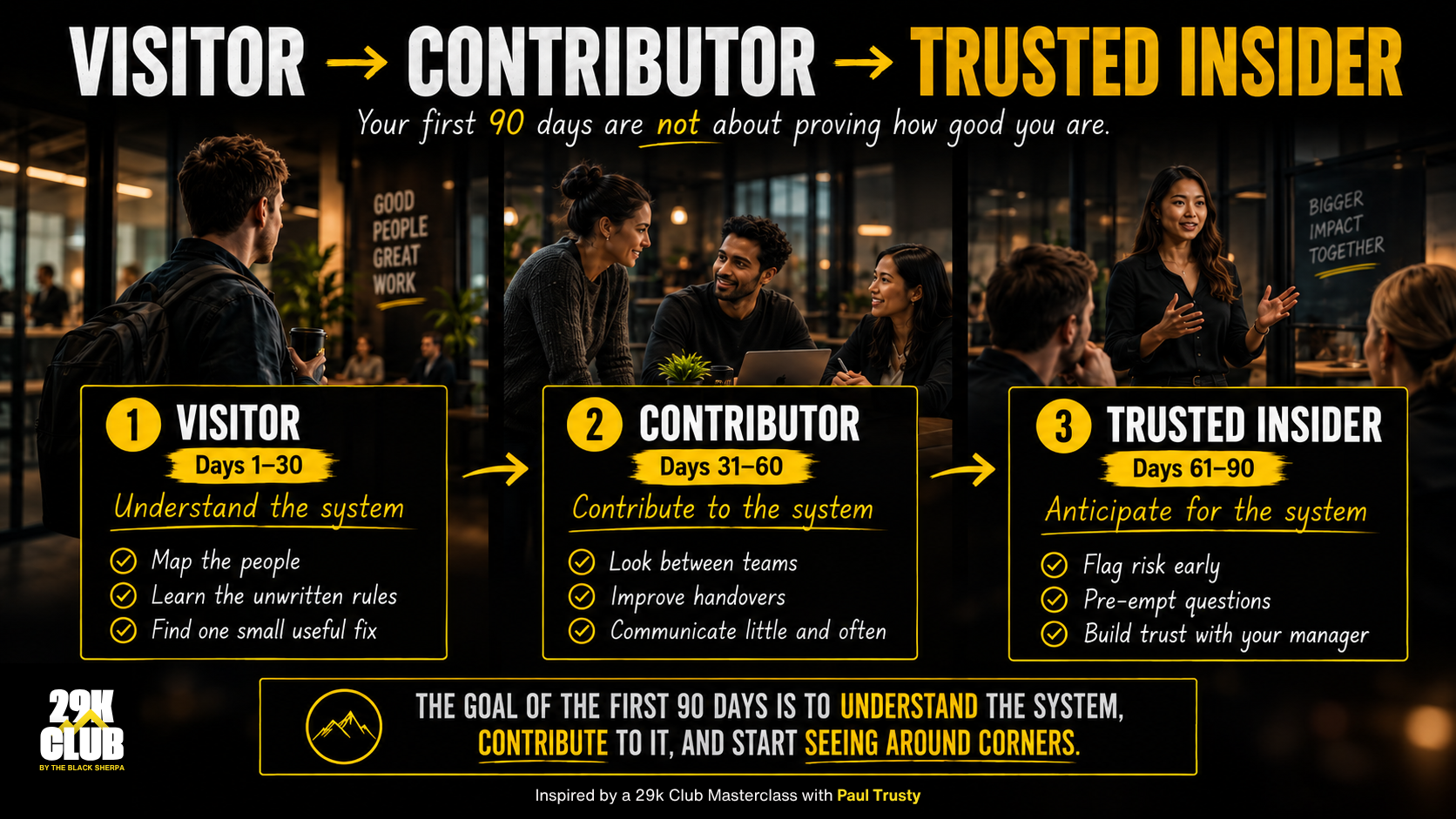
The first 90 days are not about proving how good you are. Start by understanding the system, then contribute to it, and eventually learn to anticipate what the organisation needs before you are asked.
Paul’s framework becomes even more useful when viewed as an identity shift.
Days 1–30: Visitor… understand before you improve
Map the people.
The relationships.
The pressure points.
The unwritten rules.
Ask:
“What do people usually misunderstand when they come into this department?”
Then find one small, unglamorous, immediately useful thing to improve.
Not your transformation agenda.
Something useful.
Days 31–60: Contributor… become useful beyond your job description
Look between teams.
Where are the poor handovers?
Repeated mistakes?
Unnecessary delays?
Communicate little and often.
Do not disappear for months while perfecting the answer.
Learn the organisation’s language.
Start connecting your work to wider priorities.
This is the point Paul described as:
“I belong here. I’m not a visitor anymore.”
Days 61–90: Trusted insider… start seeing around corners
Flag risk before it becomes crisis.
Pre-empt questions.
And communicate uncertainty like this:
Here’s what I know.
Here’s the potential risk.
Here’s what I’m doing about it.
Here’s when I’ll update you.
Then ask your manager the uncomfortable question:
“Was I a good hire?”
Where am I strong?
What aren’t you seeing yet?
What were you expecting from me?
What do you need next?
Do not wait until day 90 to build that relationship.
Bring your manager on the journey.
If you win, they win.
The team wins.
The organisation wins.
When you realise you’re losing the room, stop
One of the most useful moments in the discussion was almost embarrassingly simple.
What do you do when you realise you are talking too much?
Paul’s answer:
Say it.
“I think I’m talking too much. Does anyone have any questions?”
Then stop.
You do not rescue a presentation by talking harder.
Restore the conversation.
Find out what the room actually needs.
Then listen for the question behind the question.
Fresh eyes are useful. “At my old company…” usually isn’t
New starters see things others stop noticing.
Odd processes.
Broken handovers.
Unnecessary complexity.
That perspective can create enormous value.
But delivery matters.
Instead of:
“At my old company, we did it this way…”
Try:
“Why is it done this way?”
Listen.
Understand.
Then:
“Have you thought about doing X?”
Paul had seen how repeatedly using a previous employer as the benchmark could quickly create resistance.
Fresh perspective builds value.
Constant comparison rarely does.
The most dangerous career outcome isn’t failure. It’s stagnation
This might be the most important point in the whole conversation.
If you ignore all of this, you probably won’t get fired.
You may continue doing good work.
You may continue getting decent reviews.
You may remain very busy.
You just stop moving.
Your project gets deprioritised because nobody understands its relevance.
A decision based on your work happens without you.
Someone else presents the insight.
People continue describing you as technically strong.
They just don’t yet see you as somebody who belongs in the wider conversation.
And when promotion discussions happen, opportunities may go to people already demonstrating the broader skills needed at the next level.
That is not necessarily unfair.
It is a reminder that technical depth is only one dimension of readiness.
That is what makes professional invisibility dangerous.
It does not always feel like rejection.
Sometimes it feels like being permanently useful exactly where you are.
You probably don’t need to fix all six patterns
Most people finish reading something like this thinking:
I need to communicate better.
I need to build more relationships.
I need more commercial awareness.
I need to improve my presentations.
All true.
And trying to fix all of it at once usually means fixing none of it.
Paul’s diagnostic asks a much better question:
Which pattern is costing you most right now?
Five minutes.
Six possible patterns.
One practical starting action.
Maybe your problem is not confidence.
Maybe you need to cross the Trust Threshold.
Maybe your Silent CV is almost empty.
Maybe your Authority Reset is taking longer than expected.
Maybe you are answering every stakeholder question accurately while missing the Unstated Question underneath it.
Specificity gives you somewhere to start.
Take Paul’s free diagnostic and join the waitlist for his forthcoming book:
https://www.omeigotech.co.uk/diagnostic
Paul is aiming to publish the book before the end of the year, expanding on the six patterns and what scientists can practically do about them.
10 lessons worth saving
Your first 90 days are for understanding the system, not performing expertise at it.
Being right is not the same as being useful.
Lead senior stakeholder conversations with the conclusion, not the chronology.
Ask “So what?” before presenting technical work.
Listen for the unstated question behind the question.
Build relationships before you need them.
Treat your network as part of your problem-solving infrastructure.
Your expertise travels; your internal credibility may need rebuilding.
Flag uncertainty early rather than disappearing until you have the perfect answer.
If your career feels stuck despite strong performance, examine the patterns around the work… not just the work itself.
This is the work behind the work
Nobody joins a company and receives a handbook explaining:
Who actually influences decisions.
How much evidence a senior stakeholder really needs.
When to flag a problem before you have solved it.
Why someone with less technical depth might progress faster.
Or how to build advocates without becoming a performative networker.
Yet those things shape careers.
That is the territory we keep exploring inside the 29k Club.
Not because expertise does not matter.
Because expertise alone rarely tells you how to navigate the system around it.
The value of sessions like Paul’s is not simply receiving another framework.
It is having enough trust in the room for somebody to say:
“I think I do this.”
“I’ve struggled with that.”
“What could I do differently next time?”
That is where professional growth becomes useful.
Clarity. Confidence. Community.
The unwritten curriculum gets a little easier when people are willing to talk about it out loud.
Connect with Paul
If you are a scientist moving from academia into industry, an early-to-mid-career scientist trying to increase your organisational impact, or a leader responsible for developing scientific talent, Paul’s work deserves a closer look.
His work sits at an important intersection:
Scientific excellence × organisational behaviour × career progression.
Start with the diagnostic.
It takes around five minutes, identifies which of Paul’s six patterns may be holding you back, and gives you one practical action to work on.
You can also join the waitlist for his forthcoming book from the same page.
Take Paul’s free diagnostic and join the book waitlist:
https://www.omeigotech.co.uk/diagnostic
And if you lead scientific teams, talent programmes or communities supporting scientists making the transition into industry, this is a conversation worth bringing Paul into.
Because organisations do not need scientists to become less scientific.
They need brilliant scientists whose brilliance can travel.
One final question
If you started a new role tomorrow, would you spend your first month proving what you know…
or understanding what everyone else needs?
Can the people around you explain the organisational value of your expertise?
And if your technical performance is strong but your career progression feels slower than it should:
Which pattern might be getting in the way?
Good science matters. Making it matter is another skill entirely.
Climb steady 🖤
I’m Yam – Founder of The Black Sherpa
Founder | Strategist | Speaker | Host of The Black Sherpa Podcast
I founded The Black Sherpa to create a world where talent rises on merit and no one’s potential is held back by bias or barriers.
Through bold strategy, storytelling, and our flagship community, The 29k Club - I help professionals grow with confidence and support leaders to build cultures that truly live their values.
Let’s connect and build a future where inclusion powers performance, and leadership reflects the world we serve.