
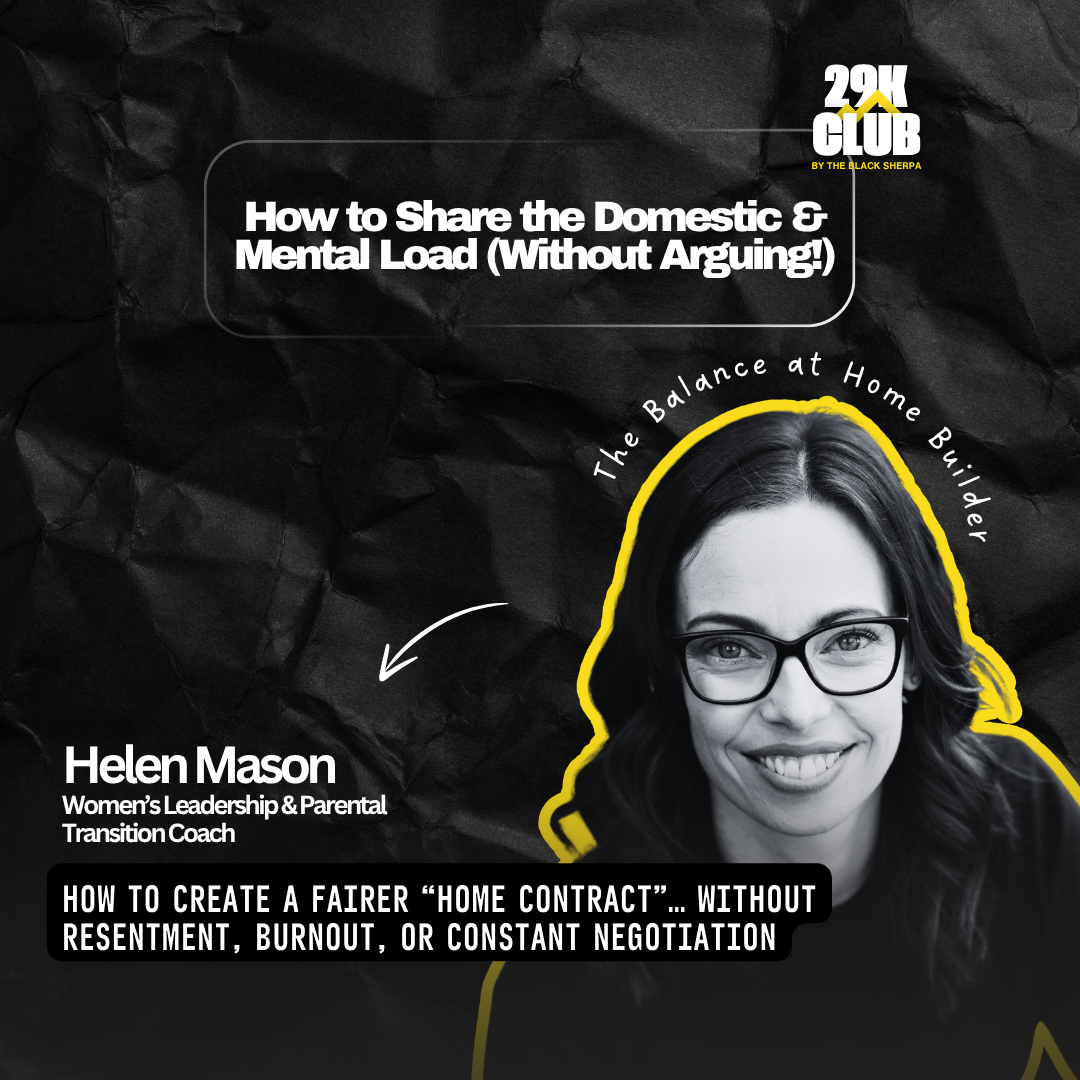
A Black Sherpa 29k Club masterclass with Helen Mason exploring how the domestic and mental load shapes careers, why fair is not always 50:50, and how to create a more sustainable home contract through visibility, shared ownership and honest conversation.
The conversation began with bananas.
Who buys them? Who remembers which ones everybody likes? Who notices when they are running out? Who makes sure they are there before someone announces that there are no bananas in the house?
The banana is visible.
The thinking behind it is not.
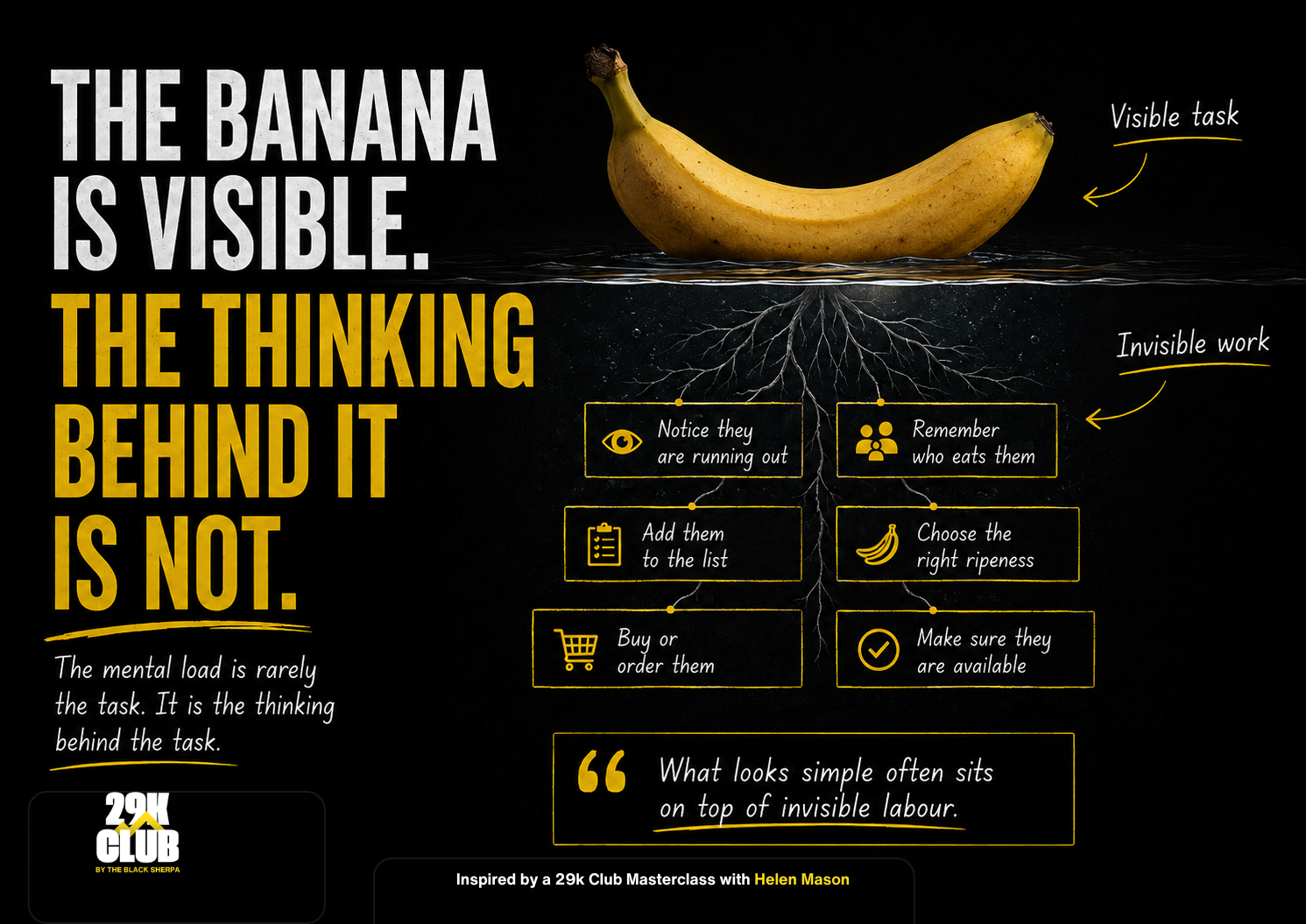
The banana takes seconds to see. The work behind it can occupy someone’s head all week
By the end of Helen Mason’s 29k Club masterclass, that light-hearted exchange had opened the door to something much bigger: resentment, unpaid labour, lost earnings and why highly capable people sometimes step away from careers they once fought hard to build.
Because the mental load at home does not remain neatly inside the home.
It follows people into meetings, leadership decisions and career choices.
And most organisations still do not see it.
Helen Mason did not leave because she lacked ambition
Helen did not become interested in the domestic mental load because she wanted a more efficient way to divide the chores.
She became interested because she experienced what happens when somebody has the capability for a senior career but not the conditions required to sustain it.
After leaving MSD, Helen moved into a marketing director role at a billion-pound veterinary company. Her son was two and a half, and she was determined that being both a woman and a mother would not prevent her from succeeding.
Eventually, the combination of the role, family responsibilities and a wider misalignment of values became unsustainable.
“This can’t go on. I can’t continue to carry all this because it will break me.”
Helen described feeling “white-hot rage” that becoming a parent had contributed to pushing her out of the workplace.
Not because she could not do the job.
Because the system surrounding the job no longer worked.
That experience now shapes her work as a qualified executive coach and certified Fair Play facilitator. Through Helen Mason Coaching, she helps capable women build careers that do not require them to burn out or opt out—particularly when parenthood has changed their capacity, priorities and relationship with ambition.
Her authority is not theoretical.
She has lived the tension she now helps other people navigate.
The domestic mental load is not simply a private problem
It is tempting to look at somebody who feels overwhelmed and conclude that they need better boundaries, a stronger calendar or improved time management.
Sometimes those tools help.
But that interpretation can hide the conditions in which their choices are being made.
Helen’s masterclass placed the household conversation within a wider system shaped by childcare pressures, limited parental leave, inconsistent return-to-work support and workplace cultures that may offer flexibility in policy while still treating it as a concession for parents.
From April 2026, statutory paternity leave became a day-one employment right in Great Britain, although eligibility for statutory pay remains subject to separate requirements. The entitlement itself remains limited to up to two weeks, according to UK government guidance on paternity leave.
That progress matters. But it does not remove the broader imbalance created when one parent quickly returns to paid work while the other becomes the default expert in the child, the home and the family operating system.
The career consequences are significant.
Office for National Statistics analysis found that mothers lost an average of £65,618 in employee earnings during the five years following the birth of their first child. Five years after the birth, their monthly earnings were, on average, 42% lower than one year before it.
The economic value of care is also easy to overlook.
Research from Carers UK and the Centre for Care estimated that unpaid care provided across the UK was worth £184.3 billion a year in 2021–22.
Globally, International Labour Organization estimates suggest that 708 million women were outside the labour force because of unpaid care responsibilities in 2023, compared with 40 million men.
Although women continue to carry a disproportionate share of unpaid care, an uneven mental load can develop in any household: heterosexual or same-sex couples, co-parenting arrangements, multigenerational homes and relationships in which a man carries more of the invisible responsibility.
This is not about assuming every family looks the same.
It is about recognising work that has been easy to ignore.
From domestic fairness to care justice
Created by Eve Rodsky after seven years of research and development, the Fair Play Method helps partners make the work of running a home and family visible and share it more equitably. The Fair Play Policy Institute now places this within a wider conversation about care justice: the value of care, the systems that support caregivers and the policies that shape who pays the personal and professional cost of unpaid labour.
That distinction matters.
Fair Play can change what happens inside a household.
It cannot, by itself, solve unaffordable childcare, inadequate leave, workplace discrimination or organisational cultures built around unlimited availability.
The personal conversation matters.
So does the policy conversation.
Otherwise, we risk teaching individuals to become better at surviving systems that were never designed around the realities of care.
What the Fair Play Method is… and what it is not
Helen described the Fair Play Method as:
“A gamification of the domestic and mental load that makes the invisible visible.”
The principle beneath it is simple:
Visibility creates value.
Once work can be seen, it can be discussed.
Once it can be discussed, it can be owned.
But Fair Play is not:
A chore chart.
A demand that every responsibility must be split equally.
A system for keeping score.
A way to prove who works hardest.
A promise that nobody will ever feel stretched.
A substitute for professional relationship support where communication, control or safety are serious concerns.
It is a framework for creating explicitly understood expectations, defining ownership and agreeing what fair means within a particular household.
Because:
“50:50 is not the goal. Fair is.”
And one household’s fair may look completely different from another’s.
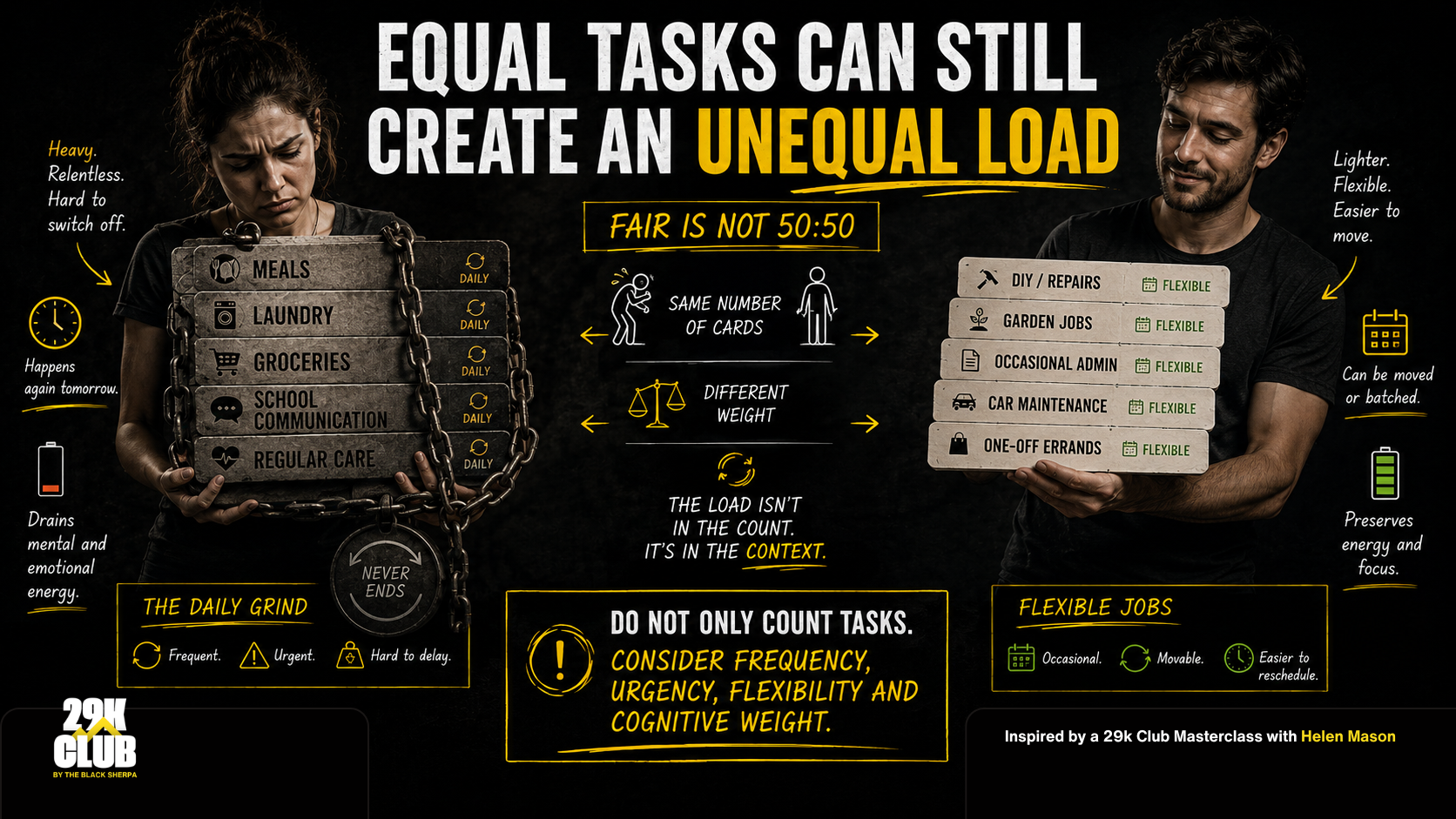
Five tasks each. Very different Tuesdays. Fairness is not found in the count… it is found in the weight
“You should have asked” leaves one person in charge
One of the most recognisable responses in conversations about the mental load at home is:
“You should have asked.”
It sounds helpful.
But it can quietly leave one person as the household project manager.
They must notice the need, define the task, assign it, explain the deadline and check whether it has been completed.
The other person performs an action.
The first person still owns the system.
Helen used a workplace comparison to make the distinction clear. Imagine arriving at work, standing beside your manager and waiting to be given your next instruction. You do not anticipate a need or accept responsibility for an outcome. You wait.
That would not be described as ownership at work.
It should not be mistaken for ownership at home.
Many people contribute in good faith without realising that completing tasks is different from carrying the thinking behind them.
Helping says:
Tell me what to do.
Ownership says:
I will make sure this is handled.
Three moments when the room shifted
The frameworks gave the conversation structure.
The stories gave it meaning.
The dishes were about safety
One member explained that the dishes were not complete until they had been washed, dried, put away and the kitchen fully reset.
Other members of the household had a different understanding of “done.”
It would be easy to dismiss her standard as excessive.
But she connected it to childhood experiences in which unfinished dishes contributed to tension and disharmony at home.
The issue was not simply cleanliness.
It was safety, stability and closure.
Helen brought the group back to one instruction:
“It’s the why. It’s not the what.”
When people argue only about whether the dishes should have been put away, they miss the humanity underneath the disagreement.
Wednesdays with Dad
Another member shared that where he grew up, caring for children was commonly understood as “mothering.”
When his wife returned to work, he arranged to keep Wednesdays free and spent the day caring for their young son.
Bathing him. Taking him out in the buggy. Being present for the ordinary moments.
Those Wednesdays became some of the most meaningful days of his life.
Sharing care did not only relieve somebody else’s load.
It expanded his experience of fatherhood.
Different strengths do not remove the need for ownership
The group also explored how neurodivergence, confidence and individual strengths affect the allocation of responsibilities.
One person may be exceptional at planning. Another may be stronger at practical execution.
Fair Play does not require people to ignore those differences.
It asks them to avoid splitting responsibility so vaguely that nobody owns the outcome.
The owner may ask somebody else to complete a particular action. But they remain responsible for ensuring that the complete job moves from idea to completion.
CPE: the difference between doing and owning
The Fair Play Method describes complete ownership through CPE:
Conception
Recognising that something needs to happen.
Planning
Researching, deciding, scheduling and preparing.
Execution
Completing the task or ensuring that it is completed.
Consider a child’s football activity.
Execution might mean driving them to training.
But ownership also includes finding the activity, registering, paying, organising kit, remembering fixtures and coordinating transport.
Taking the child on Saturday is helpful.
Owning the card means ensuring the whole system works.
This model has an obvious leadership application.
Many managers believe they are delegating when they are only transferring execution. They retain every decision, instruction and follow-up, then wonder why their teams do not show greater ownership.
The same confusion happens at home.
The Minimum Standard of Care: what does “done” mean?
Even clearly assigned responsibilities create conflict when people have different definitions of completion.
The Minimum Standard of Care, or MSC, is the standard people agree a completed responsibility must meet.
Does cleaning the bathroom include replacing empty toiletries?
Does doing the dishes include putting them away?
Does organising a birthday include buying the present, arranging transport and sending a thank-you message?
The standard should not be silently imposed by the person with the highest expectations.
It should be discussed.
And when agreement is difficult, Helen encouraged members to return to the story behind the standard:
Why does this matter?
What value is it protecting?
What happens for you when it is left incomplete?
Is this our shared standard or an expectation one of us has inherited?
The hidden barrier: sometimes letting go feels unsafe
Unequal domestic labour is not always maintained by one person deliberately refusing to contribute.
Sometimes the person carrying most of the load also struggles to relinquish control.
They may believe:
I can do it faster.
Nobody else will meet the standard.
A good parent should handle this.
I will be judged if something goes wrong.
This responsibility has become part of who I am.
This should not be interpreted as evidence that the person carrying the load caused the imbalance.
Control can develop after years of being held accountable for the outcome, repeatedly disappointed or judged more harshly when something is missed.
Helen challenged the myth that women are naturally better multitaskers. Capability is often created through repetition, expectation and necessity—not biology.
Sharing the load therefore requires two movements:
One person may need to step forward.
Another may need enough trust and evidence to step back.
Own, share and protect
Taken together, Helen’s advice suggested a useful three-part approach:
Own your standards
Helen explained that she once encouraged people to lower their standards.
She now prefers:
“Own your standards.”
Decide what genuinely matters to your household and what is being maintained because of guilt, habit or fear of judgement.
Not every responsibility needs to remain in the system.
Share the essential load
Make the responsibilities that remain visible and give them clear ownership.
Do not simply count tasks. Consider their urgency, frequency and flexibility.
Responsibilities that must happen daily or weekly… the Fair Play Daily Grind… need particular attention because the person holding them has less control over when the work happens.
Protect the space created
Do not fill every free hour with another job.
Fair Play’s “Happiness Trio” protects adult friendships, self-care and Unicorn Space: time for creativity, personal expression and the activities that help somebody feel like themselves.
Helen’s advice was memorable:
“Fill the gaps with joy, not jobs.”
A ten-minute ritual that can make Fair Play stick
Fairness is not a one-off negotiation.
Workloads change. Children’s needs change. Health, travel and pressure fluctuate.
Without a regular conversation, old habits return.
Helen and her husband use a short Friday administration meeting, often lasting five or ten minutes and accompanied by ice cream.
A practical weekly ritual might include:
Review the next seven to fourteen days.
Identify pressure points or unexpected wild cards.
Confirm ownership of the Daily Grind responsibilities.
Redeal anything that is no longer realistic.
Protect friendships, self-care and Unicorn Space.
Add ice cream… or your household equivalent.
The ritual is not romantic.
Neither is silent resentment.
Try this: the one-card conversation
Do not begin by presenting a catalogue of everything one person does and everything the other has missed.
Helen tried that.
It ended in an argument.
Instead, choose one responsibility and ask:
Why does this matter to each of us?
What are its conception, planning and execution stages?
What does complete ownership include?
What is our Minimum Standard of Care?
Which parts reflect our values?
Which parts may be inherited “shoulds”?
Who will own it until our next review?
The Fair Play Policy Institute’s resource library includes the 100 digital Fair Play cards with CPE checklists and conversation tools designed to help people begin these discussions.
The objective is not to win.
It is to practise making the invisible visible.
The career conversation many couples never have
One of the most important parts of the masterclass moved beyond household responsibilities into career design.
Helen referenced Jennifer Petriglieri’s work in Couples That Work, which describes three broad ways couples may organise their careers:
Primary–secondary: one career takes priority while the other plays a more supportive role.
Turn-taking: each person’s career takes priority during different seasons.
Primary–primary: both careers are treated as equally important, and the household is deliberately designed to support both.
None of these models is automatically right or wrong.
The danger is sleepwalking into one without ever having the conversation.
Useful questions include:
Are both our careers equally important?
Is one taking priority during this season?
Have we agreed when that may change?
Whose development, health or friendships are being deferred?
Is that sacrifice visible, intentional and time-bound?
What invisible work makes the current model possible?
Temporary imbalance is not always the problem.
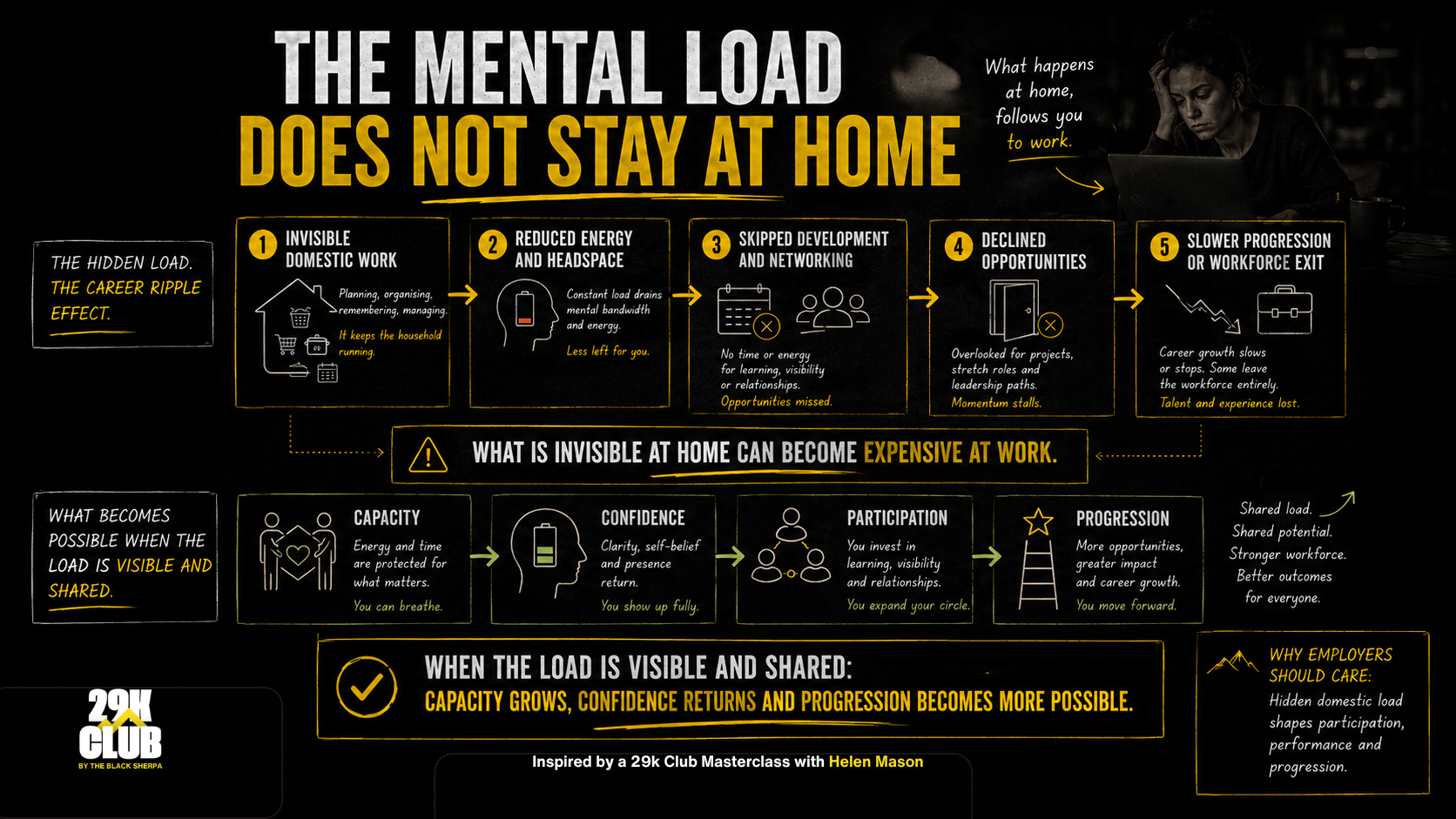
The mental load has terrible boundaries. It follows people from the kitchen table to the meeting room… and careers can quietly pay the price
An unspoken imbalance becoming permanent is.
What leaders and organisations need to see
Leaders cannot decide how responsibilities are distributed inside somebody’s home.
But they can stop behaving as though those responsibilities have no impact at work.
For individuals, the work is to notice hidden labour, question inherited expectations and ask for ownership rather than occasional assistance.
For leaders, it means resisting the assumption that constrained availability equals limited ambition.
For organisations, it means treating flexible working, parental transitions and support for caregivers as part of workforce and talent strategy—not personal favours.
Household change is not a substitute for structural reform.
But organisations cannot claim to care about leadership pipelines while ignoring the conditions that determine who can remain in them.
Why this conversation belongs inside The 29k Club
This may appear to be an unusual subject for a career-development community.
It is exactly why it belongs.
The 29k Club explores the unwritten curriculum of professional growth: the realities that affect careers but rarely make it into formal leadership programmes.
Sometimes that means influence, confidence and organisational politics.
Sometimes it means recognising that career progression is being negotiated around the kitchen table.
Helen’s masterclass did more than explain Fair Play.
It showed what became visible when real people brought the framework into their cultures, relationships, ambitions and lived experiences.
That is where insight becomes useful.
And where community becomes more than an audience.
Connect with Helen Mason
Helen helps ambitious women navigate the intersection of leadership, identity, career and family life.
Her work is particularly valuable for women who want to remain present with their children without abandoning the careers, voices and ambitions they have worked hard to build.
Through Helen Mason Coaching, she offers executive coaching, facilitation and practical tools that help women reclaim headspace, challenge inherited expectations and make sustainable career decisions.
HerAmbition Evolution coaching programmecombines one-to-one coaching with tools including the Should Audit, the Fair Play Method and leadership-development frameworks designed to help women stop shrinking, apologising and burning out.
Helen is not teaching people how to carry more.
She is helping them decide what deserves to be carried, who should own it and what they need to put down.
A final reflection
What invisible work are you carrying that nobody else can see?
Have the people in your household ever agreed what “fair” and “done” mean?
And what could become possible… in your career and your life… if the mental load at home became lighter?
Start with one card.
Make the invisible visible.
Climb steady 🖤
Sources and methodology
Statistics in this article draw on published analysis from the Office for National Statistics, the International Labour Organisation, UK government guidance, and research by Carers UK and the Centre for Care. Figures relate to different definitions of unpaid care and should be understood within the geographic and methodological context of each source.
I’m Yam – Founder of The Black Sherpa
Founder | Strategist | Speaker | Host of The Black Sherpa Podcast
I founded The Black Sherpa to create a world where talent rises on merit and no one’s potential is held back by bias or barriers.
Through bold strategy, storytelling, and our flagship community, The 29k Club - I help professionals grow with confidence and support leaders to build cultures that truly live their values.
Let’s connect and build a future where inclusion powers performance, and leadership reflects the world we serve.