
Grit at Work Isn’t Always the Answer: When a Dream Job Starts to Cost Too Much
A Black Sherpa 29k Club masterclass with Ben Yellowlees exploring when grit helps us grow, when it keeps us stuck, and how to make difficult career decisions with honesty, clarity and care.
Dream jobs can become dangerous when we are too ashamed to admit they are no longer working
Not because ambition is wrong.
Not because stretch roles are bad.
Not because hard work does not matter.
But because when the role you fought for starts costing too much, it becomes harder to tell yourself the truth.
As Ben Yellowlees put it during a recent 29k Club masterclass:
“The problem with dream jobs is that if they don’t meet your expectation, there’s a huge delta… and that delta is pain.”
That line shifted the room.
Because most ambitious professionals know what it feels like to keep pushing through a role that looks good from the outside but feels very different on the inside.
You tell yourself you should be grateful.
You tell yourself this is what growth feels like.
You tell yourself to show more grit.
But what if grit at work is not always the answer?
What if the better question is:
“Is this the pain of learning, or the pain of suffering?”
Why This Conversation About Grit at Work Matters
Career progression is often sold as a clean, upward story.
Take the stretch role. Prove yourself. Be resilient. Build your network. Stay visible. Keep climbing.
But real professional growth is rarely that neat.
Sometimes the opportunity you wanted becomes the place where your confidence starts to disappear. Sometimes the next step up becomes the season where you feel most alone. Sometimes the job that gave you purpose also starts taking too much from your health, relationships and sense of self.
And because the role looks impressive, people often stay silent.
They fear being judged.
They fear being seen as weak.
They fear the professional consequences of admitting they are struggling.
They feel shame because the job they wanted is now the job they can barely survive.
That is why conversations about workplace resilience need more honesty.
Resilience is not just endurance. It is discernment.
It is the ability to ask: is this challenge helping me grow, or is it repeatedly pulling me away from who I am?
That is the conversation many organisations still avoid. They talk about performance, engagement and leadership development, but often miss the human cost of asking people to keep going without understanding what they are carrying.
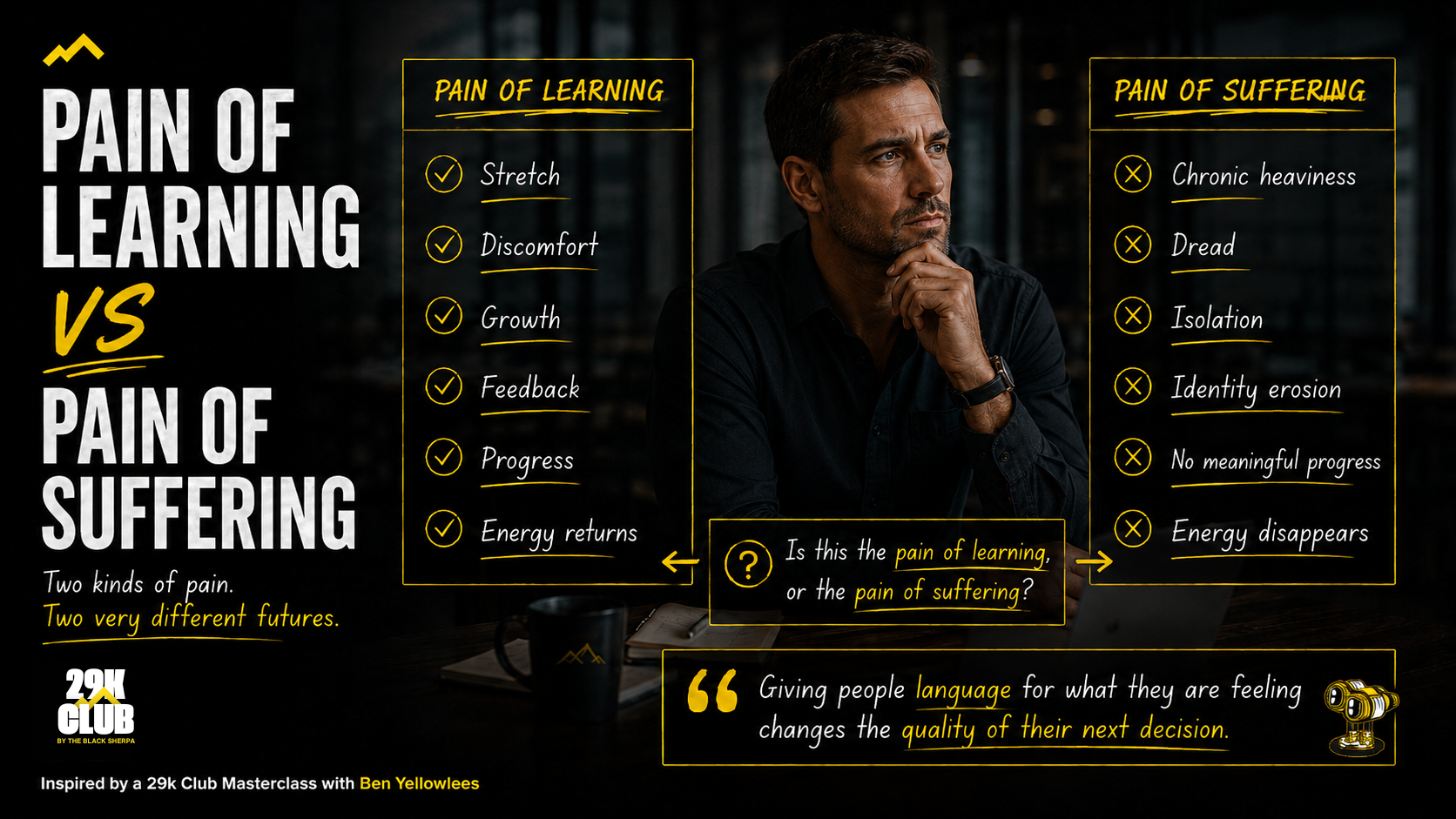
Not all pain at work means you are growing. One of the most powerful questions from Ben Yellowlees’ 29k Club masterclass was whether the discomfort you are feeling is the pain of learning… or the pain of suffering.
Ben Yellowlees: A Leader Willing to Tell the Truth Usefully
Ben Yellowlees brought more than a story to this conversation.
He brought over 20 years of experience across pharmaceuticals, including external affairs, communications, policy, market access, strategy, marketing, sales, and learning and development.
That matters because Ben understands complexity. He understands commercial environments. He understands capability building. He understands what it means to work inside large, slow-moving organisations where people are trying to do meaningful work through imperfect systems.
But what made this masterclass powerful was not only Ben’s professional background.
It was his willingness to share the human side of performance.
This was not a polished speaker session. In many ways, that is what made it better.
Ben was not there to sell a model, build a speaking platform or present himself as someone with all the answers. He was there as someone who had lived through something difficult, reflected deeply, and was generous enough to turn that experience into something useful for others.
People inside organisations often learn more from honest, thoughtful leaders than from perfectly polished leadership language.
The Hidden Trap: When Grit Becomes Harmful Endurance
Most of us have been taught to admire grit.
And rightly so.
Grit helps people get through hard things. It helps people stay committed when work becomes uncomfortable. It helps build credibility, skill and momentum.
But grit has a shadow side.
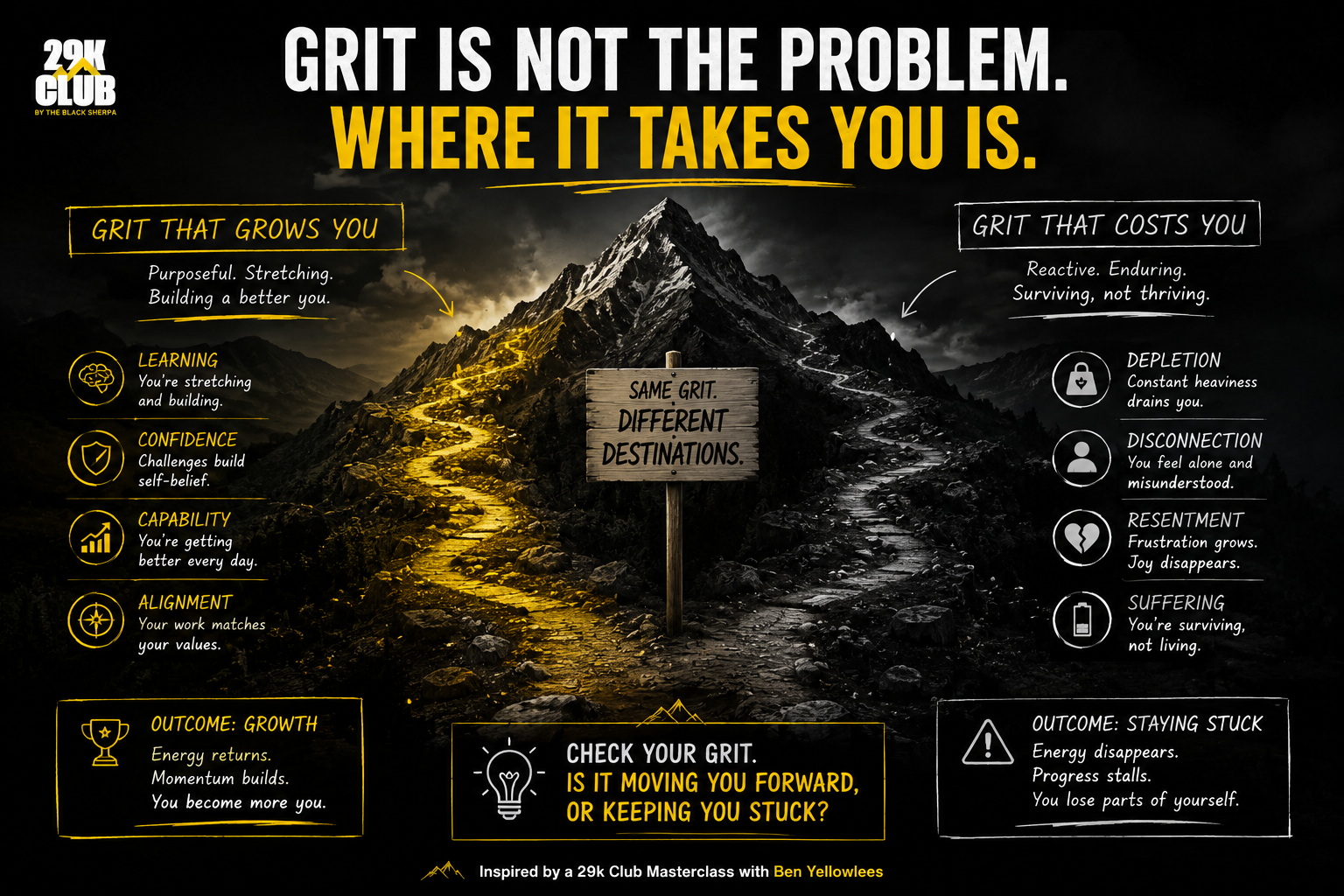
Grit is not the problem. The real question is where it is taking you. In Ben Yellowlees’ 29k Club masterclass, we explored the difference between grit that builds learning, confidence, capability and alignment… and grit that keeps people stuck in depletion, disconnection, resentment and suffering.
If you are using grit to survive something that needs to change, it can become harmful endurance.
That was one of Ben’s clearest insights.
He had commitment. He had work ethic. He had perseverance. But eventually he realised he was using those qualities to maintain a status quo he did not actually want.
That is a difficult truth for ambitious professionals.
The very traits that help you progress can also keep you stuck.
The ability to push through.
The instinct to take responsibility.
The pride in being dependable.
The desire not to let people down.
The belief that if you just work harder, think harder or adapt faster, things will improve.
Sometimes those traits are strengths.
Sometimes they become the reason you ignore the warning signs.
For individuals, the application is clear: ask whether your grit is creating movement or simply maintaining pain.
For leaders, the lesson is sharper: do not celebrate resilience without understanding what people are being resilient through.
For organisations, this is a culture question. If people only feel valued when they endure, you may be rewarding the wrong behaviour.
The Pain of Learning vs The Pain of Suffering
The most useful question from the session was simple:
“Is this the pain of learning, or the pain of suffering?”
That question deserves to sit inside every serious career development conversation.
Learning pain is part of growth. It can feel uncomfortable, exposing and frustrating. You are stretching into something new. You are building capacity. You are becoming more capable.
But suffering pain feels different.
It becomes chronic. It follows you home. It changes how you see yourself. It affects the people closest to you. It does not simply challenge your capability; it starts to erode your identity.
One of the most powerful parts of Ben’s story was that the impact had moved beyond work.
He was no longer just frustrated by role fit, ambiguity or lack of progress. He described becoming a shadow of himself. The cost was being felt at home too.
That matters.
When work starts changing who gets to experience you outside work, it is no longer just a work problem.
This is where conversations about career burnout and job misalignment become urgent. Too often, people wait until they are depleted before giving themselves permission to name what is happening.
Ben’s question gives people a way to notice earlier.
Is this difficulty producing growth?
Or is it repeatedly taking me further away from who I am?
Values-Based Career Decisions Are Not Fluffy
One of the strongest parts of Ben’s reflection was his return to values.
Integrity. Commitment. Humility.
These were not corporate words. They became diagnostic tools.
Integrity mattered because Ben wanted to do what he said he would do. But the role felt full of conversations and limited progress. Day by day, that value was being tested.
Commitment mattered because he believed in perseverance. But he began to realise he was persevering towards something he did not actually want.
Humility mattered because he valued learning and not pretending to have all the answers. But that humility had become tangled with self-criticism.
This is where values-based career decisions become practical.
Your values are not just what you say when things are calm.
They are the things that tell you when something is off.
A useful question for any professional is:
Which of my values does this role allow me to live, and which ones does it repeatedly compromise?
That question can change the quality of your next career decision.
Self-Awareness at Work Has to Lead Somewhere
Ben also spoke about asking himself “why?” repeatedly.
Why was the role triggering him?
Why did the lack of progress feel so difficult?
Why did not being understood land so deeply?
That process took him beyond surface-level frustration and into older experiences of feeling stuck, confused and unable to make sense of what was happening.
This was not about over-analysing everything.
It was about understanding what was really being activated.
That is the power of self-awareness at work. It helps you separate the situation in front of you from the story you may be carrying into it.
But self-awareness only helps if it leads somewhere.
Ben was careful not to turn older experiences into a permanent identity. The point was not, “This happened to me, so I cannot do this.”
The point was, “This is part of me, so I need to understand it with compassion and still make a choice.”
Self-awareness without agency can become rumination.
Self-awareness with agency becomes leadership.
The Decision Framework: Change the Situation, Change Yourself, or Walk Away
One of the most useful mental models from the masterclass was simple:
Can I change the situation?
Can I change myself?
Or do I need to walk away?
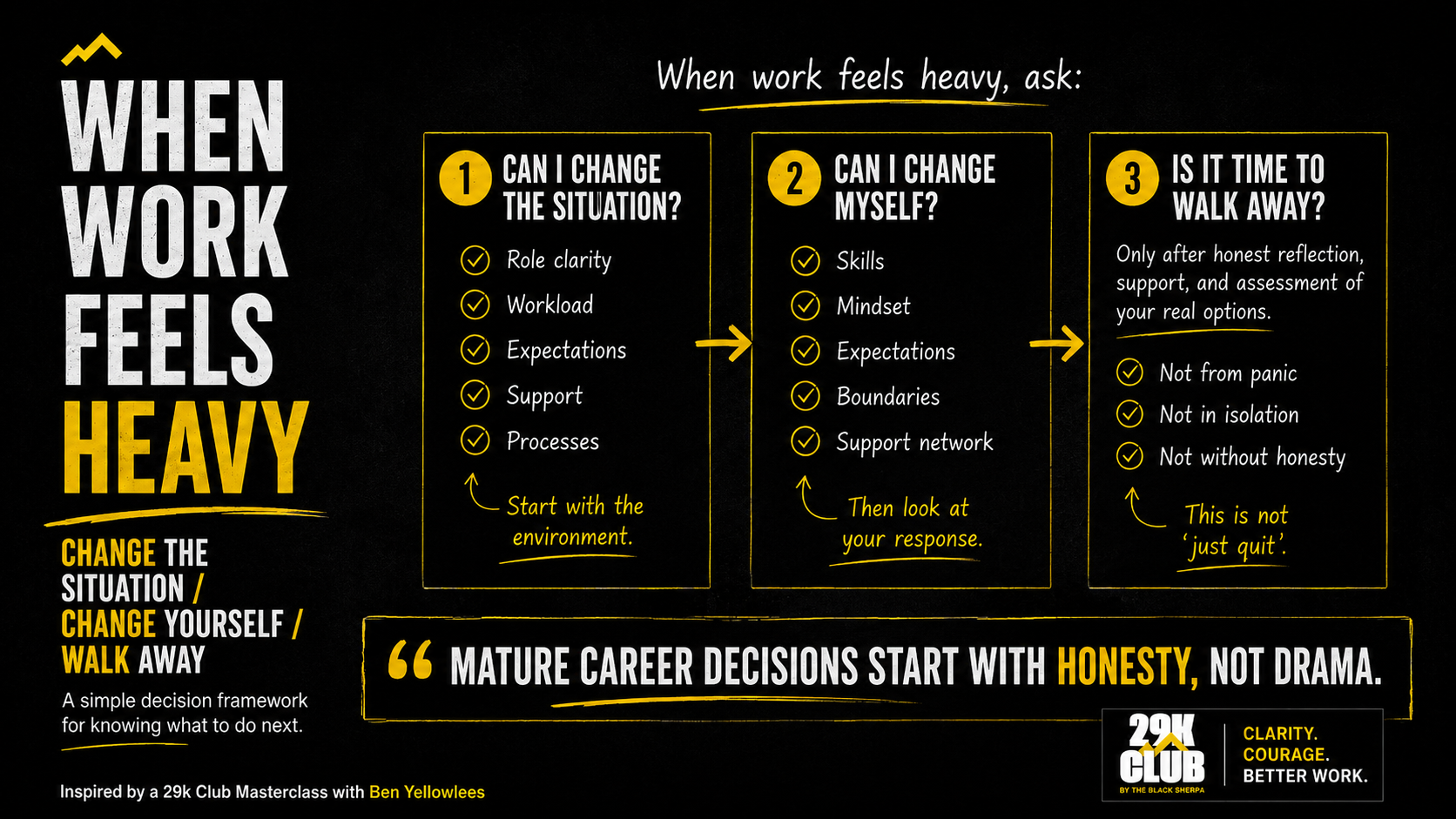
When work feels heavy, the answer is not always to push through or walk away. Ben Yellowlees’ 29k Club masterclass offered a more mature decision framework: first ask whether you can change the situation, then whether you can change your response, and only then whether it may be time to walk away.
This is a powerful framework for anyone wondering when to quit your job, when to stay, or when to adapt.
First, change the situation.
Can you create clarity? Influence the process? Speak to the right people? Reset expectations? Ask for support? Change how decisions are made?
Second, change yourself.
Can you build capability? Shift your expectations? Develop new tools? Reframe the challenge? Adapt your working style?
Third, consider walking away.
Not as a first reaction. Not as avoidance. But as a serious option when the first two routes have been explored and the cost is still too high.
This matters because the lesson was not “just quit.”
That would be too simplistic, and for many people, unrealistic.
Ben was careful to acknowledge that walking away is not equally available to everyone. People have financial responsibilities, family commitments, caring responsibilities, confidence knocks and very real constraints.
The more useful message is this:
Stop lying to yourself about the cost, then work honestly with the options genuinely available to you.
Confidence Often Comes After Action, Not Before
One of the most memorable moments came when Ben spoke about handing in his notice.
The big decision was not browsing jobs. It was not imagining a different future. It was the moment he acted.
He described a sense of lightness. Energy returning. The shackles coming off.
There was also a powerful insight underneath it:
Sometimes your brain does not believe your thoughts. It believes your actions.
That line matters for anyone stuck in overthinking.
Many professionals wait to feel confident before making a move. But confidence does not always arrive first. Sometimes action creates the evidence your confidence needs.
That does not mean acting recklessly. It means recognising that endless thinking can become another form of staying still.
Ben shared a metaphor that stayed with the room: if you are lost in the jungle, the worst thing you can do is stay still.
Any step gives you more information.
Even if it is not the perfect step, it gives you something new to work with.
Rebuilding After Walking Away
The conversation became even more relatable when one member shared that she had been through something painfully similar.
She had left a role. But leaving had not magically solved everything. The next challenge was rebuilding enough confidence to imagine entering another role without repeating the same pattern.
That is important.
Walking away is not always the end of the story.
Sometimes it is the start of a new and uncomfortable chapter.
Ben spoke about being intentional with what he could control, including his thoughts. He spoke about not waiting for motivation. He spoke about reconnecting with people, opening doors, taking the next step and being kind to himself.
He also shared something unexpected: helping others helped him.
When a difficult career experience pulls you inward, it is easy to become trapped inside your own thinking. But coaching, supporting others and putting good energy back into the world helped Ben rebuild his own sense of confidence and value.
That is one of the reasons community matters.
You do not only recover by being supported.
Sometimes you recover by remembering you still have something to give.
What If You Don’t Need a Perfect North Star Yet?
Another rich moment came when a member asked whether people need a clear goal or North Star before deciding whether to grit or quit.
Ben’s answer challenged a lot of conventional career advice.
He did not present progress as a perfectly mapped destination. He spoke instead about the importance of enjoying the now, rediscovering his value, and not chaining his sense of progress to one specific role, company or title.
That matters.
Some people need a clear thing to move towards.
Others need enough space to feel like themselves again before they can know what they want next.
Both can be true.
Sometimes the next step is not a destination.
Sometimes the next step is creating enough room to think.
Leaders Like Ben Are Gold Dust Inside Organisations
This is not a call to book Ben Yellowlees for your next leadership event.
That is not the point.
Ben is not positioning himself as a polished motivational speaker with a signature keynote and a neat three-step model for success.
The value of this conversation was different.
It came from someone inside the world of work being willing to tell the truth about what can happen when commitment, ambition and grit start to cost too much.
Leaders like that are gold dust inside organisations.
Not because they have suffered.
Not because pain automatically creates wisdom.
But because they have reflected, made sense of what happened, and are willing to share the learning in a way that can help other people ask better questions earlier.
They know what it feels like when a role looks good from the outside but feels unsustainable on the inside. They know how hard it can be to admit that the thing you wanted is no longer working. They know the difference between performing well and being well.
Organisations should pay attention to people like this before anyone gets to the edge.
Better still, they should build cultures where fewer people have to get that close before the truth is heard.
Because by the time good people are on extended leave, mentally depleted, disconnected from their confidence, or seriously considering walking away, there have often been several earlier signals worth paying attention to.
The point is not to turn every difficult personal experience into a public story.
People are entitled to privacy.
But when someone has been through something difficult, made sense of it, and is willing to share what they learned in a constructive way, we should create better spaces for that wisdom to travel.
Handled well, stories like Ben’s can help teams and leaders talk more honestly about resilience, career burnout, job misalignment, values, performance and support.
Handled badly, they become either trauma entertainment or a simplistic lesson about “just quitting.”
That is not what this was.
This was someone saying: here is what happened, here is what I noticed, here is what I wish I had asked earlier, and here are the questions that might help someone else.
If you happen to meet someone like that, listen.
If they are willing to discuss it, engage.
Their truth does not have to be your truth.
But honest experiences, shared with care, can shape how we experience work for the better.
If Work Feels Heavy, Who Should You Speak To?
One of the risks with a conversation like this is that it can make people realise how much they have been carrying.
That can be useful.
It can also feel heavy.
So if something in Ben’s story feels uncomfortably familiar, the next step is not to make a dramatic decision in isolation.
The next step is to speak to someone.
Choose the safest route available to you. That may be inside the organisation, or it may need to start outside it.
That might be a trusted friend, partner or family member who knows the difference between listening and trying to fix everything immediately.
It might be a manager you trust, especially if there are practical changes that could be made around workload, expectations, role clarity or support.
It might be HR, occupational health, an employee assistance programme, a mental health first aider, a mentor, a coach, a union representative, or another safe person inside or outside the organisation.
It might be your GP or a qualified mental health professional if the impact has started affecting your sleep, health, mood, relationships or ability to function day to day.
The important thing is this: do not wait until you are completely empty before you tell the truth.
You do not need to have the perfect language.
You do not need to have a final decision.
You do not need to know whether you are staying, leaving, changing role or asking for support.
You can start with something as simple as:
“Work is starting to feel heavier than I know how to handle on my own.”
Or:
“I don’t need you to fix this yet, but I do need to say it out loud.”
Or:
“I think I need help working out whether this is growth, or whether I’m starting to suffer.”
If you feel at risk of harming yourself, or you do not feel safe, seek urgent help immediately through local emergency services, a crisis support service in your country, or someone who can stay with you while you get support.
Big decisions become more dangerous when they are made alone, exhausted and ashamed.
Say something before you have to carry it alone for any longer.
Key Insights to Save From This Masterclass
Grit at work is only useful when it is moving you towards growth, not keeping you trapped in pain.
A dream job can still become misaligned with your values, wellbeing or sense of purpose.
The difference between learning and suffering is one of the most important career questions you can ask.
Values-based career decisions help you notice when a role is quietly eroding something important.
Self-awareness at work should create agency, not become another reason to blame yourself.
Confidence often comes after action, not before it.
When deciding whether to stay or leave, ask: can I change the situation, change myself, or do I need to walk away?
Not everyone can leave quickly or safely, so good career advice must respect real-life context.
The right people matter. Big career decisions should not be made in isolation.
Helping others can be part of rebuilding your own professional confidence.
The value is not that someone has been close to the edge. The value is what they learned, how they made sense of it, and whether others are willing to listen.
Why Ignoring This Topic Is Costly
When organisations fail to have honest conversations about grit, burnout and job misalignment, they risk creating cultures where people perform until they break.
That has consequences.
People stop speaking honestly.
They make decisions from fear.
They lose confidence.
They disconnect from their values.
They stay too long in roles that drain them.
Or they leave without ever having a meaningful conversation about what could have changed.
For ambitious professionals, the risk is internalising the wrong lesson.
You may think you were not strong enough, when actually the role was not sustainable.
You may think you lacked confidence, when actually you were making decisions in an environment that constantly depleted it.
You may think walking away means failure, when sometimes it means you finally listened to the evidence.
When this topic is handled well, something different becomes possible.
People make clearer decisions. Leaders ask better questions. Organisations build healthier cultures. Career development becomes less performative and more human.
Why This Is a Clarity, Confidence and Community Conversation
This is exactly the kind of conversation The 29k Club exists to hold.
Not surface-level career tips.
Not generic professional development.
Real conversations about the unwritten curriculum of work: the pressure, ambiguity, confidence, relationships, visibility, values and decisions that shape career progression but rarely get discussed openly.
The 29k Club is built around Clarity, Confidence and Community.
Clarity helps people see what is really happening.
Confidence helps people choose what happens next.
Community reminds people they do not have to make the hardest decisions alone.
That matters because so many professionals are trying to navigate complex work experiences in silence. They are trying to work out whether to push through, adapt, speak up, ask for help, change direction or walk away… often without enough honest conversation around them.
In this masterclass, members did not just listen to Ben’s story.
They asked real questions about leading themselves, needing a North Star, recovering after walking away, rebuilding confidence and avoiding the fear of making the same mistake again.
That is the value of being in the room.
You do not just get content.
You get proximity to the conversations that help people move with more honesty, more context and more courage.
Final Reflection: Is Your Grit Helping You Grow?
So here are the questions worth taking with you.
Is this the pain of learning, or the pain of suffering?
Is your grit at work helping you grow, or helping you ignore what needs to change?
Are you making career decisions from fear, or from a clearer understanding of your values, options and support?
And if someone around you is generous enough to tell the truth about a difficult experience at work, can you listen without rushing to judge, fix or compare?
Their truth does not have to be your truth.
But it might still help you understand your own.
Because sometimes the climb is not about pushing harder.
Sometimes the climb is choosing your next step with honesty.
Climb steady 🖤
I’m Yam – Founder of The Black Sherpa
Founder | Strategist | Speaker | Host of The Black Sherpa Podcast
I founded The Black Sherpa to create a world where talent rises on merit and no one’s potential is held back by bias or barriers.
Through bold strategy, storytelling, and our flagship community, The 29k Club - I help professionals grow with confidence and support leaders to build cultures that truly live their values.
Let’s connect and build a future where inclusion powers performance, and leadership reflects the world we serve.