
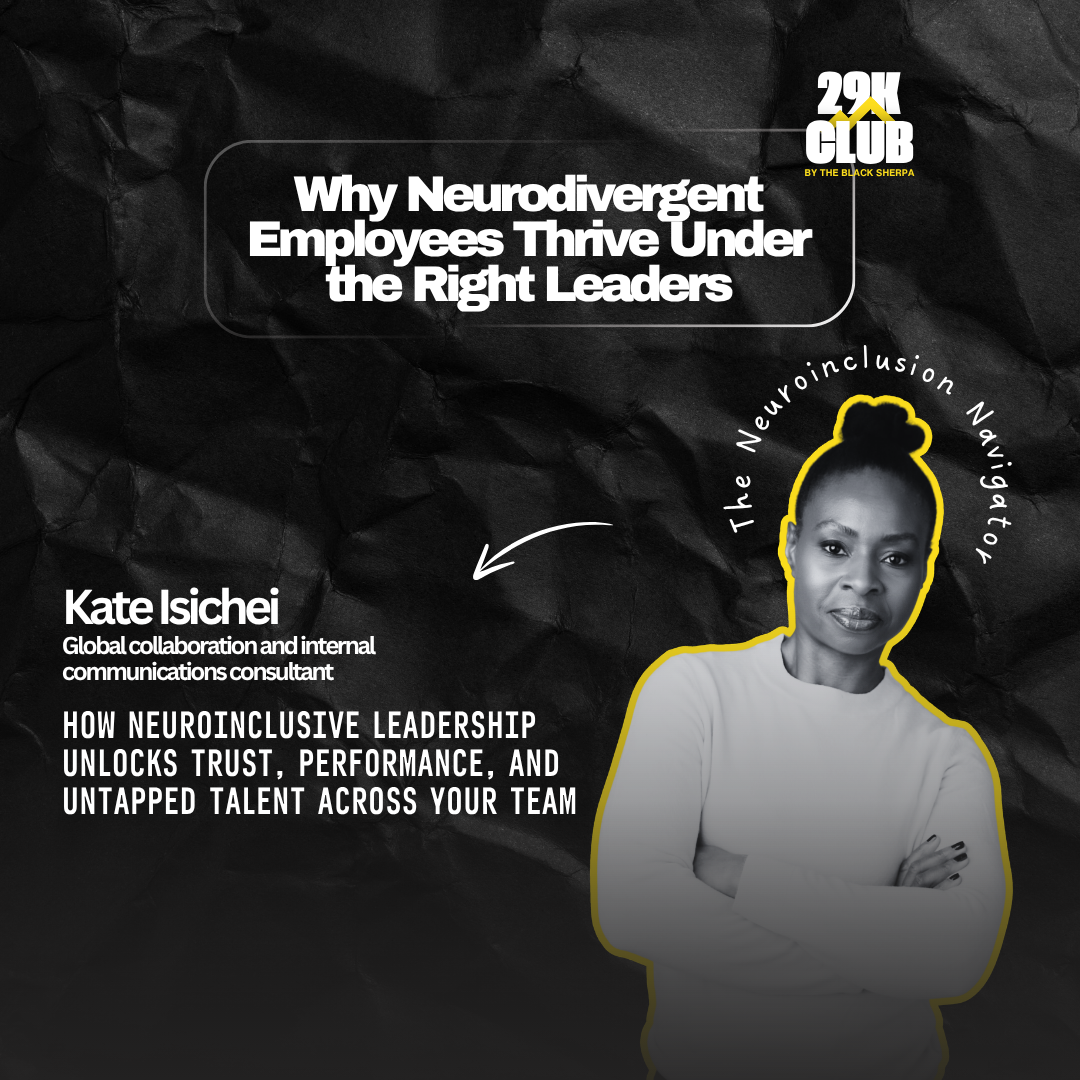
A Black Sherpa 29k Club masterclass with Kate Isichei, The Neuroinclusion Navigator, exploring how neuroinclusive leadership helps managers stop misreading difference as deficiency, build trust with neurodivergent employees and create the conditions for people to do their best work
Most managers believe they are being fair
Clear expectations. Consistent standards. Equal treatment.
But fairness is not the same as effectiveness.
And “treating everyone the same” can quietly penalise the people who think, communicate and operate differently.
That was the deeper tension inside Kate Isichei’s 29k Club masterclass on neuroinclusive leadership. Not whether neurodivergent employees are capable. Not whether organisations should care. But whether leaders are skilled enough to recognise talent when it does not present in the way they expected.
Because neurodivergent employees are not inherently less capable.
Too often, they struggle when leadership misreads difference as deficiency.
A direct communicator becomes “blunt.”
Someone who asks for clarity becomes “difficult.”
A colleague who avoids small talk becomes “not a relationship builder.”
A person overwhelmed by ambiguity becomes “not resilient.”
And slowly, quietly, the organisation starts managing the wrong problem.
How to Read This Article
This is a long read. You do not need to read it all in one go.
Start with the section that feels most useful:
Managers and leaders: read “They’re Capable… But Something Isn’t Landing”
Neurodivergent professionals: read “Self-Advocacy Without Over-Explaining Yourself”
Parents: read “For Parents Supporting Neurodivergent Children”
HR and people teams: read “Further UK Resources on Neuroinclusion”
Anyone new to the topic: start with “Key Neuroinclusion Terms”
The main idea is simple:
Neuroinclusive leadership is not about lowering standards. It is about reducing unnecessary friction so people can do their best work.
At a Glance
Neuroinclusive leadership helps managers stop misreading difference as deficiency.
Treating everyone the same can create unfair friction.
Clear communication, trust and reasonable adjustments can improve performance.
Self-advocacy does not always require full disclosure.
Parents and leaders often face a similar challenge: understanding what sits beneath behaviour.
The best leaders do not lower the bar. They remove the fog.
Jump to Section
- Key Neuroinclusion Terms
- Kate Isichei: The Neuroinclusion Navigator
- Why This Conversation Feels So Difficult at Work
- Self-Advocacy Without Over-Explaining Yourself
- The Meeting Is the Message
- The Hidden Curriculum Gets Harder When You Process Differently
- Equal Treatment Is Not Always Effective Leadership
- Ambiguity Is Not Neutral
- “They’re Capable… But Something Isn’t Landing”
- Disclosure Is Not Simple When Trust Has Not Been Built
- You Do Not Always Need a Diagnosis to Start a Better Conversation
- For Parents Supporting Neurodivergent Children
- Intent, Impact and Support
- Further UK Resources on Neuroinclusion
- Why This Conversation Belongs in The 29k Club
- Connect with Kate Isichei
- Plain English Summary
Why Neuroinclusive Leadership Matters Now
Neuroinclusive leadership is not a soft skill.
It is a performance skill.
It is the difference between seeing someone as difficult and understanding the conditions they need to do their best work. It is the difference between forcing conformity and unlocking contribution. It is the difference between equal treatment and effective leadership.
Kate reminded the room that neurodivergent people are already in our workplaces. Some are diagnosed. Some are undiagnosed. Some suspect. Some are self-diagnosed. Some are not ready to use any label at all.
Which means managers are already leading neurodivergent employees, whether they know it or not.
The problem is that many workplaces still run on hidden rules: implied expectations, vague instructions, political nuance, tone-dependent communication, small talk, social performance and a narrow idea of what “professional” looks like.
Many managers do not set out to exclude people. They simply lead from the assumption that their way of working is neutral.
But it is not neutral for everyone.
For some neurodivergent employees, the hidden curriculum of work becomes even harder to decode. And when leaders do not understand that, they can unintentionally create friction, damage trust and leave serious capability untapped.
Neuroinclusive leadership is not only about reducing harm. It is also about unlocking creativity, focus, pattern recognition, innovation and problem-solving that may otherwise be missed.
Key Neuroinclusion Terms: A Plain English Starting Point
One reason conversations about neurodivergence can feel difficult is that people are often scared of using the wrong words.
That fear is understandable.
But avoiding the conversation does not make workplaces safer. It just leaves misunderstanding untouched.
So let’s start with some useful language.
Neurodiversity
The natural variation in how human brains think, learn, process, communicate and experience the world. Everyone is neurodiverse because no two brains are exactly the same.
Neurodivergence
When someone’s brain diverges from what is typically expected. This can include autism, ADHD, dyslexia, dyspraxia and other neurotypes.
Neurotypical
Often used to describe people whose brains and processing styles broadly fit dominant social, educational and workplace norms.
Neuroinclusion
Creating environments where different ways of thinking, processing, communicating and working are understood, respected and supported.
Masking
Hiding, suppressing or adapting parts of yourself to fit expected social or workplace norms.
Stimming
Self-stimulating behaviours that can help someone regulate sensory input, emotion or stress. This might include movement, repeated sounds, fidgeting or other forms of sensory regulation.
Reasonable adjustments
Changes that help someone work, learn or participate more effectively. This might include written instructions, different meeting formats, extra processing time, clearer priorities or reduced sensory overload.
This is not about creating a “them and us.” It is about noticing when systems have been designed around one dominant way of working.
One practical point from Kate’s session was especially useful: people do not always need a formal diagnosis to start a conversation about what helps them work well. Formal processes may vary by organisation, but leaders do not need to wait for paperwork before asking better questions.
Kate Isichei: The Neuroinclusion Navigator
Kate Isichei is a neuroinclusion consultant and Neuroinclusion Navigator who helps organisations create neuroinclusive cultures where neurodivergent people can thrive.
Through her work at Where To Look Communications, Kate supports leaders and organisations to recognise the skills, creativity and innovative thinking that neurodivergent individuals can bring, but which are often overlooked.
Her journey into this work began with her children’s diagnoses of autism and ADHD. That personal experience led her to explore neurodivergence more deeply and shaped a powerful professional question:
How much potential are organisations missing because they do not know where, or how, to look?
With a background in communications and engagement, Kate brings a practical lens to neuroinclusion. Her work is not about vague awareness or tick-box inclusion. It is about helping organisations reduce unnecessary friction, build trust and create the conditions for different minds to do their best work.
Kate’s value is that she helps leaders see what they are missing before they turn misunderstanding into performance management. She brings communication expertise, coaching experience and lived insight into one of the most underdeveloped leadership capabilities of the next decade: neuroinclusive leadership.
Why This Conversation Feels So Difficult at Work
Many people are not avoiding conversations about neurodivergence because they do not care.
They are avoiding them because they are scared of saying the wrong thing, offending someone, labelling a colleague, reducing a person to a diagnosis, or opening a conversation they do not feel qualified to hold.
So the topic gets pushed into policy language, HR process or private conversations. Managers sense something is not landing, but they do not know whether to ask, challenge, support or stay quiet.
That silence has a cost.
Because when leaders avoid the conversation, people still get judged.
They get judged as difficult, blunt, disengaged, awkward, sensitive, unreliable or not ready.
The issue does not disappear. It simply gets renamed as a performance problem.
A better workplace conversation does not require everyone to become an expert. It requires people to become more respectful, more curious and more precise.
For leaders, that means asking:
What am I noticing?
What am I assuming?
Have I made expectations clear?
Have I asked what helps this person do their best work?
Am I responding to impact without making assumptions about intent?
Is this a performance issue, a communication issue, an environment issue or a trust issue?
Self-Advocacy Without Over-Explaining Yourself
Self-advocacy should not require someone to disclose everything about themselves.
Sometimes it starts with simply naming what helps.
That might sound like:
“I work best when priorities are clear.”
“Could you put that in writing so I can process it properly?”
“I may need a little time to think before responding.”
“It helps me when expectations are explicit.”
“I want to do this well. Can we clarify what good looks like?”
“I’m not asking for the standard to change. I’m asking for clarity on how to meet it.”
“Could we agree the main priority before I start?”
“I process better when I can review notes after the conversation.”
This matters because self-advocacy can feel risky.
People may worry they will be seen as difficult, needy, slow, demanding or less capable. But asking for clarity is not weakness. It is often a route to better performance.
The goal is not to explain your whole life.
The goal is to make it easier to do good work.
Manager Scripts That Reduce Pressure
Managers often avoid the conversation because they do not know how to begin.
The aim is not to diagnose someone. The aim is to create a clearer, safer and more useful conversation.
Useful starting points include:
“I want to check I’ve explained this clearly. What would help you move forward?”
“Would it help if I put the priorities in writing?”
“Let’s agree what good looks like before you start.”
“I noticed this did not land as intended. Can we talk about what happened and what would help next time?”
“You do not need to disclose anything personal, but I’d like to understand what helps you do your best work.”
“Would more structure, more time, or a different format help here?”
“I want to separate the quality of your work from the friction around how we are communicating.”
“What part of this feels unclear or difficult to act on?”
“Is there anything about the way we are working that is making this harder than it needs to be?”
These questions do not remove accountability.
They make accountability more accurate.
The Meeting Is the Message
One of the most powerful things Kate did was not in the slide deck.
It was in how she held the room.
At the beginning of the session, she made it clear that people could engage in different ways: cameras on or off, chat, mic, reactions or simply listening.
That might sound small. It was not.
It modelled the practice, not just the theory.
Too often, organisations talk about inclusion while running meetings that only reward one kind of participation: fast verbal contribution, visible engagement, cameras on, confidence in the moment and the ability to process quickly in public.
But participation is not always loud.
Engagement is not always visible.
And a camera being on is not proof that someone is present, contributing or psychologically safe.
A neuroinclusive leader asks better questions about the spaces they create:
Do people have more than one way to contribute?
Are we confusing visible engagement with real engagement?
Have we made space for people who process before speaking?
Are cameras-on expectations helping or harming?
Are we judging participation too narrowly?
The meeting is the message.
If you want a neuroinclusive culture, it has to show up in the everyday mechanics of how people gather, speak, listen, process and contribute.
The Hidden Curriculum Gets Harder When You Process Differently
The 29k Club exists to explore the hidden curriculum of work: the things that shape careers but rarely get taught directly.
How to read the room.
How to build trust.
How to understand power.
How to ask for what you need.
How to navigate ambiguity.
How to know when directness is valued and when it gets labelled as difficult.
For neurodivergent professionals, that hidden curriculum can become a maze of tone, implication, politics and unspoken expectations.
If no one names the rules, people get judged for not playing a game they were never properly taught.
Kate’s session made this visible.
Workplaces often reward people who can infer meaning quickly, soften language socially, fill silence comfortably, decode tone and sense the politics behind the words.
But what happens when someone communicates more literally?
What happens when someone does not naturally understand the purpose of small talk?
What happens when someone needs the actual instruction, not the implied one?
Too often, we label the person instead of examining the system.
That is why neuroinclusive leadership matters.
It gives managers a way to pause before turning difference into judgement.
Equal Treatment Is Not Always Effective Leadership
Many managers pride themselves on treating everyone the same.
Same communication style. Same expectations. Same meeting culture. Same performance process.
But if people process information differently, communicate differently and experience workplace environments differently, sameness can become a barrier.
Neuroinclusive leadership does not mean lowering standards. It means creating the conditions where people can meet high standards without unnecessary friction.
A manager might think they are being fair by giving the same vague instruction to everyone. But if one employee needs greater clarity to perform well, the issue is not that they are less capable. The issue is that the instruction was not effective for them.
A manager might think small talk is relationship-building. But for some neurodivergent people, it can feel confusing, draining or unnecessary.
A manager might think they are being flexible by leaving something open-ended. But for someone who needs specificity, that flexibility can feel like uncertainty.
The leadership question is not:
“Why can’t they just adapt?”
The better question is:
“What small shift would help this person do better work?”
Clarity is care.
And in leadership, clarity is often performance infrastructure.
Ambiguity Is Not Neutral
Kate’s strongest practical theme was communication.
Workplaces often run on ambiguity. People imply rather than explain. They hint rather than state. They assume others have understood because nobody challenged them in the moment.
But ambiguity can be costly.
Kate shared an example of a leader saying a meeting was cancelled. She took the words literally. Later, it became clear that the message carried nuance that had not been stated directly.
That is a useful workplace lesson.
If your communication depends on people decoding tone, subtext or implied meaning, you are creating invisible work for your team.
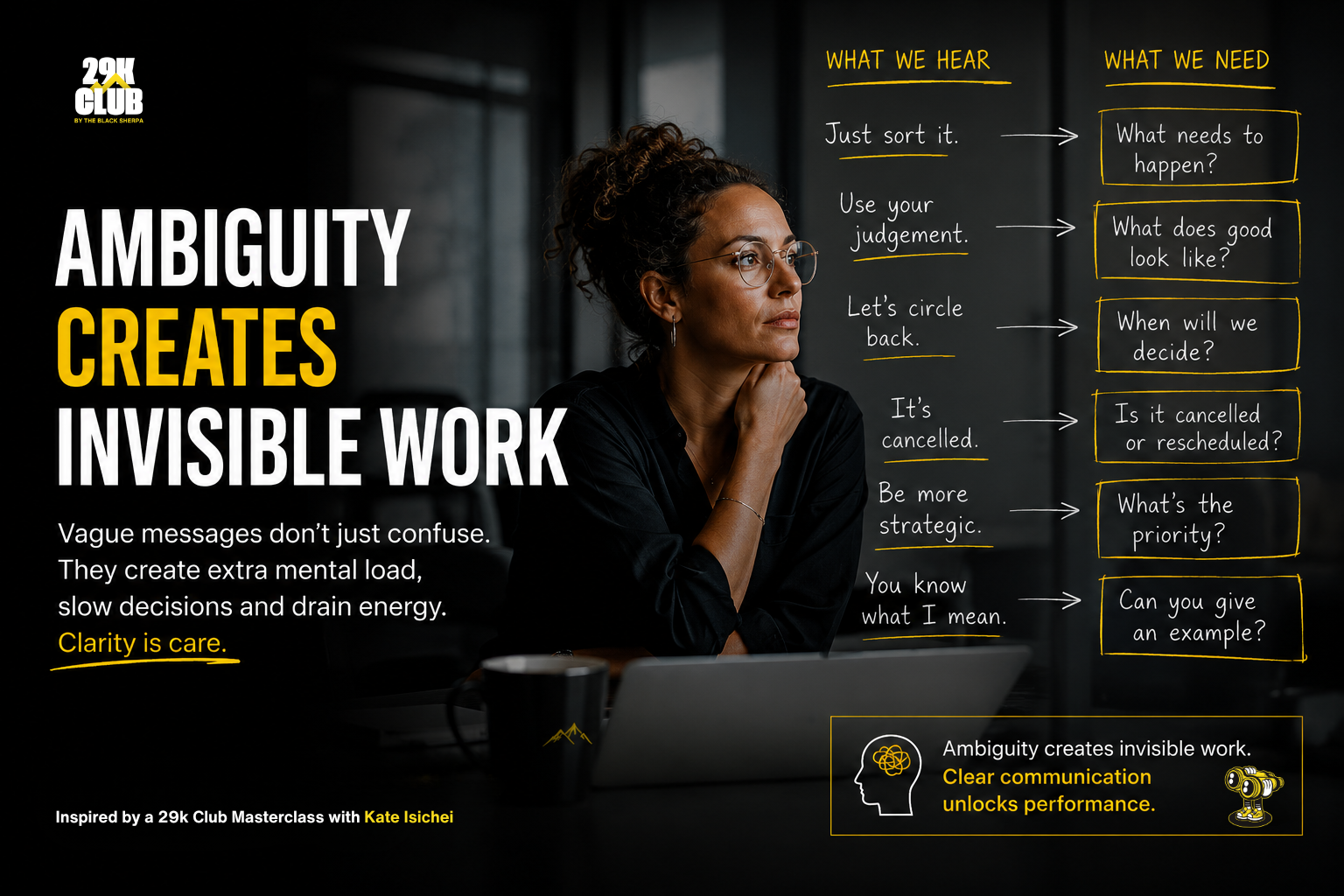
Vague communication creates invisible work; clarity reduces cognitive load and helps people contribute with confidence
For some neurodivergent employees, that invisible work can become exhausting.
Neuroinclusive leaders reduce ambiguity by being clear about:
what needs to happen
why it matters
when it is needed
what good looks like
what is flexible
what is not flexible
where people should go with questions
This is not over-explaining.
This is leadership.
It is also not about creating a “them and us.” It is about recognising that systems often reward one dominant way of processing, communicating and performing.
Clear communication helps everyone. But for some neurodivergent employees, it can be the difference between confusion and contribution.
“They’re Capable… But Something Isn’t Landing”
This may be the most important moment for any manager.
The employee is clearly capable.
The work has quality.
The thinking is there.
But something is not quite landing.
Maybe stakeholder relationships feel strained. Maybe communication is perceived as too direct. Maybe they seem disengaged in meetings. Maybe they keep asking for clarity everyone else appears to understand. Maybe they do not read the politics in the room.
This is the dangerous moment.
Because what a manager does next can either build trust or create damage.
They can become curious about the conditions around the person, or they can quietly start building a case against them.
Kate explained that many neurodivergent employees she coaches are technically strong, diligent and capable. The issue is not always the core work. The issues often appear around communication, relationship-building, political nuance, ambiguity or being perceived as too blunt or literal.
That is where leadership can go wrong.
Instead of asking, “What conditions would help this person succeed?”, managers may conclude, “This person is not performing.”
And once that story takes hold, the organisation may reach for a performance improvement plan before it has understood the person.
A better neuroinclusive leadership lens asks:
Is this person capable in the core work?
Are expectations explicit or assumed?
Is the issue technical performance or workplace interpretation?
Have we asked what helps this person do their best work?
Are we relying too heavily on social fluency as a proxy for competence?
Have reasonable adjustments been considered?
Is the manager adapting, or only expecting the employee to adapt?
This is not about excusing poor performance.
It is about diagnosing the right problem.
Curiosity before conclusion.
Disclosure Is Not Simple When Trust Has Not Been Built
One of the most honest parts of the session focused on disclosure.
Should someone disclose neurodivergence during recruitment or at work?
The discussion did not collapse into a neat answer. That was the value of it.
In a genuinely neuroinclusive organisation, disclosure can help someone access support, reasonable adjustments and a fairer working experience.
But in organisations where neurodivergence is poorly understood, disclosure can still carry risk.
That tension is uncomfortable because both things are true.
People should not have to hide to be safe.
But people should not be asked to risk themselves in systems that have not earned their trust.
This is the contradiction many employees face.
We tell people to bring their whole selves to work, but we do not always build workplaces that can hold the truth safely.
We encourage disclosure, but many people have learned that disclosure can change how they are judged.
We say we value difference, but often reward those who can perform sameness most convincingly.
The better organisational question is not:
“Why don’t people disclose?”
It is:
“What have we done to make disclosure safe, useful and worth it?”
Neuroinclusive leadership is built before disclosure happens.
It is built in the way leaders respond to difference.
It is built in how managers handle questions.
It is built in whether adjustments are treated as a burden or a route to better performance.
It is built in whether people can say, “This helps me work well,” without feeling like they are making a confession.
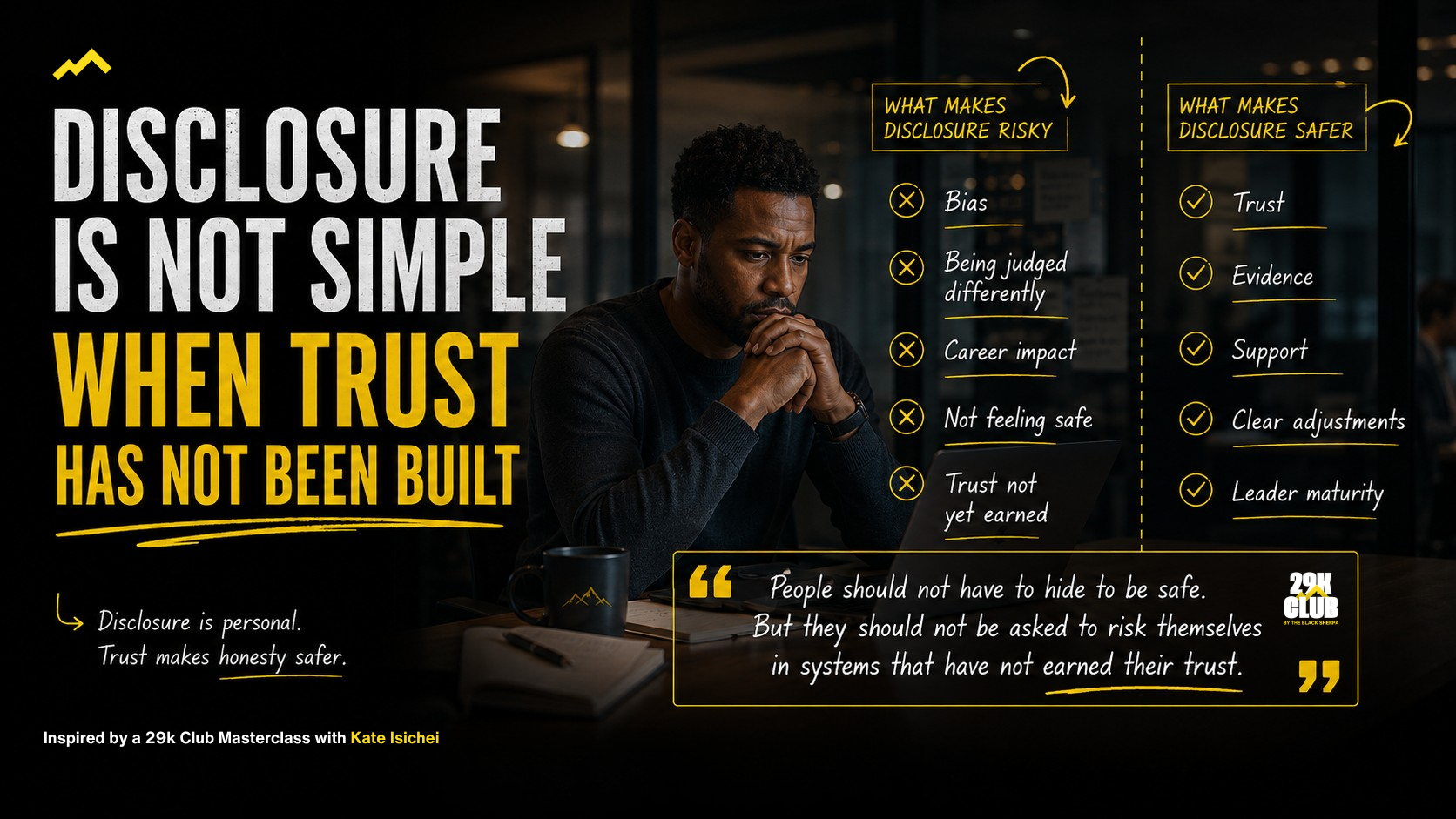
Disclosure is personal. Trust makes honesty safer. Before asking people to open up, leaders need to ask whether the environment has earned that truth
You Do Not Always Need a Diagnosis to Start a Better Conversation
One practical point from Kate’s session was especially useful: people do not always need a formal diagnosis to start a conversation about what helps them work well.
Formal processes may vary by organisation, but leaders do not need to wait for paperwork before asking better questions.
Someone might need instructions in writing.
Someone might process better with time before responding.
Someone might need clarity on priorities.
Someone might work better with fewer last-minute changes.
Someone might find certain meeting formats more draining than useful.
These are not unreasonable human needs.
Often, they are just good management signals.
The leadership opportunity is to create a culture where people can talk about how they work best before they reach crisis point.
Managers matter enormously, but they should not be left to work this out alone. Organisations need to train, support and equip them.
For Parents Supporting Neurodivergent Children
One of the most human parts of the masterclass was how often the conversation moved beyond work.
Because neuroinclusion does not begin in a policy document.
It begins in homes, schools, friendships, faith communities and family conversations.
Kate spoke openly about her own learning as a parent, including how behaviours such as stimming can be misunderstood before we understand what purpose they serve.
That is a powerful lesson for parents.
Sometimes the thing we are trying to stop is the thing helping a child regulate.
Sometimes the behaviour that looks disruptive is communication.
Sometimes the child who is labelled difficult is overwhelmed, misunderstood, sensory-seeking, anxious or trying to process the world in the only way they can.
This is not about parents becoming clinicians. It is about becoming more curious observers, more compassionate advocates and more confident partners in the conversations around their children.
For parents, the work is not to get everything right immediately.
It is to stay curious.
A helpful parental lens might include:
What is this behaviour trying to communicate?
Is my child overwhelmed, anxious, tired, overstimulated or seeking sensory input?
Am I reacting to embarrassment, inconvenience or actual harm?
Does my child understand the impact of their behaviour?
Have I explained the boundary clearly?
What support, signal or language would help next time?
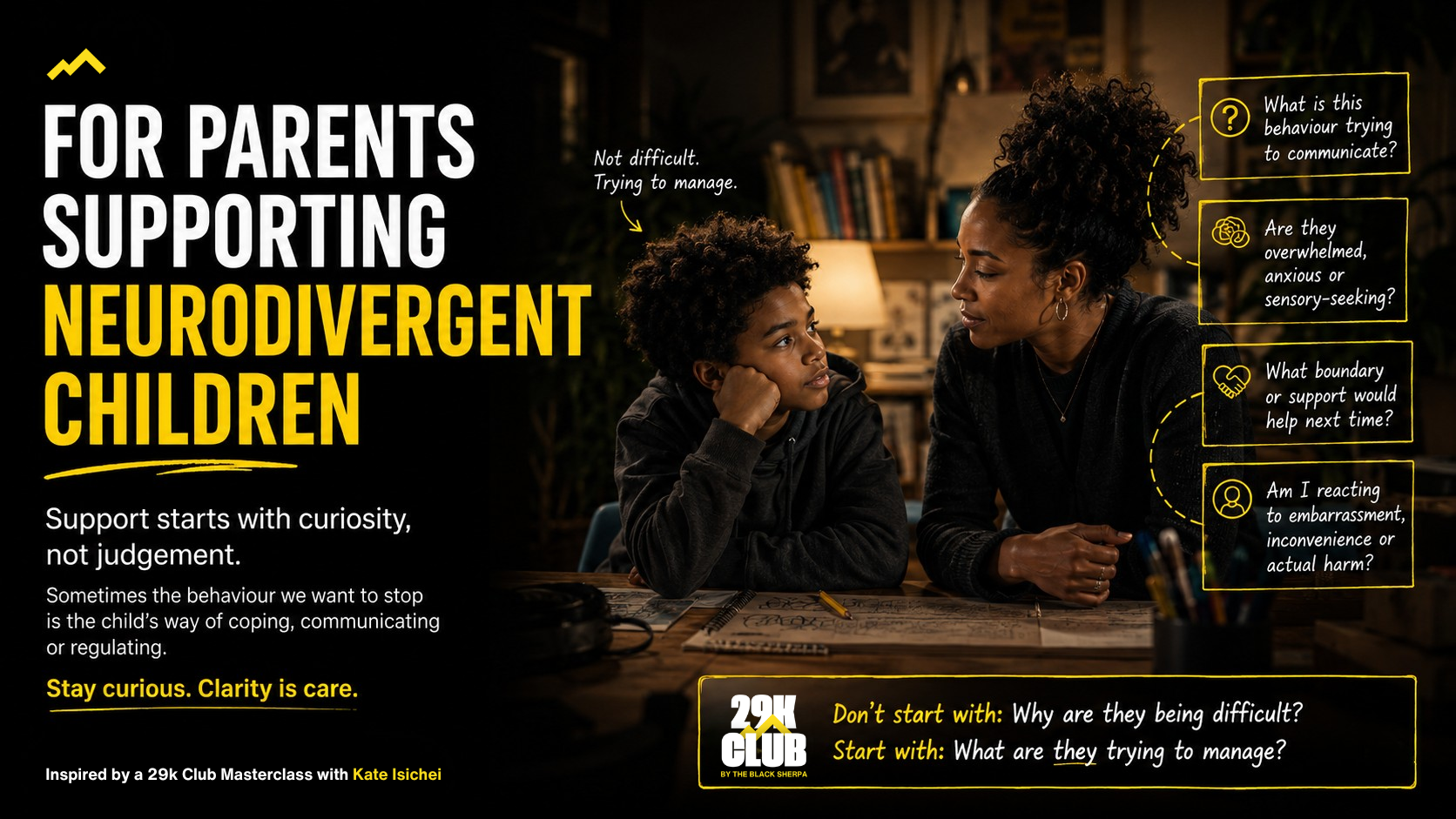
Supporting a neurodivergent child starts with looking beyond the behaviour and getting curious about what they may be communicating, experiencing or trying to manage
This matters because many parents are navigating the same tension as managers: compassion and accountability.
You can support a neurodivergent child without pretending impact does not matter.
You can set boundaries without shaming the child.
You can teach social awareness without demanding constant masking.
You can advocate for them while also helping them understand how their behaviour affects others.
The question is not, “How do I make this child fit?”
The better question is, “How do I help this child understand themselves, communicate their needs and move through the world with support, self-respect and appropriate boundaries?”
That is not easy work.
But it is important work.
And for many parents, it starts with one shift:
Stop asking, “Why are they being difficult?”
Start asking, “What are they trying to manage?”
Neuroinclusion Does Not Stop at the Office Door
One of the most valuable questions in the room came from Patricia, who asked about cultural backgrounds where neurodivergence may not be recognised or accepted.
That question matters.
Because people do not arrive at work as blank slates.
Some people are not only navigating workplace misunderstanding. They are also navigating family, faith or cultural contexts where neurodivergent traits may be interpreted as bad behaviour, poor discipline, nutrition issues, weakness or “just being difficult.”
That history shapes how safe someone feels asking for support.
It shapes whether they trust labels.
It shapes whether diagnosis feels useful, frightening, shameful or liberating.
It shapes whether they are used to being understood or corrected.
Kate spoke about the need for education, patience and gentle challenge. That matters because neuroinclusive leadership is not just about office policy. It is about understanding the stories people carry into the workplace.
If leaders want to build trust, they need to understand that disclosure is not only a professional decision.
Sometimes it is emotional.
Sometimes it is cultural.
Sometimes it is tied to years of being misunderstood.
Intent, Impact and Support
Another rich part of the session explored behaviour, boundaries and accountability.
This matters because neuroinclusive leadership can easily be misunderstood.
It is not about pretending impact does not matter.
It is not about removing all expectations.
It is not about saying any behaviour is acceptable if there is a reason behind it.
If behaviour affects others, it still needs to be discussed.
But the conversation changes when we separate intent, impact and support.
A useful model is:
Intent
What might be driving the behaviour?
Was it deliberate, accidental, sensory, emotional, communication-related or linked to misunderstanding?
Impact
How is it affecting others, the work or the relationship?
Can we name the impact clearly without shaming the person?
Support
What conversation, adjustment, boundary or signal would help next time?
This is useful for managers, parents, colleagues and teams.
It allows compassion and accountability to sit together.
You can understand the reason behind behaviour and still talk about the effect it has.
That is not contradiction.
That is mature leadership.
Key Insights from Kate Isichei’s Masterclass
1. Neuroinclusive leadership is about unlocking performance, not lowering standards.
The goal is to remove unnecessary friction so that more people can contribute at their best.
2. Treating everyone the same is not always fair.
People may need different communication, working conditions or adjustments to meet the same expectations.
3. Difference is too easily mistaken for difficulty.
Neurodivergent employees can be misread as blunt, disengaged or underperforming when the real issue may be ambiguity, overload or unmet support needs.
4. Clarity is one of the most powerful forms of support.
Vague communication creates invisible work. Clear expectations, priorities and examples reduce cognitive load and improve performance.
5. Trust must come before disclosure.
Neurodivergence may be hidden, undiagnosed or culturally misunderstood, and people should not have to risk their safety to access support.
6. Managers shape the everyday experience of inclusion.
Psychological safety is built through daily behaviour: curiosity, clear communication, thoughtful adjustments and the ability to combine compassion with accountability.
Why This Matters for Performance, Progression and Culture
When leaders lack a neuroinclusive lens, organisations pay for it.
They lose trust.
They lose talent.
They lose ideas.
They misinterpret behaviour.
They create unnecessary performance issues.
They talk about inclusion while quietly rewarding conformity.
But when leaders develop a neuroinclusive approach, something changes.
People can spend less energy masking and more energy contributing.
Teams communicate more clearly.
Managers intervene earlier and more intelligently.
Employees are less likely to be punished for difference.
Organisations get closer to the talent they already have.
This is especially important for career progression.
Because the higher people climb, the more work depends on ambiguity, relationships, perception and unwritten rules. If neurodivergent professionals are not supported to navigate those dynamics, talent can stall for reasons that have little to do with ability.
That is why this conversation belongs in leadership development, not just DEI.
And it belongs in family conversations too.
Because the same questions keep showing up:
Do we understand the person in front of us?
Do we know what they need to thrive?
Are we responding to behaviour, or trying to understand what sits beneath it?
Are we creating the conditions for trust, clarity and growth?
Further UK Resources on Neuroinclusion
This masterclass was a starting point for better conversations, not a replacement for specialist advice, workplace guidance or clinical support.
For readers who want to explore neuroinclusion, workplace adjustments or diagnosis pathways in more detail, these UK resources are useful places to start.
Acas - workplace adjustments and diagnosis
Practical guidance on reasonable adjustments for neurodivergent workers, including examples of support and the important point that employers should support workers whether or not they have a formal diagnosis.
Read Acas guidance on adjustments for neurodiversity
CIPD - HR and leadership guidance
Useful for HR teams, people leaders and managers looking to understand neuroinclusion as part of workplace culture, leadership and employee experience.
Read CIPD’s guide to neuroinclusion at work
NHS Employers - practical employer action
Helpful for practical examples of how employers can support neurodivergent staff, including open conversations, positive language, awareness and workplace adjustments.
Read NHS Employers’ guidance on embracing neurodiversity at work
National Autistic Society - autism-specific support
A useful resource for autistic people, families and employers, including support at work, reasonable adjustments and whether to tell an employer you are autistic.
Explore National Autistic Society employment guidance
ADHD Foundation - ADHD and neurodiversity support
A helpful source for education, training and resources on ADHD and wider neurodiversity for families, schools and workplaces.
Explore ADHD Foundation resources
NHS and NICE - diagnosis and clinical guidance
Useful for parents, individuals and professionals seeking clinically grounded information on ADHD, autism, diagnosis and support pathways.
Read NHS guidance on autism assessments
Read NHS guidance on ADHD in adults
Read NICE guidance on ADHD
Read NICE guidance on autism in adults
The point is not to become an expert overnight. It is to move from avoidance to better questions, better conversations and better support.
Why This Conversation Belongs in The 29k Club
This is exactly the kind of conversation The 29k Club exists to hold.
Not polished answers.
Braver questions.
The kind people should be able to ask at work and in life, but often cannot.
Because career development is not just about CVs, promotions and confidence. It is about understanding the hidden curriculum of work: the unwritten rules, invisible expectations and unspoken dynamics that shape who gets seen, supported and progressed.
Kate’s masterclass sat right at the heart of that mission.
The room explored diagnosis, disclosure, burnout, culture, recruitment, parenting, performance and language. Not as a polished panel. As a real community of professionals trying to understand what better could look like.
That is the value of The 29k Club.
It is not just the content.
It is the room.
A space where people can ask the questions they are not sure they are allowed to ask elsewhere.
A space where leaders, managers and professionals can think out loud without pretending they have it all figured out.
A space built around clarity, confidence and community.
Connect with Kate Isichei
If you lead people, develop managers, influence culture, support young people or care about unlocking hidden talent, Kate Isichei is someone worth knowing.
As The Neuroinclusion Navigator, Kate helps organisations create neuroinclusive cultures that reduce unnecessary friction and recognise capability that may otherwise be missed.
Her work is especially relevant for:
people managers
senior leaders
HR and people teams
employee resource groups
leadership development teams
organisations serious about inclusion beyond policy
parents and communities seeking better understanding
teams navigating communication, trust and performance challenges
If your organisation has ever looked at someone and thought, “They’re capable, but something’s not quite landing,” Kate’s work can help you ask better questions before you reach the wrong conclusion.
You can learn more about Kate’s work at www.WhereToLookComms.co.uk, connect with her on LinkedIn at linkedin.com/in/kateisichei, or contact her at KateIsichei@WhereToLookComms.co.uk.
Final Reflection: Are You Being Fair, or Are You Being Effective?
Neuroinclusive leadership starts with a hard question.
Are you treating people equally, or are you leading them effectively?
Are you reading behaviour accurately, or through the lens of your own working style?
Are you creating clarity, or expecting people to decode you?
And if someone is struggling, have you asked whether the issue is capability, communication, environment or trust?
At work, in teams, in schools and at home, the question is often the same:
Are we trying to fix the person, or understand the conditions they need to thrive?
The best leaders do not lower the bar.
They remove the fog.
Plain English Summary
Neuroinclusive leadership means leading people in a way that reduces unnecessary friction.
It is not about lowering standards.
It is about being clearer, more flexible and more curious before judging someone’s behaviour or performance.
At work and at home, the better question is often:
“What is this person trying to manage, and what would help them thrive?”
Climb Steady 🖤
I’m Yam – Founder of The Black Sherpa
Founder | Strategist | Speaker | Host of The Black Sherpa Podcast
I founded The Black Sherpa to create a world where talent rises on merit and no one’s potential is held back by bias or barriers.
Through bold strategy, storytelling, and our flagship community, The 29k Club - I help professionals grow with confidence and support leaders to build cultures that truly live their values.
Let’s connect and build a future where inclusion powers performance, and leadership reflects the world we serve.