
What If Omnichannel Is Not Your 29k Destination?
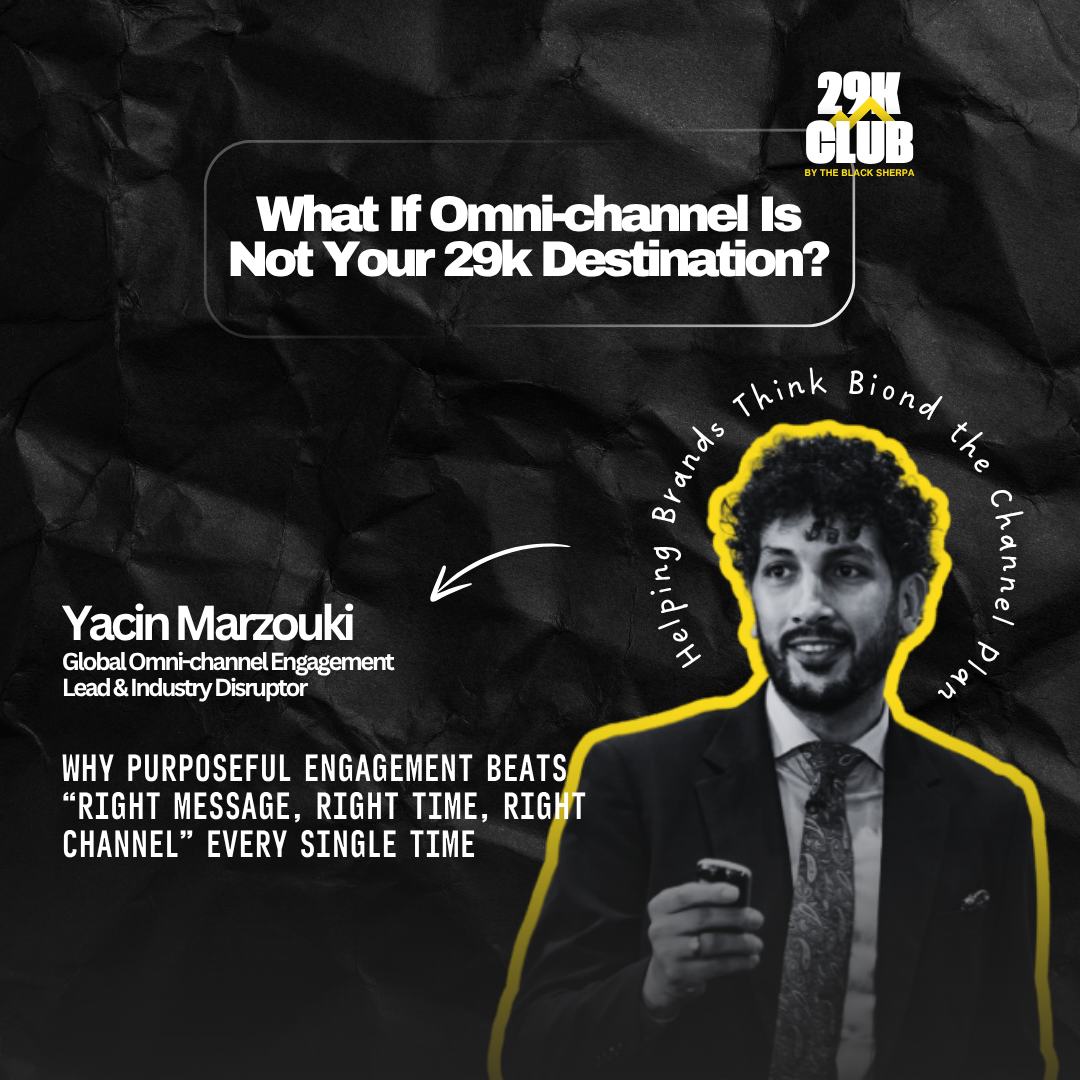
A Black Sherpa 29k Club masterclass with Yacin Marzouki, founder of Biond Health, exploring why omnichannel may not be the real destination in pharma, and how better HCP engagement starts with customer need, maturity, useful content and clearer measures of impact.
Why Omnichannel in Pharma Is Not the Destination: How to Name Reality Without Killing Ambition
Some teams are talking about omnichannel.
Others are still trying to make multichannel work without breaking the people expected to deliver it.
That was the tension sitting underneath Yacin Marzouki’s recent 29k Club masterclass on omnichannel in pharma. Not whether technology matters. Not whether digital engagement is useful. Not whether healthcare professional engagement needs to evolve.
The harder question was this:
What if omnichannel is not the destination?
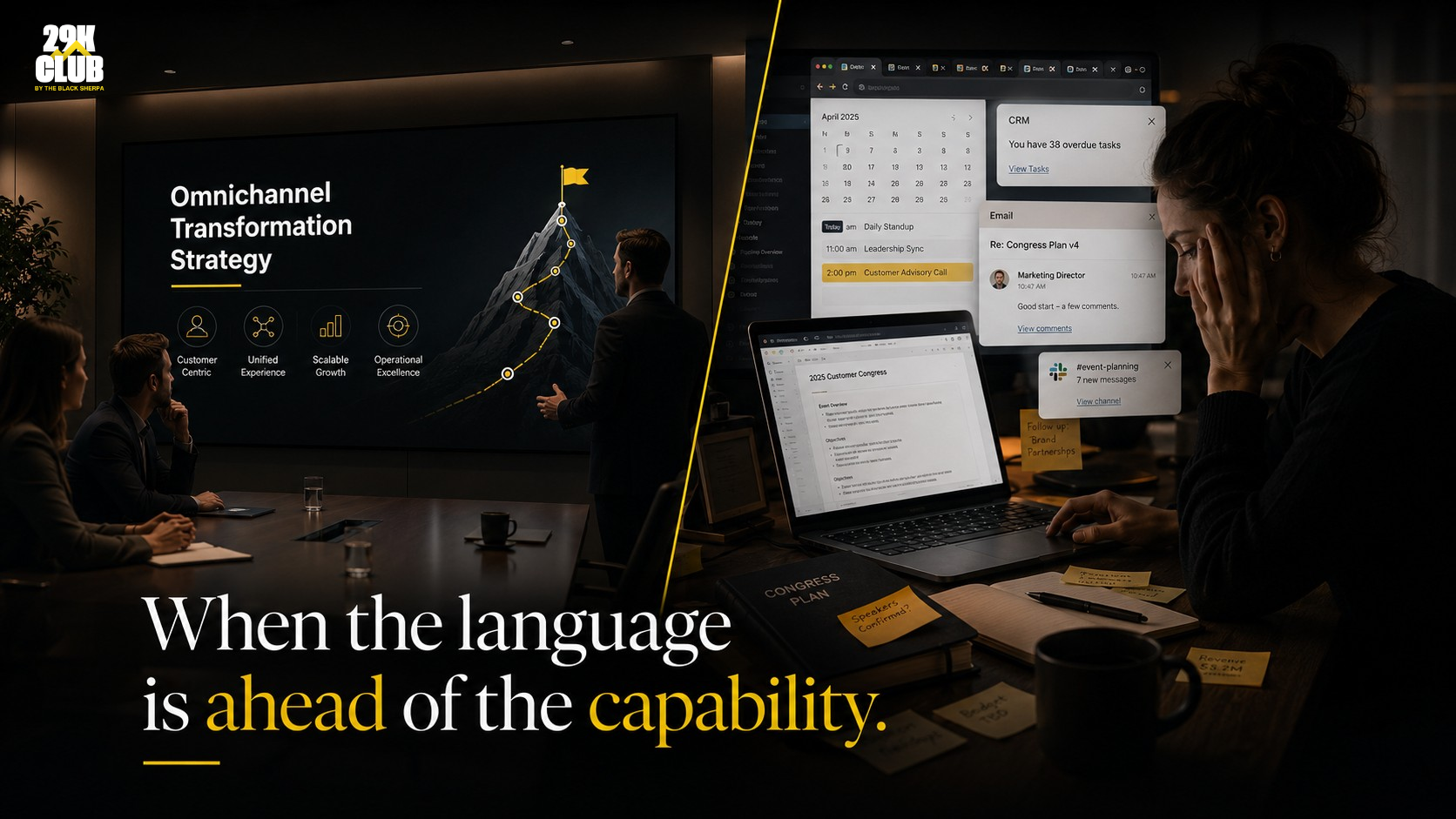
The gap between omnichannel ambition and delivery reality is where the real work begins
Early in the session, one member put the reality plainly. Her company was trying to move towards multichannel because it was “very far behind, let alone omnichannel.” That one comment brought the whole conversation down from strategy language into real working life.
Because this is where many professionals sit.
Between ambition and reality.
Between the language the organisation uses and the capability the team actually has.
Between what leaders want to say is happening and what people on the ground are trying to make work.
Yacin’s challenge was sharp:
“Very often we jump to the conclusion that we need to do omnichannel, but no one really understands what, why or how this should be done.”
That is not just a pharma problem.
That is a workplace problem.
When the language gets ahead of the capability, people are left carrying the gap.
Why this conversation about omnichannel in pharma matters now
There is pressure in pharma and life sciences to sound advanced.
Every brand wants an omnichannel strategy.
Every organisation wants to look digitally mature.
Every team wants to prove it is customer-centric.
Every plan seems to carry some version of “the right message, at the right time, through the right channel.”
In simple terms, omnichannel means creating a connected experience across multiple channels, so each interaction builds on the last.
In Pharma, that might include rep conversations, emails, webinars, congresses, Healthcare Professional (HCP) portals, websites, medical education and other touchpoints working together rather than operating in isolation.
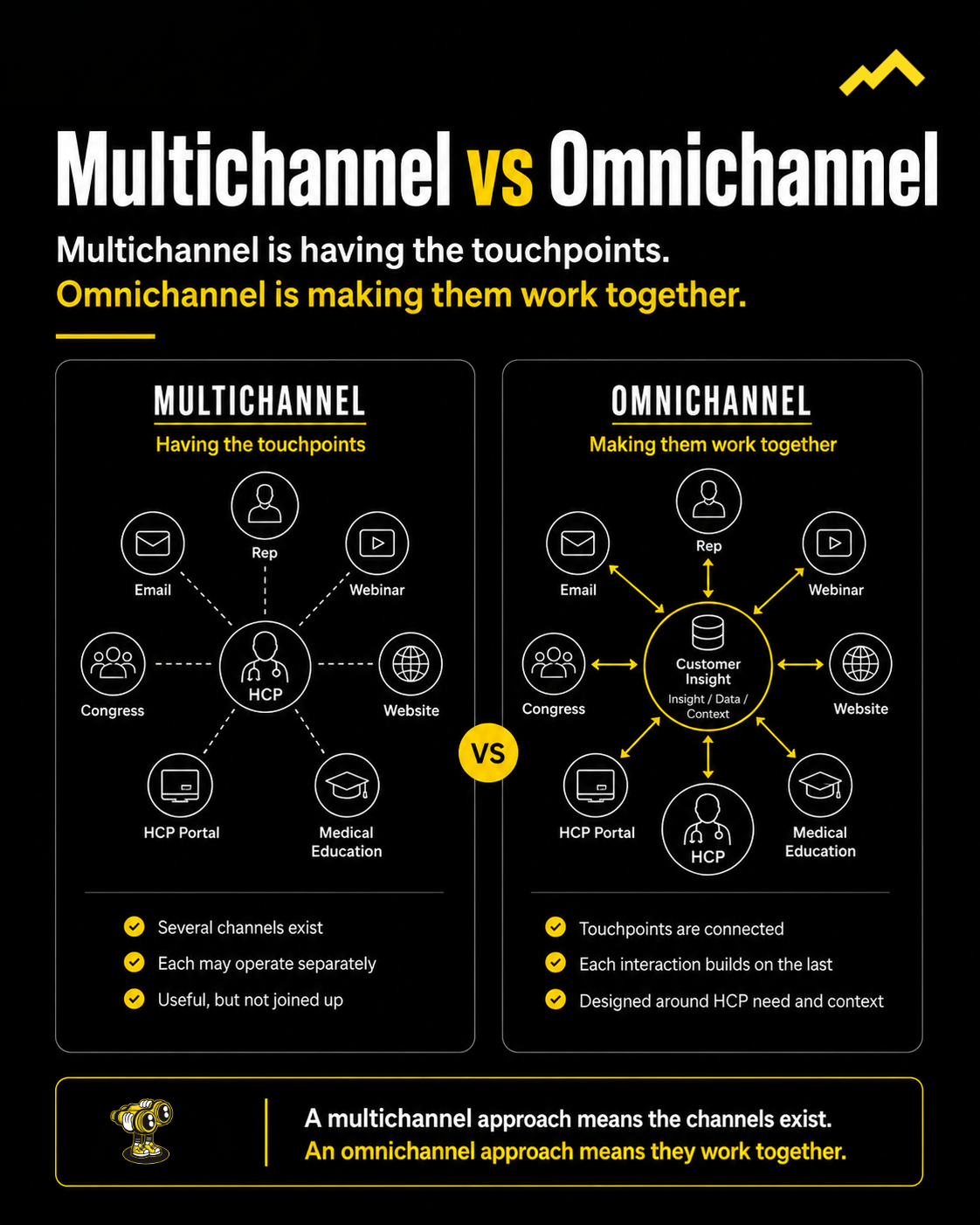
Multichannel gives you the touchpoints; omnichannel connects them around the needs of the HCP
A basic multichannel approach may mean all those channels exist.
An omnichannel approach means they are connected, coordinated and shaped around the needs, behaviours and context of the healthcare professional.
But Yacin invited the room to slow down and ask where that language came from.
Omnichannel did not begin in Pharma. It came from retail. In retail, someone searches for a Barcelona shirt once and, from that moment, their intent can be tracked, profiled and served through ads across different platforms.
That may work when the goal is selling a football shirt.
Healthcare is different.
HCP engagement is wrapped in evidence, ethics, regulation, patient need, prescribing decisions, trust, local market context and medical education. A doctor is not browsing for trainers. A patient journey is not the same as a consumer purchase journey. A prescribing decision is not a checkout basket.
So when pharma borrows omnichannel language from retail without adapting it properly, it risks building systems that look impressive but do not help the people they are meant to serve.
Yacin reframed omnichannel as a distribution method, not the strategy itself.
Medical affairs generates and disseminates data. Brand teams turn that evidence into meaningful education, messaging, positioning and value narratives. Omnichannel is then the way relevant information reaches the right HCPs through connected touchpoints.
The destination is not omnichannel.
The destination is helping HCPs access relevant information to support informed clinical decision-making.
That distinction changes everything.
Meet Yacin Marzouki: the expert challenging pharma’s engagement habits
Yacin Marzouki is the founder of Biond Health, and his work sits at the intersection of pharma marketing, HCP engagement, omnichannel maturity and customer-centred strategy.
What made the session especially compelling was that Yacin was not speaking like someone safely outside the work. He is building too. Like many people trying to create something useful around the edges of large systems, he understands ambition, pressure, limited time, imperfect conditions and the need to make decisions before everything is neat.
That founder-to-founder reality came through before the session even started. There was a human conversation about building a business, managing energy, working around family life, and accepting that the list is never really finished.
That matters because Yacin’s view of omnichannel is not theoretical polish. It is practical. He founded Biond Health after seeing a gap in how pharma focuses too heavily on technology and channels, and not enough on mindset, skillset, toolset and the actual engagement model.
His work matters now because many pharma teams are being asked to become more sophisticated before they have been helped to become more useful.
The real problem is not omnichannel. It is expectation without maturity.
One of the strongest moments came when Deanna named a tension many people will recognise.
She reflected that organisations often introduce advanced technology before the basics are ready. Teams are expected to jump to a higher level of maturity without building the blocks underneath it. Then “expectation versus what is actually possible” becomes friction inside the team.
That line is important.
Because a lot of workplace frustration lives in that gap.
Leaders want progress.
Global teams want scale.
Digital teams want adoption.
Brand teams want clarity.
Local teams want something they can actually execute.
HCPs want something useful.
And somewhere in the middle, a professional is trying to raise a sensible concern without being seen as the negative person in the room.
That is the hidden career challenge inside this conversation.
Naming reality is not negativity. It is strategy.
Yacin’s advice was not to block ambition. It was to map maturity properly. What is the product ambition? What is the positioning? What does the HCP need? What engagement level is actually required? What can the organisation execute with excellence today?
That is a different kind of leadership.
Not “we cannot do this.”
But “this is what we are mature enough to do well, and this is what needs to be true before we move further.”
For ambitious professionals, that is a powerful career skill.
The content problem in pharma is not creation. It is usefulness.
One of the biggest pauses in the room came when Yacin referenced industry data suggesting that 77% of pharma content is rarely or never seen by HCPs.
It is the kind of figure that gets attention, but Yacin did not use it as a cheap shock stat. He used it to open a more useful question about whether pharma’s content systems are actually serving the people they are designed for.
He also framed the possible scale of the issue in striking terms, suggesting that the level of wasted effort could be worth billions across the industry — potentially comparable to the kind of investment required to bring a molecule to market.
The exact number will always depend on how waste is defined, measured and attributed. But the strategic point is hard to ignore:
If large volumes of approved content are rarely used, rarely seen, or rarely delivered in a way that helps HCPs, the problem is bigger than content production.
That number is uncomfortable because pharma content is not easy to create.
It takes time, budget, medical review, approval, localisation, coordination and effort. So if a significant proportion of that content is rarely or never seen, the issue is not just waste. It is misalignment.
Yacin explained that global teams often create large volumes of content that local markets cannot fully use. Organisations build HCP portals they cannot properly feed. Detail aids become huge, but reps use the same few pages. Portals are filled with content, but only the mode of action or patient profiles get traction.
The hidden question is not:
How do we make more content?
It is:
How do we make content that is useful enough to be used?
That is where pharma customer engagement often needs a reset.
For individuals, this means learning to question whether the work is actually helping the customer.
For leaders, it means listening carefully to local teams and field teams.
For organisations, it means stopping the habit of mistaking production for progress.
Because more content is not the same as better HCP engagement.
Omnichannel maturity starts with knowing what mountain you are climbing
One of Yacin’s most memorable metaphors was the mountain.
Not every team needs Everest.
Some teams need Arthur’s Seat.
Some need Mount Fuji.
Some may genuinely need Everest.
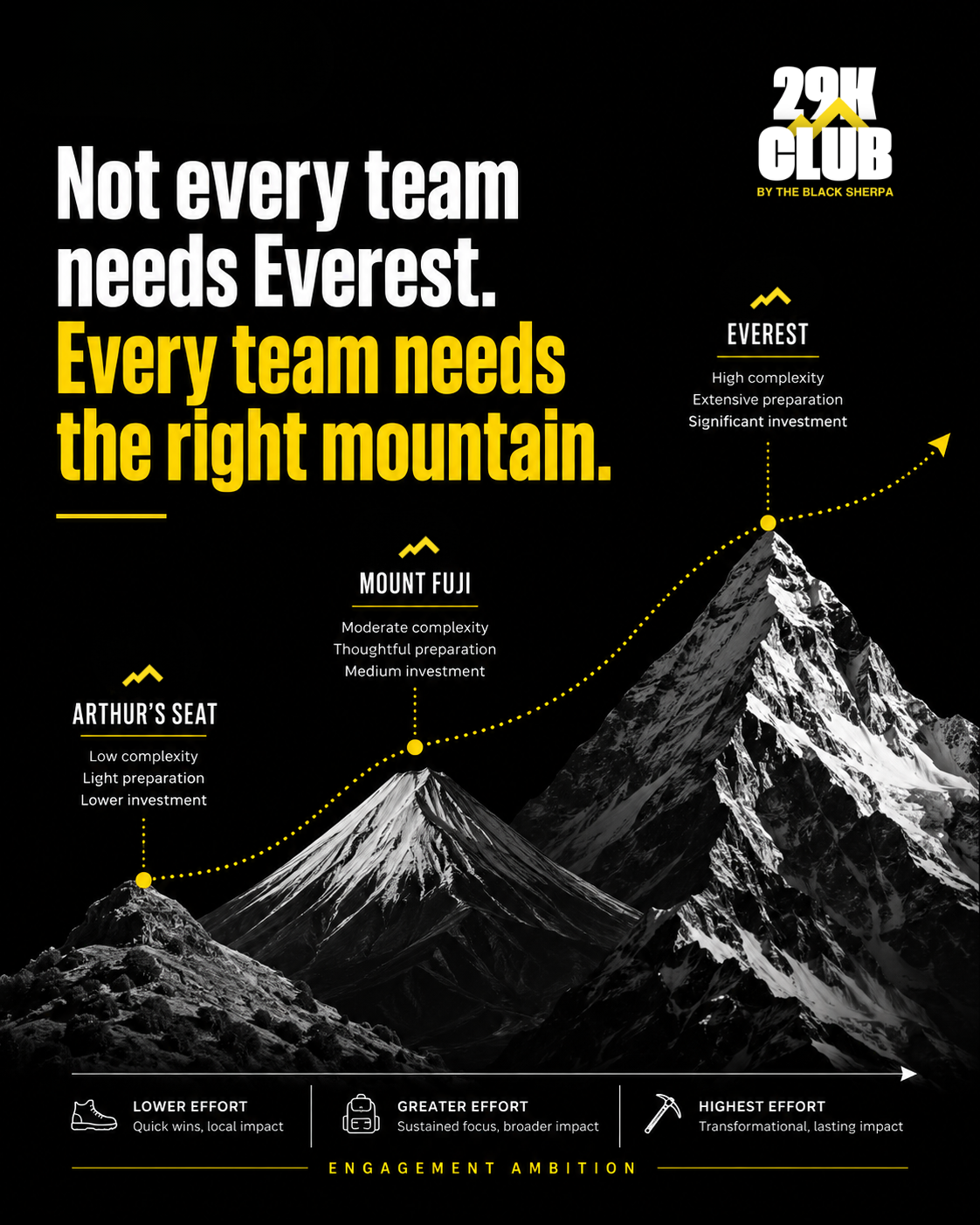
Not every engagement strategy needs to climb Everest; the smarter move is choosing the mountain your team can actually climb well
Each mountain requires a different level of preparation, investment, training and support.
The same is true of omnichannel in pharma.
A highly specialised oncology product with five treatment centres does not need the same engagement model as a broader therapy area with hundreds of HCPs. A mature product facing generics does not require the same level of investment as a major launch brand. A local affiliate does not always have the same data infrastructure, budget or people as a global team.
This is where the distinction between multichannel and omnichannel matters.
Multichannel means you have several channels available. Reps, emails, webinars, congresses, websites, HCP portals and medical education may all exist, but they may still operate separately.
Omnichannel means those channels are connected. Each touchpoint should build on the last, with the experience shaped around the needs, behaviour and context of the healthcare professional.
That sounds simple. In practice, it is hard.
Because once teams start talking about true omnichannel, they are also talking about connected data, reusable content, coordinated journeys, aligned teams, clear measurement, and the ability to respond intelligently to what HCPs actually do or need.
But too often, teams compare themselves to the biggest players in the industry. They talk about personalisation, next best action, AI personas and modular content before the foundations are in place.
Yacin’s message was freeing:
Every team needs to define its own omnichannel ambition.
That requires honest questions.
Where are we now?
What customer need are we solving?
What content do we have?
What data do we trust?
What channels can we execute well?
What would be over-engineered for our context?
The goal is not to look like you are climbing Everest.
The goal is to climb the right mountain well.
You may not need Olympic excellence. You may need above-average consistency.
Another line from Yacin deserves more attention.
He argued that the goal is not always to reach the very top of the maturity curve. In many cases, nobody in the market is really there. The goal may simply be to become above average in the things that matter: strategy, content, channels, data, measurement and communication.
That is not a lack of ambition.
It is mature ambition.
The corporate world loves words like world-class, best-in-class and transformational. But sometimes those words create pressure without clarity. Teams start chasing Olympic excellence with the budget, bandwidth and capability of someone training around a full-time job.
This is not about lowering standards. It is about choosing the standard that matches the mission, market and maturity of the team.
Yacin’s point was more useful:
Define your ambition.
Understand your resources.
Get better than average where it matters.
Do not collapse under the weight of a maturity model you cannot execute.
For professionals, that is a relief.
For leaders, it is a responsibility.
Technology will not save an immature engagement model
A sophisticated tool introduced too early does not accelerate maturity. It exposes immaturity.
Yacin used a simple analogy: buying an expensive bike will not make you faster if you have not trained. The bike might be lighter and better, but you still need the cardio, strength, skill and preparation.
That is the issue with many pharma technology investments.
Next best action does not make sense if the content strategy is not differentiated. AI personas do not help if the data foundation is weak. Modular content will not save a team that cannot agree what problem it is solving.
This is where Yacin’s mindset, skillset and toolset model becomes useful.
Mindset: What do we believe about customer engagement? Are we genuinely trying to understand HCP needs?
Skillset: Do our people have the capability to interpret data, use tools and communicate well?
Toolset: Do we have the right systems, processes, frameworks and technology?
Many organisations over-invest in toolset and under-invest in mindset and skillset.
That is how dashboards become decoration.
That is how platforms become storage cupboards.
That is how teams become busy but not effective.
The lesson is simple:
Capability before complexity.
Great HCP engagement does not feel like marketing. It feels like help.
Perhaps the most human question in the session came from Deanna:
What makes an HCP feel genuinely supported rather than marketed to?
That question cut through everything.
Yacin’s answer brought the conversation back to usefulness. Great healthcare professional engagement starts with understanding what HCPs need, not what the brand wants to say.
That could mean patient identification tools.
It could mean peer-to-peer education.
It could mean multidisciplinary learning.
It could mean better support around adherence.
It could mean safety information that helps HCPs answer patient questions with confidence.
The message pharma wants to lead with is not always the question the patient needs answered first.
Yacin made this point clearly around safety. Pharma teams often want to lead with efficacy. But patients often ask first: is it safe?
That makes safety more than a defensive message. It can be a trust-building message.
If your content helps an HCP make a better decision, it is support.
If it only pushes your message, it is promotion dressed as engagement.
That difference matters.
Because HCPs do not primarily care about your brand plan. They care about the patient in front of them, the decision they need to make and the problem they are trying to solve.
If you only listen to Key Opinion Leaders, you may miss the customer
One of Yacin’s more provocative points was about Key Opinion Leaders, often referred to as KOLs.
He was not saying KOLs do not matter. Quite the opposite. They bring expertise, data fluency and deep scientific understanding.
His point was that their expertise can be highly specialised, and therefore not always representative of everyday clinical reality.
Some KOLs know the literature inside out. They are close to the evidence, the science and the academic debate. That makes their perspective valuable. It also means their reality may not always mirror the day-to-day pressures of every HCP in clinical practice.
If KOL insight becomes the only voice shaping HCP content strategy, teams risk designing engagement for the most informed people in the system rather than the people making pressured decisions every day.
That is why Yacin encouraged teams to speak more directly with real-world HCPs and to listen properly to reps.
The rep is often closest to the live customer reaction. They hear what lands, what gets ignored, what confuses people and what HCPs actually ask when the polished meeting is over.
This is not about replacing research.
It is about widening the sources of truth.
The hidden career skill: demonstrating impact clearly
The session also moved beyond omnichannel strategy into career development.
When asked what skill will matter most for people building careers in brand, marketing, medical, digital or customer engagement, Yacin gave a very 29k Club answer.
People need to get better at demonstrating impact.
His line was sharp:
“In the corporate world, there are two things at play: demonstrating impact and the antics of pretending you are demonstrating impact.”
That is the unwritten curriculum of work.
Some people do valuable work but struggle to explain it.
Some people are excellent at making activity look like impact.
Some teams measure everything and still do not know what changed.
Reach is not always impact.
Frequency is not always impact.
Open rate is not always impact.
Attendance is not always impact.
Impact is movement over time.
A congress does not prove impact because it happened. The question is what happened before, during and after. What was the objective? Who did we reach? What follow-up happened? Did knowledge, confidence, understanding or appropriate action change over time?
For ambitious professionals, this is career-defining.
Doing the work is not the same as being able to explain the value of the work.
That is not performative self-promotion.
That is clarity.
The Omnichannel Reality Check Framework
Before your next omnichannel, brand planning or HCP engagement meeting, use this simple framework.
1. What are we trying to help HCPs understand, decide or do?
Start with the customer need, not the channel.
2. Are we building around customer need or brand ambition?
Be honest. Many plans naturally drift towards what the brand wants to say.
3. What maturity level are we actually operating at?
Single channel, multichannel, cross-channel or true omnichannel? Name reality clearly.
4. What can we execute well with the resources we have?
Do not chase ten weak channels if two strong ones would serve the customer better.
5. How will we know if this changed anything over time?
Impact is not a screenshot. It is a pattern.
This is not just an omnichannel framework.
It is a way to name reality without killing ambition.
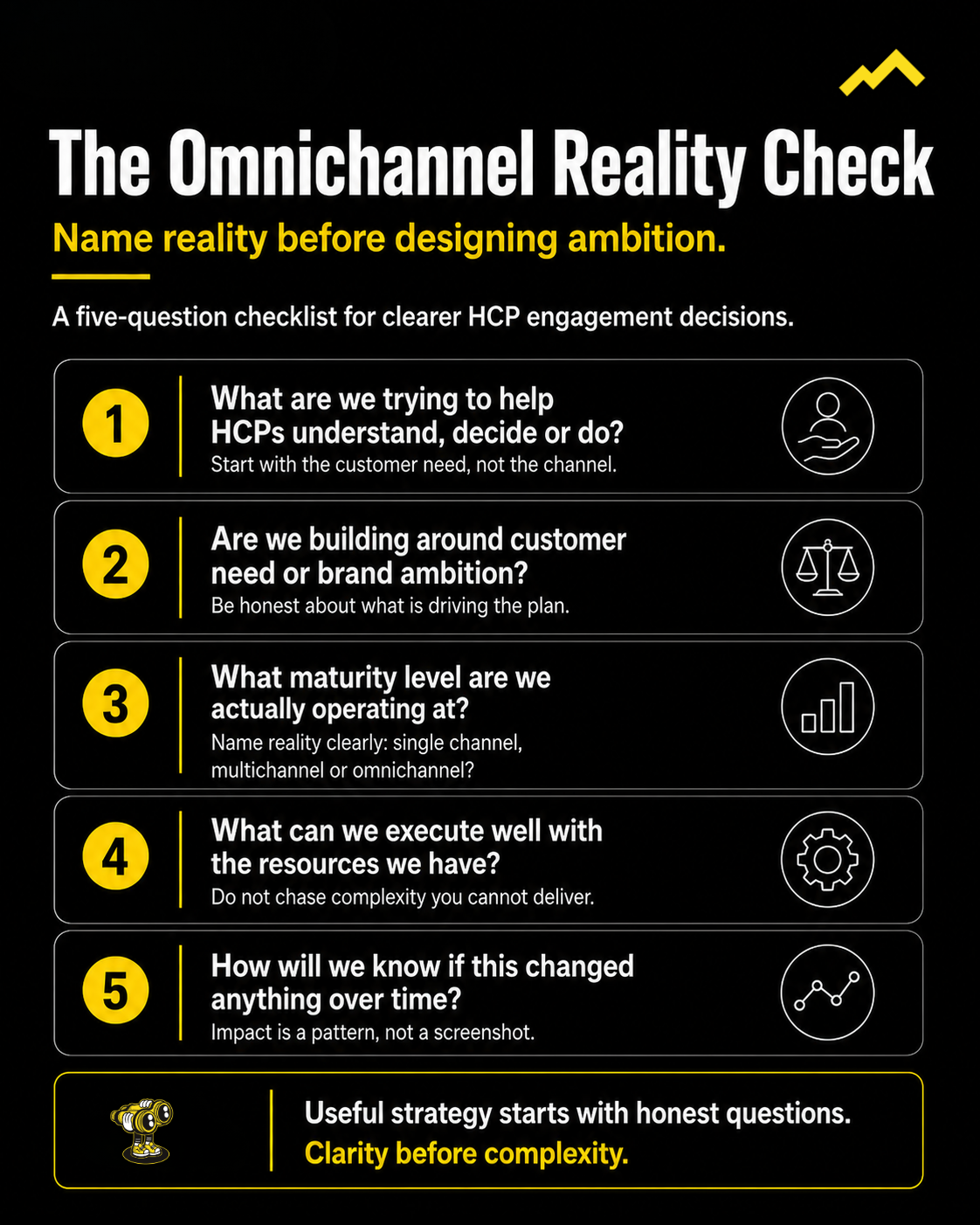
Five questions to help teams name reality before designing omnichannel ambition
Key insights to save
Omnichannel in pharma should be treated as a distribution method, not the destination.
The gap between ambition and what is actually possible is where a lot of workplace friction lives.
Naming reality is not negativity. It is strategy.
Pharma borrowed omnichannel language from retail, but HCP engagement is more complex than consumer marketing.
The 77% content figure should not be treated as a throwaway stat; it should prompt better questions about usefulness, localisation and delivery.
Every team needs to define its own omnichannel ambition based on therapy area, customer need, budget and maturity.
You may not need Olympic excellence. You may need above-average consistency.
Technology introduced too early exposes immaturity rather than creating progress.
Great HCP engagement feels like support, not marketing.
Safety is not only a defensive message. It can be a trust-building message.
If you only listen to Key Opinion Leaders (KOLs), you may miss the everyday customer reality.
Doing the work is not enough. You need to explain the value of the work.
Why ignoring this matters
If pharma keeps treating omnichannel as the destination, the risks are obvious.
More unused content.
More wasted budget.
More frustrated local teams.
More technology without adoption.
More dashboards without decisions.
More HCPs receiving messages that do not help them.
More professionals feeling the pressure to deliver maturity their system has not built.
But when teams apply this thinking properly, something better becomes possible.
Brand plans become more honest.
Medical and commercial teams align around real problems.
Content becomes more useful.
Reps become stronger insight channels.
Measurement becomes more meaningful.
HCP engagement becomes more human.
Professionals build the language to demonstrate their impact.
That is why this conversation matters beyond omnichannel.
It is about how people navigate the work behind the work.
Why this belongs inside The 29k Club
The 29k Club exists for this kind of conversation.
Not polished theory.
Not empty career advice.
Not buzzwords repeated until they sound true.
Real conversations with people who understand how work actually works.
This masterclass sat at the intersection of career development, professional growth and leadership development. It gave members language they can use in meetings, frameworks they can apply in their roles, and sharper questions they can take back into their organisations.
That is what people get in the room: not just answers, but better questions.
It is proximity to the kind of thinking that helps ambitious professionals build clarity, confidence and community while navigating the unwritten rules of work.
Sometimes the advantage is not having the loudest voice in the room.
It is knowing which question to ask next.
Connect with Yacin Marzouki
If you work in pharma, healthcare, life sciences, medical affairs, brand strategy, digital transformation or HCP engagement, Yacin Marzouki is someone to know.
Through Biond Health, he helps teams think more clearly about customer engagement, omnichannel maturity and what it really takes to build useful, credible, customer-centred strategies.
His work is especially relevant for teams tired of chasing technology without seeing better engagement, or leaders who want to move beyond generic brand plans and build something more grounded in customer need.
Follow him. Speak to him. Bring him into the right rooms.
This is a conversation more organisations need to have.
Final reflection
Before your next omnichannel meeting, ask yourself:
Are we chasing omnichannel because it is the right strategy, or because it is the language everyone expects us to use?
Do we know what HCPs actually need, or are we building engagement around what we want to say?
Can we demonstrate impact over time, or are we still confusing activity with progress?
And perhaps most importantly:
Can we name reality without killing ambition?
Do not chase the most impressive mountain.
Climb the right one 🖤
I’m Yam – Founder of The Black Sherpa
Founder | Strategist | Speaker | Host of The Black Sherpa Podcast
I founded The Black Sherpa to create a world where talent rises on merit and no one’s potential is held back by bias or barriers.
Through bold strategy, storytelling, and our flagship community, The 29k Club - I help professionals grow with confidence and support leaders to build cultures that truly live their values.
Let’s connect and build a future where inclusion powers performance, and leadership reflects the world we serve.