
Perception: Observation Vs Judgement
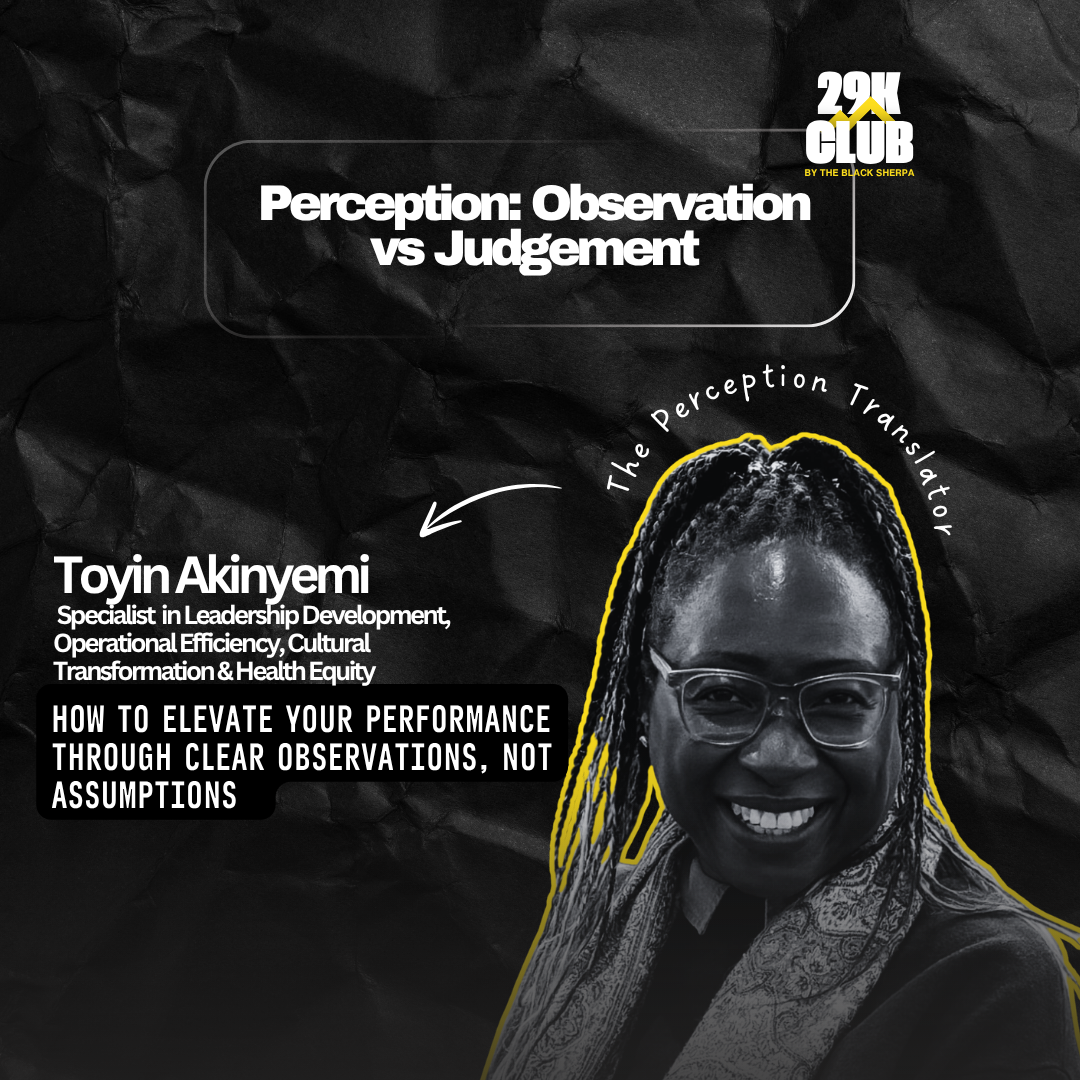
A Black Sherpa 29k Club masterclass with Toyin Akinyemi, leadership development coach and licensed Insights Discovery practitioner, exploring how observation, assumption and judgement shape perception, inclusion and opportunity at work.
Workplace Perception Bias: The Stories We Build About People Before We Really Know Them
Someone is quiet in a meeting.
So we decide they are not engaged.
Someone gives direct feedback.
So we decide they are difficult.
Someone does not smile.
So we decide they are cold, rude, unhappy, uninterested, arrogant, awkward, or “not a people person.”
Maybe.
Or maybe they are processing. Maybe they are tired. Maybe they are choosing their words carefully. Maybe they come from a culture where warmth does not always look like performance. Maybe they are neurodivergent. Maybe they are under pressure. Maybe they are the only person in the room who has noticed the thing everyone else has missed.
That was the uncomfortable brilliance of Toyin Akinyemi’s 29k Club masterclass on observation vs judgement.
It was not a fluffy conversation about being nicer at work.
It was a practical conversation about workplace perception bias: the hidden process by which we turn limited information into confident conclusions about people’s capability, confidence, character and potential.
Or, put more simply:
It was about the stories we build about people at work before we really know them.
And if we are honest, we all do it.
Why Workplace Perception Bias Matters More Than Most Organisations Admit
Most organisations talk about unconscious bias at work as if it only appears in hiring panels, promotion conversations or annual diversity training.
But workplace perception bias happens earlier than that.
It happens in the meeting before the meeting.
It happens when someone joins a Zoom call and does not speak straight away.
It happens when a colleague’s tone feels too blunt.
It happens when someone’s clothes, accent, body language, silence, confidence, nervousness or communication style becomes evidence in a case they did not know was being built against them.
And that is why this conversation matters for career progression, inclusive leadership and professional growth.
Because careers are not only shaped by performance.
They are shaped by interpretation.
People are rarely judged only on the quality of their output. They are judged on what others believe their behaviour means.
That belief can shape who gets trusted, stretched, sponsored, protected, listened to, promoted or quietly overlooked.
Toyin’s session gave the 29k Club community a simple but powerful lens:
Observation is what happened.
Assumption is what we think might explain it.
Judgement is what we decide it means.
That distinction sounds basic.
It is not.
It is one of the most important leadership development tools many professionals are never taught.
And to be clear, this is not about shaming people for making assumptions.
It is about slowing down before those assumptions become decisions.
Toyin Akinyemi: Leadership Development That Starts Before the Feedback Form
Toyin Akinyemi brought exactly the kind of energy, clarity and practical wisdom that makes people lean in.
She is a leadership development coach, licensed Insights Discovery practitioner and NLP practitioner for business. Her work sits at the intersection of leadership transformation, self-awareness, communication, behaviour change and community engagement.
But what made this session land was not the credentials alone.
It was the way she took something many people vaguely understand — perception — and made it immediately practical.
Toyin’s point of view is simple, but deeply useful:
Before you can lead people well, include people properly, or communicate with real impact, you have to understand the filters you are using to interpret them.
That matters in corporate teams.
It matters in healthcare systems.
It matters in community engagement.
It matters anywhere people are making decisions about other people with partial information.
Which is, unfortunately, everywhere.
Observation vs Judgement: The Difference That Changes Everything
One of the strongest moments in the session came when Toyin asked the group what they notice when meeting someone for the first time.
The answers were honest.
Height. Dress. Shoes. Handshake. Smile. Mannerisms. Body language. Smell. Race. Colour. Class markers. Confidence. Warmth. Attractiveness. How other people respond to them.
Then she shifted the question.
What judgements do we make?
That is where the room got interesting.
Professional or not professional. Warm or cold. Confident or shy. High status or low status. Someone we will get on with. Someone who “fits.” Someone who does not.
Toyin’s explanation was sharp:
Think police report.
Black hair. Red T-shirt. Brown shoes. No smile. Spoke twice. Arrived late.
Those are observations.
But “not interested”, “unprofessional”, “rude”, “low confidence”, “not leadership material” or “difficult” are not observations.
They are interpretations.
And the danger is that we often treat our interpretations like evidence.
That is where workplace assumptions become costly.
For individuals, the application is self-awareness. Notice when you are moving from fact to story.
For leaders, the application is discipline. Do not convert limited data into fixed labels.
For organisations, the application is culture. Build systems that challenge premature judgement before it becomes performance narrative.
The Brain Hates Gaps, So It Invents Stories
Toyin used visual exercises to show how people can look at the same thing and see something completely different.
A young woman. An old woman. A boy. Apparently, even a lion.
Same image. Different interpretations.
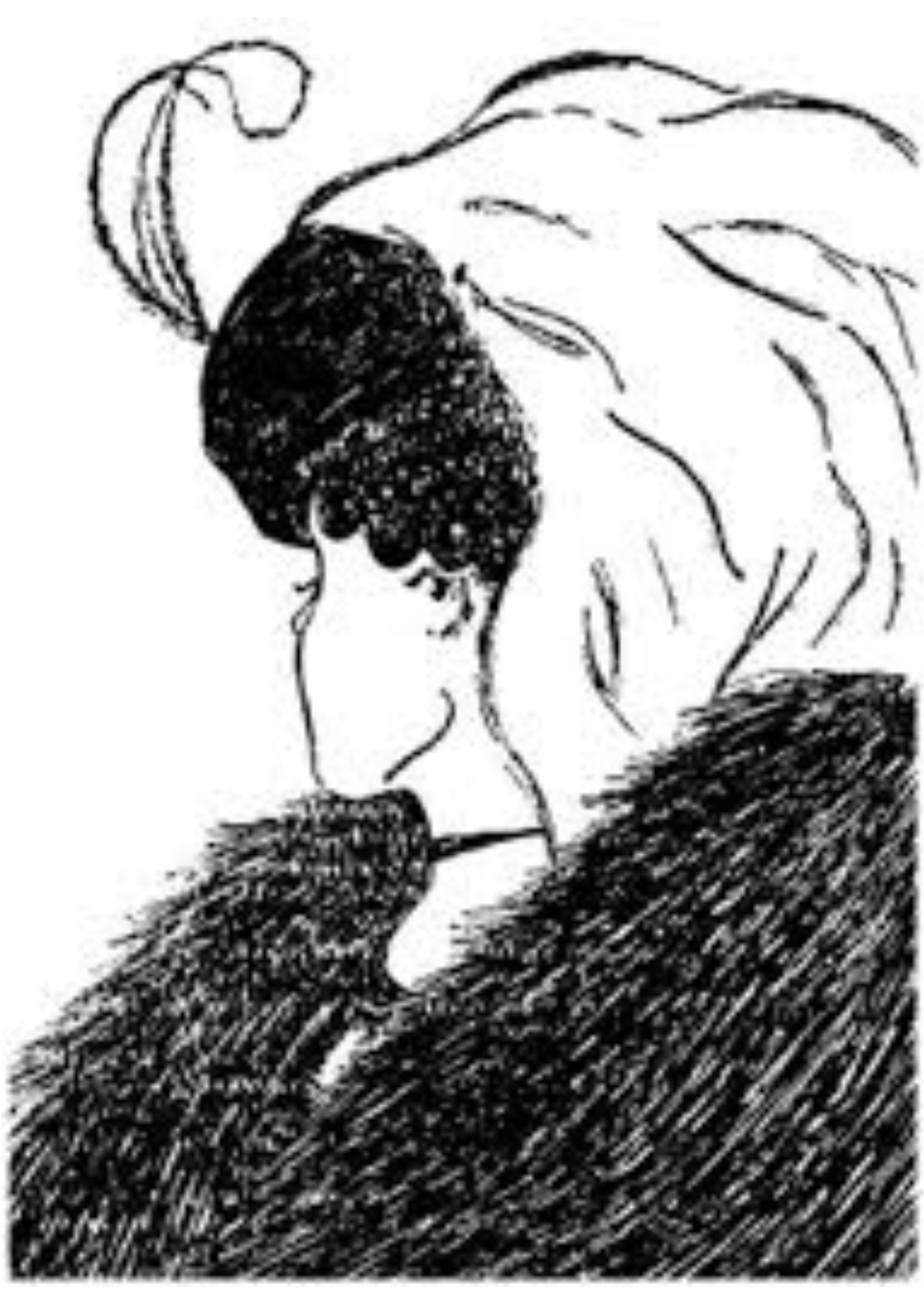
What we see first is not always the whole picture
The point was not whether people saw the “right” thing. The point was that people could look at the same data and build different realities.
But there was another layer too.
The exercise did not only reveal what people saw. It revealed how people processed and shared what they saw.
Some people named their interpretation quickly and confidently. Others needed more time. Some waited until they could see what others were seeing. Some were still trying to work out whether they saw anything at all.
That matters at work.
Because even the way someone shares their perception can become something other people interpret.
The person who speaks first may be seen as confident.
The person who pauses may be seen as unsure.
The person who needs more time may be seen as less engaged.
The person still processing may be mistaken for someone with nothing to add.
That is workplace culture in miniature.
A restructure is announced. One person sees opportunity. Another sees threat.
A new system is introduced. One person sees progress. Another sees unnecessary disruption.
A colleague pauses before answering. One person sees thoughtfulness. Another sees uncertainty.
The brain wants things to make sense. When the full picture is missing, it fills in the blanks using past experience, culture, personality, stress, fear, confidence, insecurity, social conditioning and whatever else happens to be lying around in the mental junk drawer.
That does not make us bad.
It makes us human.
But unexamined humanity can become bad leadership.
The practical question becomes:
What story am I adding to the facts?
That question alone could save teams from countless unnecessary misunderstandings.
Context Changes the Meaning of Behaviour
One of the richest parts of the masterclass was the discussion around culture and communication styles at work.
A smile does not always mean agreement.
A lack of eye contact does not always mean disengagement.
Silence does not always mean lack of confidence.
No handshake does not always mean disrespect.
Direct feedback does not always mean aggression.
And directness can be useful, but it still needs care, context and respect.
Toyin shared examples of how eye contact can be interpreted differently across cultures. In some environments, direct eye contact may signal confidence. In others, it may be read as disrespectful.
That matters.
Because many workplace norms are presented as neutral when they are actually cultural.
“Good presence.”
“Executive communication.”
“Gravitas.”
“Confidence.”
“Polish.”
“Fit.”
These words often sound objective. But they can hide highly subjective expectations about how people should speak, move, dress, challenge, respond, disagree or take up space.
Too often, workplaces mistake the dominant communication style for the professional standard.
This is particularly important for underrepresented professionals.
Not because they need fixing.
But because assumptions about confidence, communication style, polish or fit can quietly shape access to opportunity.
The burden should not sit only with underrepresented professionals to decode the room. Leaders and systems also need to examine what they reward, misread and overlook.
For individuals, the lesson is not to abandon yourself. It is to understand the room without being swallowed by it.
For leaders, the lesson is to ask: “Am I judging capability, or am I judging familiarity?”
For organisations, the lesson is to stop pretending that one style of communication equals leadership potential.
Some People Speak to Think. Others Think to Speak.
This was one of the most useful leadership development insights from the session.
Some people process out loud.
They talk their way into clarity. They start with half a thought, build it in conversation, and leave saying, “Great chat,” even if the other person barely got a word in.
Others think before speaking.
They need time. They digest. They organise. They may pause. They may not jump in immediately. They may offer the most valuable contribution after the loudest part of the conversation has already passed.
Neither style is better.
But many workplaces reward the first one more visibly.
The person who speaks quickly is often seen as confident.
The person who pauses is often seen as unsure.
The person who processes aloud is seen as engaged.
The person who processes internally is seen as quiet.
This has huge implications for psychological safety in teams.
If every meeting rewards speed, volume and instant opinion, you are not necessarily getting the best thinking.
You are getting the thinking that travels fastest.
For individuals, this means knowing your own processing style and finding ways to signal contribution.
For leaders, it means designing meetings that do not confuse airtime with value.
For organisations, it means rethinking how performance, presence and potential are recognised.
The Hidden Cost of Getting People Wrong
One of the most powerful member reflections came through a story about assumptions in real life.
A tattooed builder arrived to quote for a loft conversion, and assumptions were made before he had much chance to be known.
Years later, he became the storyteller’s husband.
It was funny. Human. Disarming.
But it also carried the whole point of the session.
The person you dismiss too quickly might be the person who changes your life.
At work, that might be the colleague you underestimate.
The candidate who does not interview in the expected style.
The employee who lacks polish but has extraordinary judgement.
The person who is quiet in meetings but brilliant in preparation.
The colleague whose directness is actually clarity.
The leader whose warmth does not look like yours.
Workplace perception bias does not just hurt feelings. It blocks possibility.
It can close doors before people have had a fair chance to walk through them.
The Observation - Assumption - Judgement Framework
The most practical framework from the session can be used immediately.
1. Observation: What happened?
Strip it back to fact.
“They did not respond to my message today.”
“They did not speak in the meeting.”
“They gave direct feedback.”
“They did not make eye contact.”
“They arrived five minutes late.”
2. Assumption: What am I making that mean?
This is where the story starts.
“They are ignoring me.”
“They are not engaged.”
“They are annoyed.”
“They lack confidence.”
“They do not respect the meeting.”
3. Judgement: What have I decided about them?
This is where it becomes dangerous.
“They are rude.”
“They are not leadership material.”
“They are difficult.”
“They are unreliable.”
“They do not fit here.”
4. Curiosity: What else could be true?
This is the interruption.
Maybe they are processing.
Maybe they are under pressure.
Maybe they misunderstood.
Maybe they are choosing their words.
Maybe they need clarity.
Maybe they are navigating something invisible.
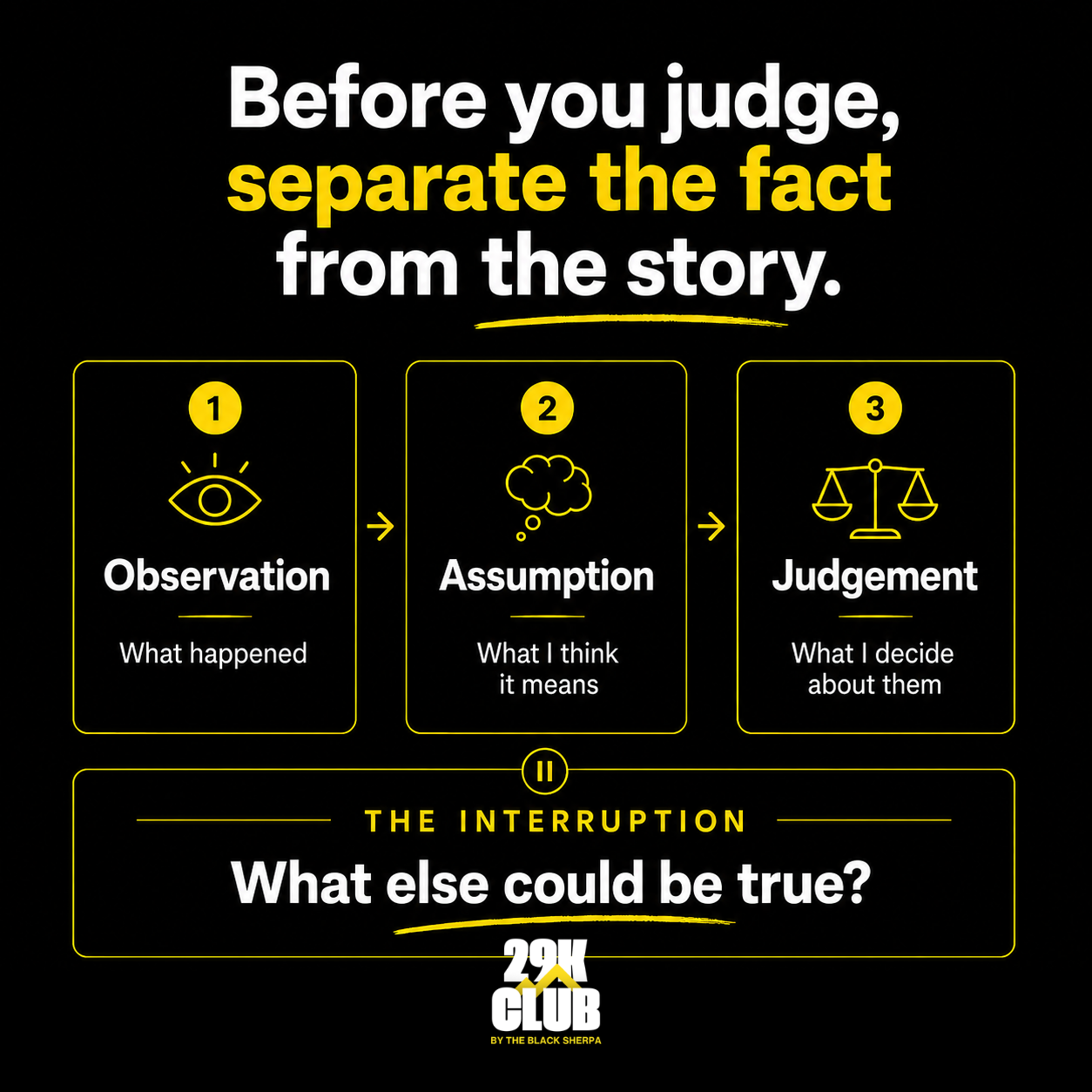
The fastest judgement is not always the fairest one
This is not about ignoring patterns. It is about refusing to build a verdict from a snapshot.
Key Insights Worth Saving
Workplace perception bias often begins before formal decisions are made.
Observation is fact; judgement is interpretation.
The brain fills gaps quickly, especially when under pressure.
A smile does not always mean agreement, and silence does not always mean disengagement.
Communication styles at work are shaped by culture, personality, neurodiversity, safety and context.
Inclusive leadership requires curiosity before conclusion.
Some people speak to think; others think to speak.
Psychological safety improves when teams stop rewarding only the fastest voices.
Assumptions about “fit” can quietly restrict career progression.
Better leadership starts with asking: “What else could be true?”
Why This Matters for Performance, Progression and Culture
Ignoring workplace perception bias is expensive.
It damages trust.
It weakens feedback.
It creates false performance narratives.
It makes talented people feel misunderstood.
It rewards familiarity over contribution.
It allows bias to hide inside language that sounds professional.
And it creates cultures where people spend more energy managing perception than doing meaningful work.
But when teams learn to separate observation from judgement, something shifts.
Feedback becomes cleaner.
Conversations become braver.
Leaders become more accurate.
People feel less boxed in by first impressions.
Difference becomes easier to understand.
And career progression becomes less dependent on whether someone naturally matches the dominant style in the room.
This is the kind of conversation most organisations say they want.
But too few create the conditions to have it properly.
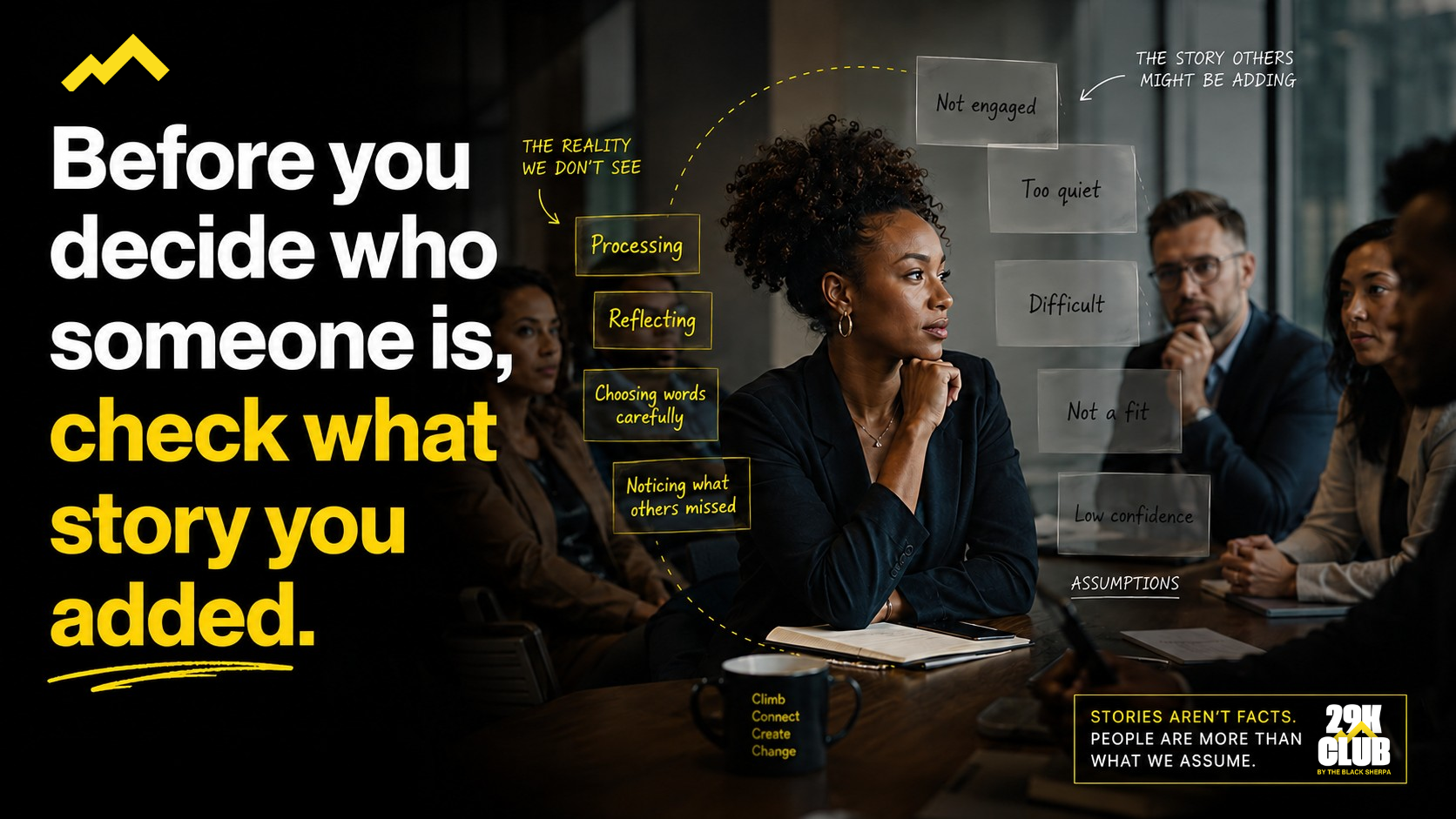
The story you tell yourself about someone can shape the opportunity they receive
Why This Conversation Belongs in the 29k Club
This is exactly why the 29k Club exists.
Not for generic career tips.
Not for motivational noise.
But for the conversations sitting underneath professional growth. The ones about confidence, context, communication, perception, access, leadership and the unwritten curriculum of work.
The hidden rules are not always written in policies.
Sometimes they live in how people interpret your silence. Your confidence. Your tone. Your clothes. Your questions. Your ambition. Your difference.
The 29k Club creates space to explore those dynamics honestly, with people who are navigating them in real time.
It is a career development community built around Clarity, Confidence and Community.
And sessions like this matter because they do not just tell people what to do.
They help people see what is really happening.
That is the work behind the work.
Connect With Toyin Akinyemi
Toyin is the kind of leadership development expert more teams should be learning from.
If you are leading teams, designing development programmes, working on inclusion, improving communication, supporting culture change, or trying to help people understand themselves and others more clearly, Toyin’s work is worth paying attention to.
She brings energy, expertise and practical tools that help people move from assumption to awareness.
And right now, that feels urgent.
Because the future of work does not just need smarter strategies.
It needs better interpretation.
See more at Ingeniumcoaching.co.uk
Final Reflection
Before your next meeting, feedback conversation or leadership decision, ask yourself:
What did I actually observe?
What am I assuming?
What else could be true?
Because sometimes the problem is not what we noticed.
It is the whole story we built around it.
Pause before you make the story permanent.
Climb steady 🖤
I’m Yam – Founder of The Black Sherpa
Founder | Strategist | Speaker | Host of The Black Sherpa Podcast
I founded The Black Sherpa to create a world where talent rises on merit and no one’s potential is held back by bias or barriers.
Through bold strategy, storytelling, and our flagship community, The 29k Club - I help professionals grow with confidence and support leaders to build cultures that truly live their values.
Let’s connect and build a future where inclusion powers performance, and leadership reflects the world we serve.