
Belonging at Work Is Not Passive: How to Become the Villager Every Community Needs
A Black Sherpa 29k Club masterclass with Vita Stimpson, community builder and advisor to mission-driven founders, exploring how intentional participation builds real belonging, influence and community at work.
Everyone wants a village until it is time to be a villager
We want the support.
The introductions.
The recommendations.
The confidence boost.
The “I know someone you should speak to” moment.
But here is the uncomfortable bit.
Many of us join communities, teams and workplaces waiting to feel included before we contribute.
Vita Stimpson gently challenged that idea in her 29k Club masterclass.
Her message was simple:
Belonging is not just something you receive. It is something you practise.
And that matters far beyond online communities.
Because your workplace is a community too.
Your team is a community.
Your industry is a community.
Your network is a community.
Your profession is a community.
This does not mean belonging is only an individual responsibility. Organisations, leaders and community builders still have a duty to create spaces that are fair, accessible and psychologically safe.
But Vita’s challenge was about agency.
In the spaces where participation is possible, what can we do to help build the village we also need?
Because sometimes, where there is enough safety to participate, you do not only think your way into belonging.
You act your way into it.
Why Belonging at Work Matters More Than Most Organisations Admit
Most organisations talk about belonging at work as if it is mainly a culture initiative.
Run a survey.
Launch a network.
Write a values statement.
Host a panel.
Hope people feel more connected.
But real workplace community is built in the small moments people often overlook.
Who gets welcomed into the room.
Who gets remembered after the meeting.
Who gets introduced to someone useful.
Who gets followed up with after sharing something difficult.
Who gets included in the informal conversation.
Who becomes known before they have to prove themselves ten times over.
This is where belonging at work becomes inseparable from career progression.
Because opportunity rarely moves through job descriptions alone.
It moves through trust.
Through familiarity.
Through relationships.
Through reputation.
Through the quiet confidence people have that you are someone worth involving.
For ambitious professionals, especially those navigating the unwritten rules of work, this matters deeply.
You can be talented and still be overlooked.
You can be capable and still be under-connected.
You can deliver great work and still not be front of mind when opportunities appear.
And to be clear, that is not always because you failed to show up properly.
Bias exists.
Exclusion exists.
Closed networks exist.
Poor leadership exists.
Some rooms are not as open as they claim to be.
That is why belonging at work has to be shared work.
Organisations have to build better rooms.
Leaders have to notice who is being left at the edge.
Communities have to be designed with care.
But individuals also deserve practical tools for the spaces that are capable of becoming healthier.
That is why this conversation landed so strongly inside The 29k Club. Vita was not just talking about “being nice” in a community. She was talking about how people build the relational capital that helps them move through rooms with more confidence, contribution and connection.
Vita Stimpson: The Community Builder Who Understands the Human Bit
Vita Stimpson works at the sharp end of online community building.
She is Head of Community for Richard Moore’s Art of Sell community and supports creators, experts and founders, including people like Matt Barker and Jacob Cass, to build membership spaces that people actually want to participate in.
That distinction matters.
It is one thing to gather people in a digital room.
It is another to create a space where people contribute, connect, return, recommend and feel part of something real.
Vita’s work sits in that gap: the human behaviour behind community growth.
I first connected with Vita after reaching out to Richard Moore to ask about community building. Richard has built a significant audience and learning ecosystem around sales excellence through Art of Sell. When I asked him about community, his response was direct: if you want to talk about that properly, speak to Vita.
That was the right steer.
Because what made Vita’s session land was not only her experience managing and advising communities. It was the fact that her understanding of belonging is personal.
After moving to the UK from Ukraine at 13, Vita learned early that belonging is not always automatic. Sometimes you have to read rooms, understand people, find allies and build a sense of safety around yourself.
That experience runs underneath her work now.
She does not talk about community as a fluffy engagement tactic. She talks about it as something people feel. Something that shapes confidence, contribution, visibility and opportunity.
Early in the session, Vita said something that made her expertise feel even more accessible:
“I’m Vita. And I’m not special.”
That line mattered.
Because the people who are best at community are not always the loudest, most senior or most polished. Often, they are the people who have learned how to notice, connect, create safety and act with intention.
That is the work Vita helps people understand.
Not how to fill a room.
How to make the room matter.
“Everyone Wants a Village, But No One Wants to Be a Villager”
The central line of the masterclass came from a phrase Vita had heard from another community builder:
“Everyone wants a village, but no one wants to be a villager.”
It stopped the room because it exposed something quietly true.
Many people want the benefits of community without the responsibility of contribution.
They want the support system.
They want the introduction.
They want the advice.
They want the opportunity.
They want the sense that someone is looking out for them.
But the village is not built by wanting it.
It is built by villagers.
Vita used “villager” as a metaphor for active participation: the person who helps create the support system they also benefit from.
A passive member waits to be impressed.
A villager brings energy.
That does not mean everyone has to be loud, extroverted or constantly visible. Vita was clear on this. Different people show up in different ways.
Some people bring energy on camera.
Some people are brilliant in the chat.
Some people ask thoughtful questions.
Some people make quiet introductions behind the scenes.
Some people consistently welcome others.
Some people listen deeply and follow up later.
The point is not to perform community.
The point is to participate in a way that is true to you.
That is a powerful lesson for workplace community too.
You do not need to become the loudest person in the room to become valuable.
But you do need to become someone who acts.
Community Building at Work Starts With Intention
One of Vita’s first practical points was simple:
Show up with intention.
Ask yourself: why am I here?
That question can feel uncomfortable because the honest answer may be personally motivated.
You may want confidence.
You may want better connections.
You may want career clarity.
You may want access to people who think differently.
You may want support through a transition.
You may want to practise showing up before you do it in a higher-stakes work environment.
That is not a bad thing.
Being clear about what you need from a community does not make your participation selfish in a negative sense. It makes it more honest.
The issue is not wanting something from a community.
The issue is wanting the benefits of the village without taking any responsibility for the village.
This is where many professional networks fall flat.
People join. They observe. They wait. They decide the space is not valuable. But they never tell anyone what they need. They never contribute to the conversation. They never follow up. They never make themselves knowable.
Then they leave, disappointed that the village did not somehow read their mind.
Vita challenged that pattern gently, but clearly.
If you want more from a community, show up with more intention.
That applies inside The 29k Club.
It applies inside your workplace.
It applies in leadership spaces, employee networks, industry events and online professional communities.
You cannot always control whether a room immediately recognises your value.
But you can decide how intentionally you enter it.
Belonging Is Shared Work
It is worth saying this clearly.
Belonging is not only the responsibility of the person trying to belong.
Leaders, organisations and community builders have a responsibility to create spaces that are fair, safe, accessible and worth participating in.
That means thinking about who feels able to speak.
Who gets interrupted.
Who has access to informal networks.
Whose ideas are taken seriously.
Who is expected to assimilate before they are included.
Who is invited into rooms where decisions are actually made.
Vita’s challenge was not about blaming individuals for exclusion.
It was about agency.
In the spaces where there is enough safety to participate, what can we do to help build the village we also need?
That distinction matters.
Because “try harder to belong” is not the message.
The message is:
Do not underestimate the power of small, intentional acts in spaces that are capable of meeting you halfway.
The Relationship-Building Framework: Notice, Remember, Follow Up
One of the most useful parts of the session was Vita’s explanation of how conversations become real relationships.
Most people are surrounded by weak conversational moments.
“Nice to meet you.”
“How’s work?”
“Great session.”
“Let’s stay in touch.”
But very few people know how to turn a moment into a relationship.
Vita’s advice was beautifully human:
Pay attention to the personal details.
Not in an intrusive way.
Not in a forced way.
Not as a networking tactic.
But because people want to feel seen, heard, remembered and valued.
Vita shared a story from Wardaha, an Art of Sell speaker with experience across brands including Airbnb and Louis Vuitton. The lesson was not about luxury service. It was about human attention.
In the story, the details that made the experience memorable were not only the obvious functional ones. They were the personal ones: the dog’s name, the reason for the gathering, the shared love of cooking, the things that made people feel seen.
That is a powerful reminder for anyone trying to build relationships at work.
After a conversation, ask yourself:
What did they mention that mattered to them?
What did they say that others might miss?
What could I follow up on that would make them feel remembered?
What connection, resource or encouragement could genuinely help?
This is relationship intelligence.
For individuals, it builds trust.
For leaders, it builds psychological safety.
For organisations, it creates cultures where people feel like humans, not job titles.
The framework is simple:
Notice. Remember. Follow up.
That is how a conversation becomes a relationship.
And relationships are where so much of career development really happens.
The Power Move: Connect Two People
One of the strongest moments in the session came when the group reflected on simple actions members could take inside a community.
The one that stood out was this:
Connect two people.
Not you connecting with two people.
You connecting two other people.
That is a different level of professional networking.
It says: “I am paying attention to the room.”
It says: “I understand what people need.”
It says: “I am willing to create value even when I am not the centre of it.”
Many people approach networking as a personal extraction exercise.
Who can help me?
Who can open a door for me?
Who can give me advice?
Who can get me closer to the opportunity?
Those questions are not wrong.
Self-advocacy matters, especially in systems where good work is not always noticed fairly.
But the people who become genuinely valued in a network often do something else alongside advocating for themselves.
They connect people to ideas.
People to people.
People to opportunities.
People to encouragement.
People to rooms they did not know existed.
That is how you become known as someone who strengthens the ecosystem.
For ambitious professionals, this matters because reputation is not only built on what you achieve. It is also built on what happens around you because you were there.
Do people leave stronger?
Clearer?
More connected?
More confident?
More resourced?
If yes, you are not just in the village.
You are building it.
The VILLAGE Framework: A Practical Checklist for Belonging at Work
Belonging is easier to talk about than practise.
That is why Vita’s session was so useful. It did not leave the idea of community floating in the air as a warm concept. It brought it back to behaviour.
So if you want to become a better villager in any community, including your workplace, start with the VILLAGE Framework.
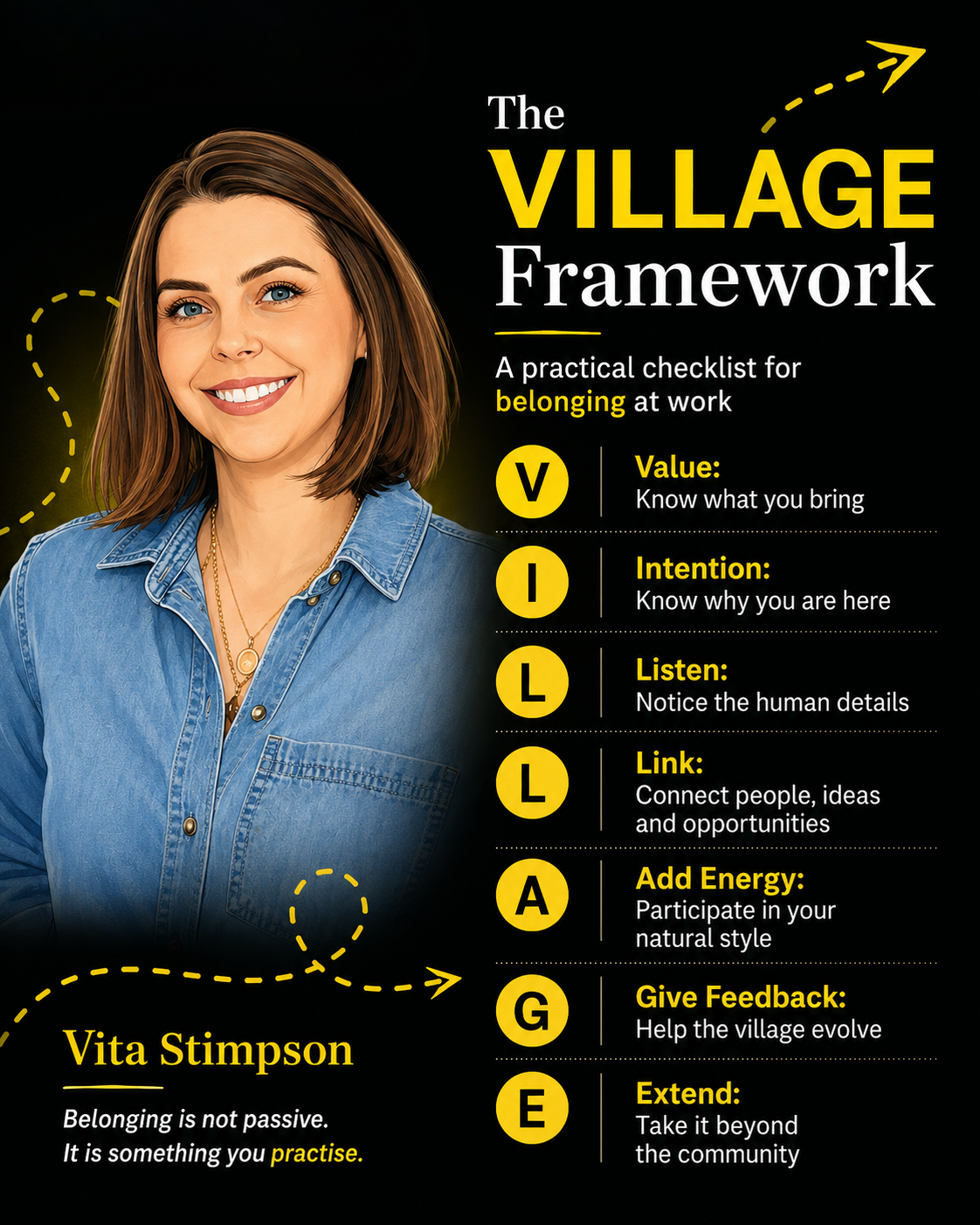
A practical checklist for building belonging at work through intentional community participation.
V — Value: Know what you bring
Before you can contribute well, get clear on what you can offer.
That does not mean pretending to be the expert in the room. It means recognising that your experience, perspective, encouragement, curiosity and connections may be useful to someone else.
Ask yourself:
What experience, knowledge or perspective do I bring?
What have I learned that might help someone else?
What kind of problems do people often come to me with?
Where can I be useful without needing to be the expert on everything?
Action: Add a short introduction or reintroduction in the community. Share who you are, what you are working on, what you can help with and what you are curious about.
At work, this might look like being clearer in a team meeting about the kind of work you want to contribute to, or letting people know where your strengths are beyond your job title.
People cannot easily connect you to what they do not know you care about.
And in imperfect systems, making your value visible is one way to give others less room to miss it.
I — Intention: Know why you are here
Vita’s point about intention matters because many people enter communities passively.
They join, look around, wait for value to arrive and then quietly decide whether the space is “worth it”.
A better question is:
What am I here to practise, learn or build?
Ask yourself:
What do I want from this community?
What am I hoping to learn, practise or explore?
What kind of people would be useful for me to connect with?
Where do I need more clarity, confidence or support?
Action: Write down one thing you want to get from the community this month.
That small act changes how you show up.
If you know you want to build confidence, you may ask more questions.
If you know you want career clarity, you may join the mentoring circle.
If you know you want to expand your network, you may make one thoughtful introduction each week.
If you know you want to practise visibility, you may start contributing before you feel fully ready.
Intention turns participation into development.
L — Listen: Notice the human details
Relationships grow when people feel seen, heard, remembered and valued.
That is not about collecting personal facts like a CRM system.
It is about paying attention.
Ask yourself:
What did someone mention that mattered to them?
What challenge, goal or moment did they share?
What did they say that others might miss?
What could I remember and follow up on later?
Action: Follow up with one person this week about something they mentioned previously.
This might be a presentation they were nervous about.
A job interview they were preparing for.
A difficult conversation they were working through.
A personal milestone they shared.
A project they cared about.
The follow-up does not have to be dramatic.
Sometimes it is as simple as:
“I remembered you had that conversation this week. Hope it went okay.”
That is how people feel held without being smothered.
It is also how trust quietly builds.
L — Link: Connect people, ideas and opportunities
This is the power move.
If you want to become valuable in a community, become someone who connects dots.
Ask yourself:
Who in this community should know each other?
Who has solved a problem someone else is facing?
What resource, event, person or idea could help someone move forward?
Where can I create value without needing to be the centre of it?
Action: Make one thoughtful introduction between two people.
A thoughtful introduction is not simply throwing two names into a chat and hoping for the best.
It gives context.
Try:
“I thought you two should connect because you are both exploring similar challenges around interview preparation. No pressure either way, but I think there could be a useful conversation here.”
Or:
“You mentioned you were trying to understand market access. I know someone in the community who has worked in that space and might be willing to share some perspective.”
This is how community becomes more than content.
It becomes movement.
A — Add Energy: Participate in your natural style
You do not need to be loud.
But you do need to be present.
One of the strongest points Vita made was that different people contribute differently. Some bring visible energy. Some bring thoughtful questions. Some bring humour. Some bring careful listening. Some bring structure. Some bring challenge. Some bring encouragement.
All of it can matter.
Ask yourself:
How do I naturally contribute best?
Am I a question asker, encourager, connector, reflector, challenger or organiser?
Where am I waiting to be invited when I could simply take part?
Action: Comment on one post, ask one question, celebrate one win or attend one live session with intention.
The aim is not to become someone else.
The aim is to stop hiding the useful parts of who you already are.
At work, adding energy might mean asking the question others are avoiding.
It might mean recognising someone’s contribution.
It might mean bringing a helpful resource.
It might mean making the meeting feel more human.
Energy is not always volume.
Sometimes energy is care.
G — Give Feedback: Help the village evolve
If something is not working, do not just disappear.
Help shape it.
This was one of the strongest tensions in the session. Sometimes people leave communities, teams or networks because something did not work for them, but they never gave the space a chance to improve.
Of course, some spaces are not right. Some are poorly run. Some are unhealthy. Some should be left.
But often, there is a step before exit.
Useful feedback.
Ask yourself:
What is working well?
What could be better?
What am I waiting for that I could help create?
Is my feedback constructive, specific and offered with care?
Action: Share one useful suggestion with the community host, group lead or team.
That might sound like:
“I’m finding the sessions useful, but I’d love more chances to connect with people afterwards.”
Or:
“I think a smaller group around interview practice could be really useful. I’d be happy to help get it started.”
Or:
“I’m not sure I’ve found my way into the community yet. Is there a good place you’d suggest I start?”
Feedback offered with care is not criticism.
It is contribution.
E — Extend: Take it beyond the community
The workplace is a village too.
This is the part that matters most.
The point of a community like The 29k Club is not just to become better at participating in The 29k Club. It is to practise behaviours that transfer into work, leadership, relationships and opportunity.
Ask yourself:
Where could I apply this at work?
Who needs to feel more welcomed, seen or remembered?
What relationship have I left at “nice conversation” level?
Where could I become more useful, visible or trusted?
Action: Take one villager behaviour into your workplace this week.
Welcome the new starter.
Follow up with the colleague who seemed quieter than usual.
Connect two people working on similar challenges.
Share useful context with someone outside the inner circle.
Ask the question that helps someone else contribute.
Celebrate someone whose work is usually invisible.
A village is not built by one big gesture.
It is built through small, repeated signals of care, contribution and consistency.
That is true in communities.
It is true in workplaces.
It is true in careers.
The Chat Is Not Always a Distraction
One of the most revealing reflections came after the session, when Vita spoke about the energy in the chat.
Many facilitators worry when the chat is busy.
They see it as noise.
Distraction.
Loss of control.
A sign that people are not paying attention.
Vita saw something different.
She saw people bonding.
The side jokes, reactions, questions and comments were not taking away from the session. They were evidence that people felt safe enough to participate in their own way.
That is an important lesson for anyone leading virtual communities, workplace learning sessions or online masterclasses.
Engagement does not always look like one person speaking at a time.
Sometimes community is happening in the margins.
The chat can be where people test an idea.
Where someone feels brave enough to add a comment.
Where humour creates safety.
Where members recognise each other.
Where the formal session becomes a shared experience.
For leaders, this is worth paying attention to.
If your only measure of engagement is who speaks out loud, you may miss the quieter ways people are connecting.
A healthy workplace community creates more than one route into participation.
Culture Is Not Built by Rules. It Is Built by Osmosis.
Another important thread was the role of rules in community.
Many leaders ask: what rules do we need to enforce behaviour?
Vita offered a different lens.
The strongest communities often teach people how to behave through observation. Through tone. Through repeated signals. Through what gets welcomed, modelled and protected.
As she put it, when you walk into a restaurant, you do not need a long list of instructions telling you to sit down, use cutlery and not splash around on the floor. You understand the norms because you observe them.
Community culture works the same way.
New members learn quickly:
Do people say hello here?
Do people celebrate each other?
Do people ask thoughtful questions?
Do people challenge respectfully?
Do people share honestly?
Do people follow up?
Do people protect the tone of the space?
This is culture by osmosis.
For leaders, this is a critical lesson.
You cannot outsource culture to a code of conduct. You have to model it until it becomes recognisable.
For individuals, it is a reminder that you are always shaping the room.
Even silence shapes culture.
Even a like shapes culture.
Even a welcome message shapes culture.
Even the way you disagree shapes culture.
The question is not whether you influence the community.
The question is what kind of influence you are having.
Care Without Overstepping: Awareness, Not Intrusion
One of the most practical questions came from Wadsi, who asked how you take a personal interest in someone without blurring professional boundaries.
That question matters because many people want to be more human at work, but worry about overstepping.
Vita’s answer was subtle and useful.
You do not need to become someone’s therapist to show care.
You do not need to ask for every detail.
You do not need to make their private situation the centre of every future conversation.
You do not need to force intimacy.
Sometimes the most powerful thing you can do is acknowledge what someone shared, show you remembered, and give them space.
For example:
“I know last time we spoke things were a bit heavy. I hope things are easing a little.”
Then move forward.
That is care without intrusion.
It is awareness, not overstepping.
For managers, mentors, colleagues and community members, this distinction is vital. Psychological safety is not created by prying. It is created when people feel they can be human without losing control of their own story.
That is a skill.
And like most relational skills, it is built through practice.
What To Do With the Occasional Donut
As Nick jokingly put it in the session, every community eventually meets the occasional donut.
The person who disrupts the rhythm.
The person who ignores the norms.
The person who pulls too much energy.
The person who risks dragging the culture away from what makes it work.
Nick brought this to life through the story of F3, an early-morning fitness community that meets in car parks and runs on shared standards, rituals and accountability.
His question was serious:
How do you protect the standards of a community when someone is not living by them?
Vita’s response became a useful mini-framework:
Remove. Redirect. Bring back into the fold.
In other words:
Do not immediately turn it into public drama.
Where possible, take the person aside.
Stay calm.
Avoid adding fuel.
Remind them what the space is about.
Show them the value of the culture.
Give them a route back in.
This is a helpful leadership development lesson too.
Protecting culture does not always mean publicly calling someone out. Sometimes it means having the courage to realign someone privately before resentment spreads.
Of course, some behaviours require firmer boundaries.
But not every misstep needs to become a spectacle.
Healthy communities need both grace and standards.
Villages Within Villages: Why Smaller Circles Matter
Another strong question came from Lucy, who asked how smaller communities can form inside a bigger, more diverse community.
That question matters because many organisations face the same tension.
How do you create belonging across difference?
How do you build one shared culture without flattening people into one identity?
How do you allow smaller groups to form without creating exclusion?
Vita’s answer was that villages within villages are natural.
We are not one thing.
We may be professionals, parents, runners, carers, creatives, neurodivergent thinkers, leaders, job seekers, mentors, introverts, extroverts and learners all at once.
Inside a larger community, smaller circles will naturally emerge around shared experiences, identities, working styles or development goals.
That might look like interview practice groups.
Wellbeing circles.
Leadership conversations.
Parenting discussions.
Industry-specific spaces.
Neurodiversity conversations.
Accountability groups.
Peer mentoring pods.
The key is that these smaller villages should be additive, not exclusive.
It is and, not or.
That distinction matters for any organisation trying to build belonging at work.
People need shared purpose, but they also need spaces where specific experiences can be understood more deeply.
The strongest communities make room for both.
When Community Is Not Working: Build, Adapt or Leave?
Vita also addressed a more uncomfortable question.
What happens when a community is not giving you what you hoped for?
Her advice was balanced and mature.
First, observe.
Then participate.
Then ask for help.
Then give feedback.
Then decide.
If you feel disconnected, it may be worth asking whether the space has failed you, whether you have not yet found your way in, or whether both things are true.
It may be that onboarding missed something.
It may be that the structure is unclear.
It may be that you have not yet taken a step in.
It may be that the founder or host would genuinely want to help but does not know what you need.
It may also be that the space is simply not right for you.
That is where feedback becomes a form of contribution.
Not destructive criticism.
Not silent resentment.
Not disappearing without a word.
But honest, constructive feedback that gives the space a chance to evolve.
This matters inside organisations too.
People often disengage before they communicate.
They withdraw from teams, networks, employee groups or development programmes because something did not land. Sometimes leaving is right. Some spaces are unhealthy, unsafe, neglected or simply not right for you.
But often, there is a middle step:
Speak up while there is still something to build.
Healthy community is a living organism.
It changes because the people inside it care enough to shape it.
The 7-Day Villager Checklist
If the VILLAGE Framework gives you the model, this checklist gives you the first week.
Do not overthink it.
Pick one small action each day.
Day 1: Reintroduce yourself
Share who you are, what you are working on, what you can offer and what you need.
This does not need to be polished. It just needs to make you easier to know.
Day 2: Welcome someone
Say hello to a new member, a quieter colleague or someone who has recently shown up.
Belonging often starts with being acknowledged.
Day 3: Follow up properly
Message someone about something they mentioned before.
Make them feel remembered.
Day 4: Connect two people
Introduce two people who could help, encourage or challenge each other.
Add context so the introduction feels thoughtful.
Day 5: Celebrate a win
Publicly or privately acknowledge someone’s progress.
Celebration creates energy. It also teaches people what the community values.
Day 6: Add to the conversation
Reply with more than “great post”.
Share what it made you think, feel, question or reconsider.
Day 7: Take it to work
Use one of these behaviours in your team, organisation or wider network.
Because the workplace is a village too.
This checklist will not transform a community overnight.
But it will change your relationship with it.
You stop waiting for the village to prove itself.
You begin practising the behaviours that make the village real.
Proximity Is the Privilege
One of the reasons this conversation matters so much to The 29k Club is because proximity is one of the biggest hidden advantages in modern careers.
Proximity to real people.
Real decisions.
Real mistakes.
Real conversations.
Real challenges.
Real solutions.
Some professionals get that proximity early because they are recognised as talent, sponsored well, mentored informally or already close to power.
Many capable people do not.
They are left trying to decode workplace dynamics from the outside.
They do the work, but miss the context.
They attend the meeting, but miss the pre-meeting.
They hear the announcement, but not the conversation that shaped it.
They get feedback, but not the real interpretation.
They are told to network, but not shown how trust is actually built.
The 29k Club exists to close that gap.
Not by pretending there is one magic answer.
But by creating a room where ambitious professionals can practise the conversations, behaviours and relationship skills that often sit behind career progression.
This is why Vita’s session mattered.
It was not only about community engagement.
It was about the work behind the work.
The 29k Club: Practising the Unwritten Rules of Work
The 29k Club is not just a content library or a calendar of masterclasses.
It is a career development community for ambitious professionals who want to understand the unwritten rules of work.
The hidden curriculum.
The informal relationship dynamics.
The confidence gaps.
The visibility challenges.
The conversations people are not always taught how to have.
Our three core pillars are Clarity, Confidence and Community.
This session sat beautifully at the intersection of all three.
Clarity: What do I actually want from this room?
Confidence: How do I show up in a way that feels true to me?
Community: How do I help build the village I want to benefit from?
That is the work.
Not passive development.
Not performative networking.
Not pretending everyone has it figured out.
Real conversations.
Real people.
Real application.
The kind of room where members can practise the behaviours that help them navigate work with more intention.
Key Insights: How to Become a Better Villager at Work
Belonging is not passive. It is shaped by small, repeated behaviours: showing up, welcoming, remembering, connecting and following up
Belonging is shared work. Leaders and organisations must build fair, safe spaces, but individuals still have agency in how they participate
The best networking is not just who you know. It is who you connect, who you support and what becomes possible because you were in the room
Relationships grow through human attention. People remember when they feel seen, heard, valued and followed up with
Quiet consistency counts. You do not need to be the loudest person in the community to become one of the most trusted
Culture is built by osmosis. People learn what a community values by watching what gets welcomed, repeated and protected
The workplace is a village too. The same behaviours that build community also build trust, visibility, influence and career opportunity
Why You Should Connect With Vita
If you are building an online community, membership space, learning ecosystem or professional network, Vita Stimpson is someone worth paying attention to.
She understands the infrastructure of community.
But more importantly, she understands the human behaviour that makes community work.
She helps founders, creators and experts think about how people enter a space, participate in it, connect with each other and keep coming back because they feel part of something real.
Her work with Richard Moore’s Art of Sell community, and her support for people such as Matt Barker and Jacob Cass, shows the breadth of spaces where this thinking matters.
Because community is not only about platforms, posts or programming.
It is about whether people feel enough trust, clarity and connection to contribute.
If your community has members but no energy, content but no connection, or ambition but no culture, Vita’s perspective is one to seek out.
Follow her on LinkedIn.
Start a conversation.
Invite her into your thinking.
Collaborate with her if you are serious about building a community people actually want to be part of.
The internet does not need more rooms people join and quietly abandon.
It needs better villages.
Final Reflection: What Kind of Villager Are You?
So here are the questions worth sitting with:
Where are you waiting for belonging at work instead of helping to create it?
Who could you follow up with, remember or reconnect with this week?
What small action would make you more valuable in the communities you are already part of?
You do not need to become louder.
You do not need to perform.
You do not need to become someone else.
But where there is enough safety to participate, you do need to act.
Because everyone wants the village.
The work is becoming a villager.
Climb steady 🖤
I’m Yam – Founder of The Black Sherpa
Founder | Strategist | Speaker | Host of The Black Sherpa Podcast
I founded The Black Sherpa to create a world where talent rises on merit and no one’s potential is held back by bias or barriers.
Through bold strategy, storytelling, and our flagship community, The 29k Club - I help professionals grow with confidence and support leaders to build cultures that truly live their values.
Let’s connect and build a future where inclusion powers performance, and leadership reflects the world we serve.