
Workplace Wellbeing Toolkit: Stop Trying to Become a Better Robot
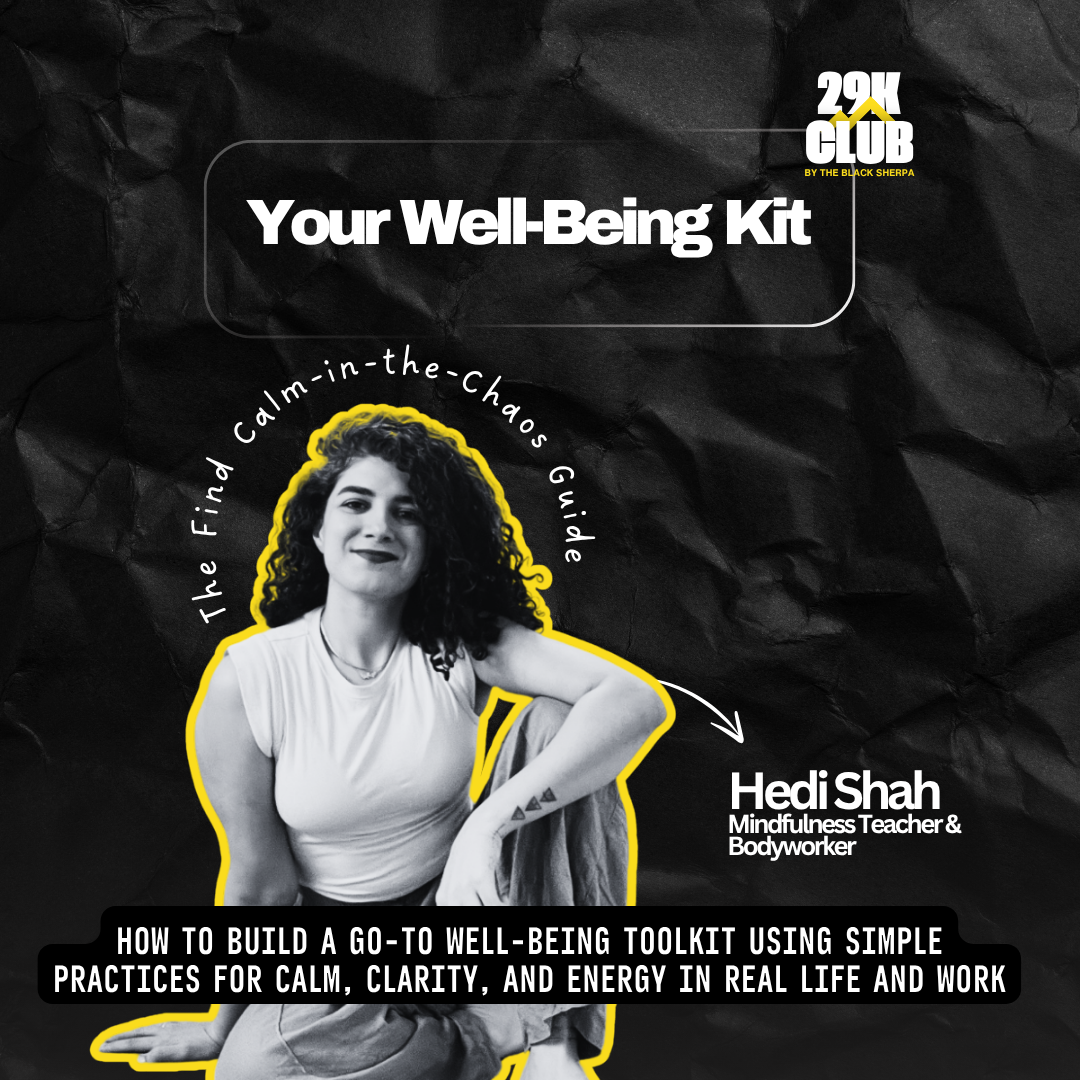
A Black Sherpa 29k Club masterclass with Hedi Shah, mindfulness teacher and bodyworker, helping professionals build a practical wellbeing toolkit for calm, clarity and sustainable energy in life and work.
“This is going to feel weird”
That was basically the warning before Hedi Shah started.
And that was exactly why the session mattered.
Because a lot of workplace wellbeing conversations still feel too clean. Too corporate. Too sanitised. They talk about resilience while ignoring exhaustion. They talk about performance while ignoring the body carrying the pressure. They talk about self-care as if people are failing because they haven’t downloaded the right app, bought the right journal or found the perfect morning routine.
But this 29k Club masterclass was different.
It was Friday. People were joining with full lives in the background. Work to finish. Children to ferry around. Parents to care for. Fish and chips eaten. Weekends to prepare for. Nervous systems that had probably done more than they had been thanked for.
And then Hedi landed one of the simplest, most uncomfortable truths of the whole session:
“Rest is a genuine need… not a reward.”
That was the conversation.
Not how do we become more productive robots?
But how do we stop abandoning ourselves in the name of being useful?
Why Workplace Wellbeing Matters More Than Most Organisations Admit
Workplace wellbeing is often treated like a side conversation.
A lunchtime webinar.
A meditation app.
A poster near the kitchen.
A polite reminder to “take breaks” in a culture that rewards people for never really switching off.
But the real challenge is deeper.
A lot of professionals, especially in demanding corporate, scientific, healthcare, life sciences and leadership environments, have been trained to push through. To perform. To be responsive. To stay useful. To ignore discomfort until it becomes unavoidable.
That has consequences.
Because people are not job titles.
They arrive at development sessions as carers, parents, founders, employees, partners, leaders, tired humans and people trying to hold several lives together at once.
The point is not to celebrate people carrying impossible loads. It is to recognise the reality many professionals are already carrying into work.
And yet, so much professional development still behaves as though people are simply brains on Zoom.
Better strategy.
Better confidence.
Better communication.
Better stakeholder management.
Better executive presence.
All useful.
But if your body is exhausted, tense, overloaded or disconnected, even the best strategy has a cost.
That is why this conversation matters.
Because sustainable performance is not about becoming a better robot.
It is about remembering you are not one.
And importantly, this is not about telling individuals to breathe their way through broken systems. Individual regulation matters. But it cannot compensate for chronically unrealistic workloads, poor boundaries, psychological unsafety or cultures that reward over-functioning.
The stronger question is not only:
“How do people cope better?”
It is also:
“What kind of work are we asking people to cope with?”
Meet Hedi Shah: The Practitioner Helping People Return to Their Bodies
Hedi works across nervous system regulation, breathwork, posture-focused strength training, active rehabilitation and embodied wellbeing.
But what made this session powerful was not just the toolkit.
It was the point of view.
Hedi was not selling wellbeing as another “should”. In fact, she challenged the entire culture of shoulds and shouldn’ts. Most people already know they “should” move more, breathe better, rest properly, meditate, eat well, take breaks and stop scrolling.
The problem is not always knowledge.
The problem is disconnection.
Hedi supports people who have tried many different things but still feel stuck, in pain, overloaded, exhausted or disconnected from themselves. Her work helps people understand what their body may have been trying to communicate… and gives them practical ways to listen before the body has to shout.
That matters now because the modern workplace is full of people who look functional but feel fried.
People who are still delivering, still showing up, still answering emails, still being helpful, still being “resilient”…
…but quietly losing access to themselves.
Hedi’s work is a reminder that workplace wellbeing is not a luxury. It is not softness for people who cannot cope.
It is part of the foundation of sustainable performance.
Her work gives people simple, body-based practices they can use before, during and after demanding work… not as a clinical cure or a magic fix, but as supportive tools for reconnecting with the body, regulating energy and creating more choice in how they show up.
Rest Is Not a Reward for Good Behaviour
One of the most powerful reflections in the room came from Carol, who said she wanted to remind herself that rest is a genuine need, not something you earn after doing enough.
That line deserves to be taken seriously.
Because many high performers, high carers and high-capacity people have absorbed a dangerous idea:
Once I finish enough, then I can rest.
But enough never arrives.
There is always another email.
Another meeting.
Another deadline.
Another person to support.
Another opportunity to chase.
Another standard to meet.
Another version of yourself you are trying to become.
So rest gets pushed further and further away.
But you do not earn hydration.
You do not earn sleep.
You do not earn food.
You do not earn recovery.
You need those things because you are human.
This is where workplace wellbeing gets uncomfortable. Because the issue is not simply that people are busy. It is that many people have moralised exhaustion.
If I am tired, I must not be disciplined enough.
If I need rest, I must not be committed enough.
If I slow down, I might fall behind.
If I stop holding everything, something might collapse.
But rest is not the opposite of ambition.
Rest is one of the conditions that makes ambition sustainable.
Individual application
Ask yourself: where am I treating rest like a reward rather than a requirement?
Leadership application
Notice whether your team culture praises recovery or only praises responsiveness.
Organisational application
Stop outsourcing wellbeing to individuals while designing work in ways that make recovery difficult.
The Hidden Workplace Wellbeing Problem: We Optimise Everything Except Our Energy
Hedi opened by naming a contradiction many people recognised immediately.
You can meditate.
You can go to the gym.
You can walk.
You can eat well.
You can have a “wellbeing routine”.
And still reach the end of the working day feeling numb, dissociated and unavailable for the rest of your life.
That is especially relevant in hybrid and remote work.
The modern home-working professional can move from Teams call to Teams call, Slack message to email, proposal to spreadsheet, without ever really transitioning between moments.
The commute disappeared for many people, but so did some of the natural decompression that came with it.
No corridor walk.
No train platform pause.
No change of environment.
No embodied signal that one thing has ended and another has begun.
So the body stays in work mode.
Even when the laptop closes.
And this is where the conversation became very real.
If You Ignore Your Body at 11am, It Will Invoice You at 6pm
One of the most painfully relatable moments was Hedi naming the absurdity of how many people delay basic needs.
You are hungry, but you just need to finish this.
You are tense, but you just need to get through the next meeting.
You are exhausted, but you just need to push to the end of the day.
Then 6pm arrives and you wonder why you feel awful.
That is not a mystery.
That is an invoice.
Your body has been making requests all day.
You just kept declining the meeting.
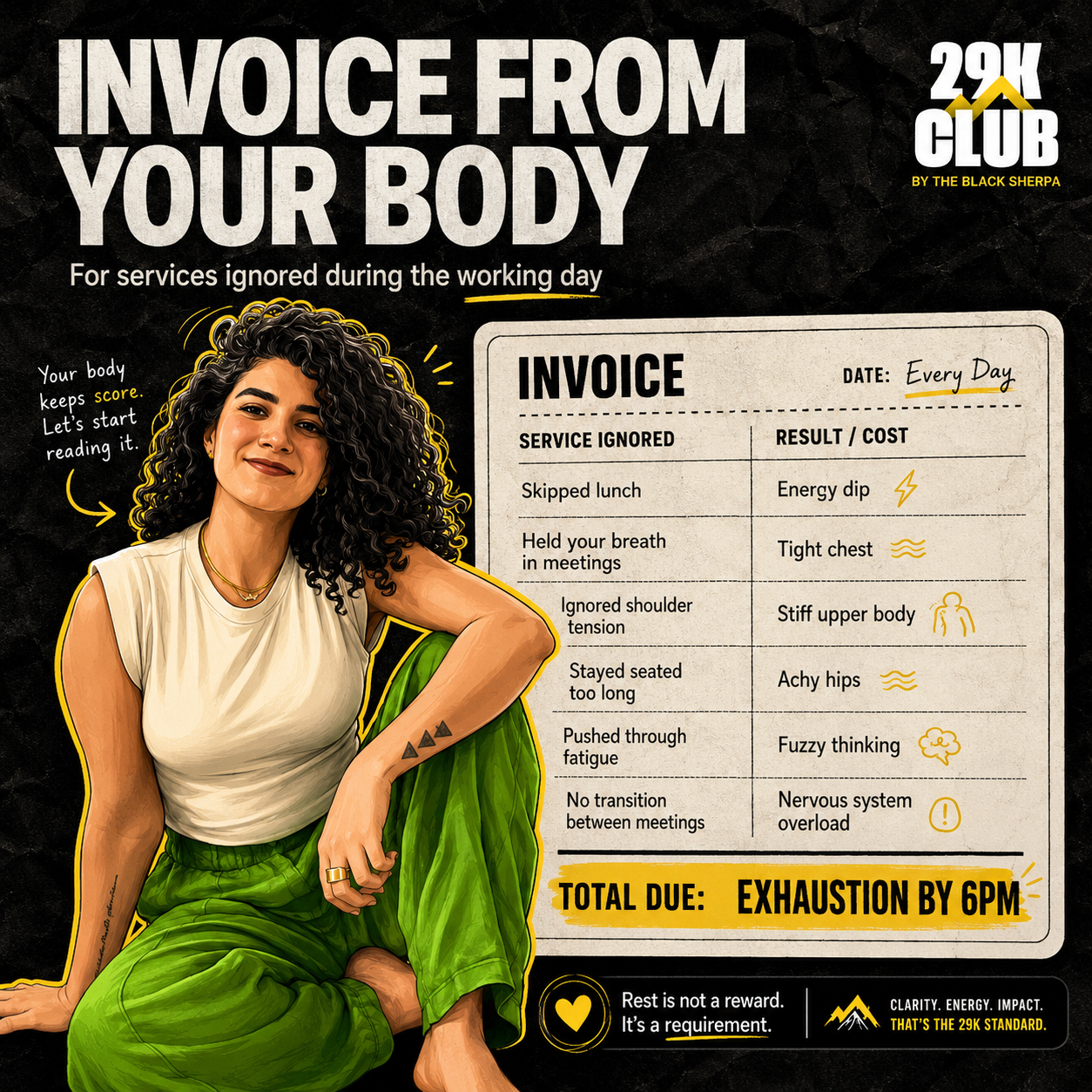
Your body keeps score… and if you ignore the signals all day, exhaustion sends the invoice.
This is why the idea of 50/50 mindfulness was so useful. Hedi described it as keeping some attention on the body and some attention on the conversation, task or person in front of you.
Not disappearing into yourself.
Not becoming self-conscious.
Just staying connected enough to notice what your body is communicating before it has to become loud.
For professionals who live in their heads, this is a serious leadership skill.
Because the body often notices things before the mind has language for them.
A shift in energy.
A tightening in the chest.
A sense that something is off.
A feeling that you are performing rather than being present.
The more disconnected you are from your body, the easier it is to override those signals.
The more connected you are, the more choice you have.
Breathwork for Workplace Stress: The Power of Soft Breathing
One of the most useful parts of the session was Hedi’s challenge to “deep breathing”.
Most of us have been told to take a deep breath when we are stressed.
But Hedi showed how many people turn deep breathing into effort.
Shoulders lift.
Neck muscles engage.
The ribcage strains.
The breath becomes another performance.
Instead, she introduced soft breathing, or what she called “ninja breath”.
No noise.
Less effort.
Less forcing.
Less trying to perform calm.
The idea was not to inflate the belly dramatically or drag the shoulders upwards. It was to allow the diaphragm to do more of the work and let the body relearn a calmer, softer pattern.
Her reminder was powerful:
“We breathe about 20,000 reps a day.”
That means breathing is not just a wellbeing exercise.
It is a daily movement pattern.
If that pattern is tense, forced or shallow, it can quietly shape how regulated, grounded and present we feel throughout the day.
Framework: The Soft Breath Reset
Use this before a difficult meeting, after a challenging email or when your body feels wired but your mind is trying to carry on.
Relax your shoulders.
Stop trying to take a heroic breath.
Inhale softly and silently.
Let the breath arrive rather than forcing it.
Exhale without drama.
Repeat for three to five breaths.
None of these practices are one-size-fits-all. They can be adapted seated, standing, gently, quietly, eyes open, camera off or in whatever way is accessible and supportive for your body.
For some people, closing the eyes, meditation or focusing inward may not feel safe or useful. The invitation is always to adapt. Keep your eyes open. Look around the room. Stay connected to your surroundings. Choose the version of the practice that supports you.
This is workplace wellbeing at its most practical.
Not a 45-minute ritual.
A reset you can use between calendar blocks.
Nervous System Regulation at Work: Orientation, Shaking and the Body’s Sense of Safety
One of the most striking parts of the masterclass was how simple some of the tools were.
Hedi invited the group to look around the room.
That was it.
Slowly scan the space.
Move the eyes.
Let the head turn.
Notice objects.
Rest your gaze somewhere pleasant.
It sounded almost too simple.
But her explanation gave it weight.
When we stare at screens for hours, we can slip into tunnel vision. Constant screen focus, pressure, conflict or a difficult message can all contribute to the body feeling as though it needs to stay on high alert.
So the body needs signals that remind it:
You are here.
You are safe enough in this moment.
This is the room.
This is the present.
Then came shaking.
Hands.
Wrists.
Shoulders.
Legs.
Whole body.
Music on.
Forty-five seconds.
The energy shift in the room was visible.
And yes, it was a bit weird.
That was the point.
Wellbeing does not land properly in spaces where everyone is performing professionalism. It lands in spaces where people feel safe enough to be human.
That is why the 29k Club room mattered.
The session worked because people participated. Cameras on. Chat active. People willing to try something different. People willing to move beyond the awkwardness.
But participation does not always have to look loud.
It can look like speaking, typing, listening, adapting, keeping your camera off, choosing not to do a movement, or simply staying present in a way that feels right for you.
This was not passive content consumption.
It was community in practice.
Framework: The 3-Part Nervous System Reset
Orient: Look around and reconnect with the room.
Shake: Move excess tension through the body in whatever way is accessible.
Notice: Pause and feel the difference.
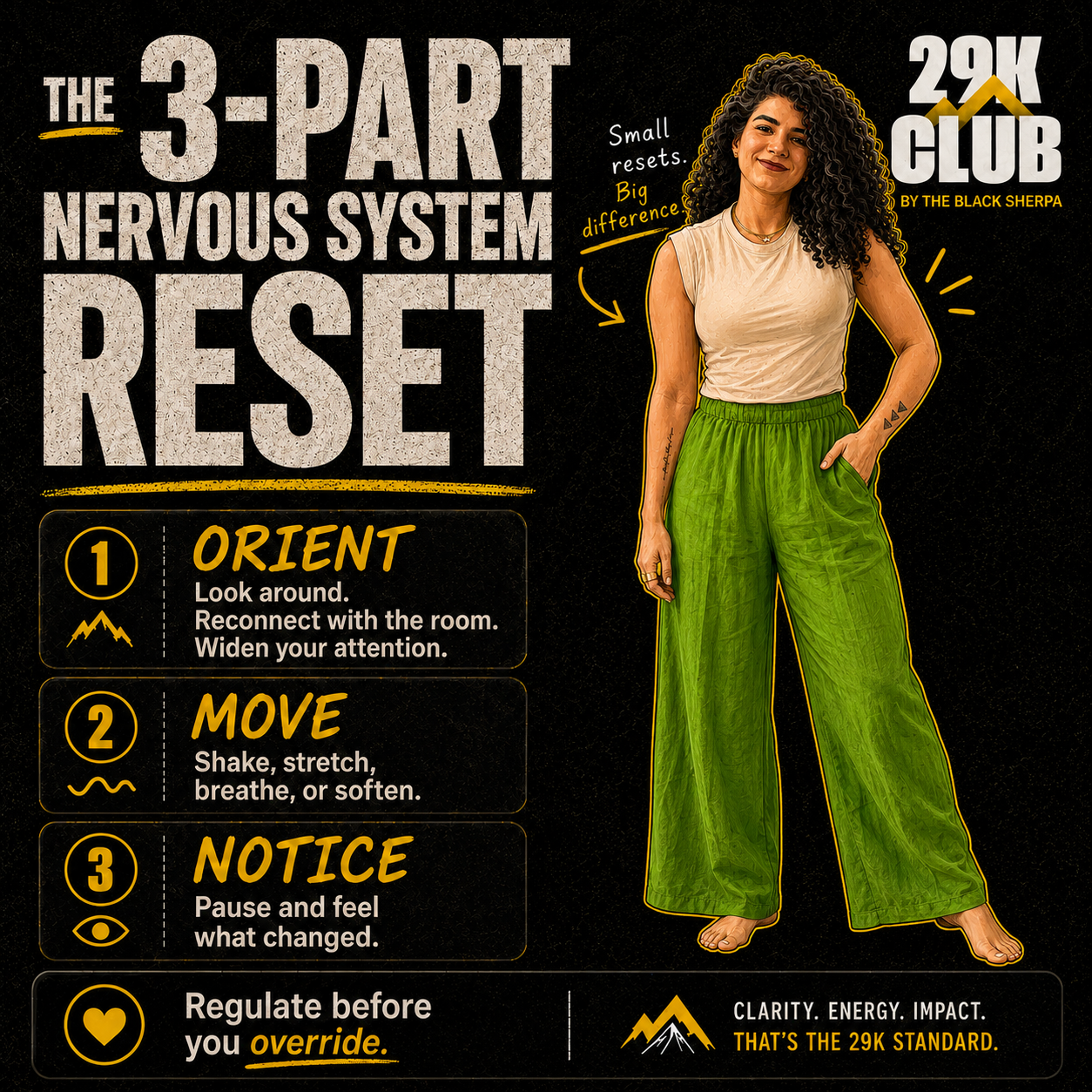
Small resets can make a big difference… here’s a simple 3-part nervous system reset to help you regulate before you override
Application
Individual: Use orientation after intense screen work. Use shaking or gentle movement before switching from work mode to home mode.
Leader: Normalise physical resets. Not every wellbeing practice has to look polished, and not everyone will engage in the same way.
Organisation: Design workshops and meetings that allow people to arrive as bodies, not just brains.
Movement Snacks at Work: Why Your Perfect Desk Setup Might Be Part of the Problem
Hedi challenged another modern workplace obsession: the perfect ergonomic setup.
Of course, good equipment matters.
But her point was sharper than that.
No setup is good enough to let a human body remain fixed for hours.
The body needs movement variability. If posture gets stuck, pain and tension can become the body’s way of asking for movement.
This is where the idea of movement snacks becomes useful.
Small pieces of movement throughout the day.
Not a full workout.
Not a gym session.
Not a heroic transformation.
Just enough movement to interrupt stillness.
Hedi shared simple ways to build this in: changing working positions, using a standing desk, sitting differently, walking while planning, using voice notes, dancing between focus blocks or doing small errands after meetings.
And again, the invitation is to adapt.
A movement snack could be a walk.
It could be standing.
It could be seated stretching.
It could be rolling your shoulders.
It could be unclenching your jaw.
It could be changing your breathing.
It could be looking away from the screen.
The best example was Hedi’s twist on the Pomodoro technique:
25 minutes of focused work.
1 minute of dancing.
Her line was brilliant:
“Sometimes it gets so fun that it feels illegal.”
That sentence captures something important.
A lot of professionals have been conditioned to believe work should feel serious, strained and slightly punishing. But fun can be a performance strategy. Joy can improve energy. Movement can sharpen thinking.
Why Does Fun at Work Feel Suspicious?
Many of us have inherited a version of professionalism where strain looks credible and joy looks unserious.
If it feels hard, it must matter.
If it feels heavy, it must be important.
If it feels enjoyable, maybe we are not working properly.
But what if that belief is part of the problem?
What if making work more joyful, rhythmic and embodied is not a distraction from performance?
What if it is part of how we sustain it?
This does not mean every task becomes fun.
Some work is boring. Some work is difficult. Some work is admin-heavy. Some work simply needs to be done.
But Hedi’s challenge was useful: can we bring more play, music, movement and pleasure into the way we work, especially when the task itself is not naturally energising?
That is not childish.
That is intelligent energy management.
Posture, Performance and the High Achiever Body
One of the biggest “room shift” moments came when Hedi talked about posture.
Most people hear “posture” and immediately pull their shoulders back, lift their chest, tighten their back and try to look confident.
Hedi challenged that.
Because some people do not just sit like high performers.
They brace like high performers.
Chest up.
Back tense.
Lower back tight.
Ready for battle.
Always proving.
Always prepared.
Always performing readiness.
Hedi shared that many high-performing people she works with hold themselves in hyper-extension. The body becomes armour. Confidence becomes tension. Presence becomes performance.
She connected this to a deeper story:
“We need to go above and beyond for us to be enough.”
That is not just a posture issue.
That is a career progression issue.
A leadership issue.
A belonging issue.
A self-worth issue.
Many professionals are not just sitting badly.
They are carrying the pressure to be exceptional in their spine, jaw, shoulders and lower back.
And the pressure to be endlessly capable is not distributed evenly. For many people, especially those navigating caregiving, underrepresentation, bias or additional emotional labour, the cost of always being “fine” can be even higher.
Instead of “standing up straight”, Hedi introduced a more useful idea: postural neutrality.
Not collapsed.
Not puffed up.
Not performing confidence.
Not hiding.
Held. Lengthened. Softened. Available.
Framework: The Posture of Neutrality
Find the middle of your feet.
Soften your knees.
Feel the ground beneath you.
Imagine a gentle string lifting the crown of your head.
Let yourself be held instead of holding yourself together.
Notice what shifts.
This can also be adapted seated, with feet grounded, shoulders softened and the crown of the head gently lengthening upward.
That phrase - “let yourself be held” - felt especially important.
Because so many ambitious people are very good at holding everything.
The work.
The pressure.
The family responsibilities.
The ambition.
The fear of dropping the ball.
The need to be seen as capable.
But sustainable performance may require a different skill.
Not more holding.
More support.
Not Everything That Stops Work Restores You
Hedi described autopilot as the thing that steals joy, presence and pleasure.
That landed.
Because many people do not end the day intentionally. They collapse into whatever gives the quickest dopamine hit.
Scrolling.
Streaming.
Snacking.
Overworking.
Replying.
Refreshing.
Half-watching something while feeling nothing.
Hedi shared her own example of finishing work exhausted, lying on the sofa and watching interior design shows at double speed without feeling anything when the reveal happened.
That detail mattered because it was specific.
Most people have their own version.
The thing that looks like rest but does not restore you.
This distinction is important:
Rest restores.
Recovery regulates.
Numbing disconnects.
Autopilot avoids.
Not everything that stops work restores you.
Sometimes it just helps you disappear from yourself for a while.
Hedi’s intervention was not dramatic. She started washing her hands after work, almost as a ritual for washing away the energy of the day. That small somatic interruption created enough space for a better choice.
Tea.
Cooking.
Walking.
Watching intentionally.
Doing nothing properly.
Framework: The Autopilot Interrupt
Ask yourself:
What do I do when I am depleted but not restored?
What is one tiny body-based interruption I can place before it?
Can I make the next choice more intentional, without turning it into another self-improvement project?
This is where workplace wellbeing becomes personal.
Not performative.
Practical.
The Thing That Grounds You Might Already Be in Front of You
One of the most personal moments came during the orientation exercise.
As Hedi invited us to look around the room, I found myself looking at the family photo on my desk.
It is always there.
But I do not always see it.
That was the point.
Sometimes the thing that grounds us is already in front of us. We have just stopped receiving it.
That led to one of Hedi’s most beautiful reflections after the session. She spoke about how we place notes, photos and reminders around us, but often stop seeing them. We keep chasing more, adding more, buying more, striving for more, but how often do we actually receive the goodness already around us?
That feels especially relevant for people who are used to being capable.
High performers are often excellent at pursuing more and surprisingly poor at receiving what is already nourishing them.
The photo.
The view.
The dog.
The cup of tea.
The message from a friend.
The quiet room.
The moment of progress.
The person who believes in you.
The community that keeps showing up.
Wellbeing is not always about adding something new.
Sometimes it is about becoming available to what is already there.
The Ego Cost of Always Trying to Prove Value
Another thread from the session deserves naming.
Before the masterclass began, we spoke about community, generosity, ego and the tension of giving value without knowing what will come back.
That is a very real pressure for founders, coaches, consultants, leaders and anyone building something meaningful.
Should I give this much?
Is this too much?
What if there is no return?
What if I am not valued?
What if I am doing all this and it does not land?
Sometimes wellbeing is not just about managing stress.
It is about managing the punishment we give ourselves when effort does not immediately produce visible return.
That punishment can be brutal.
You gave too much.
You should have charged more.
You are being naive.
You are behind.
You are not doing enough.
You need to prove it was worth it.
That inner voice can exhaust people as much as the actual work.
This is why embodied wellbeing matters for ambitious people. Because ambition without regulation can turn every act of generosity into a transaction and every delay into a threat.
Hedi’s work gently points toward another way.
Give with intention.
Notice your body.
Watch the ego.
Do not let the absence of immediate return become a reason to abandon yourself.
Signs You Might Be Overriding Yourself at Work
This is the part worth saving.
You might be overriding yourself if:
You delay eating because you “just need to finish this”
You finish work and collapse into scrolling or streaming
You confuse tension with readiness
You feel guilty resting before everything is done
You have wellbeing routines but still end the day numb
You need pressure to feel productive
You struggle to receive what is already good around you
You treat fun as suspicious
You perform confidence instead of feeling grounded
You move from meeting to meeting with no transition
You call it resilience when it is actually disconnection
This is not about shame.
And it is not always about individual choice.
Sometimes the pattern is personal. Sometimes the pattern is cultural. Sometimes the pattern is a poorly designed workload, a team norm, a leadership expectation or an organisation that has normalised over-functioning.
But once the pattern is visible, it becomes easier to ask better questions.
What can I interrupt?
What support do I need?
What boundary is missing?
What system is rewarding this behaviour?
What conversation needs to happen?
Key Insights From the Masterclass
Workplace wellbeing is not a reward for finishing the work. It is part of how you sustain the work.
High performers, high carers and high-capacity people often override basic biological needs and call it commitment.
Breathwork for workplace stress does not have to mean big, dramatic breathing. Soft breathing can be more useful.
Nervous system regulation at work can start with simple orientation: look around, reconnect with the room, widen your attention.
Movement snacks help disrupt the fixed posture and screen-based stillness of hybrid work.
The “perfect desk setup” is not enough if your body stays locked in one position all day.
Some people do not just sit like high performers. They brace like high performers.
Autopilot can look like rest, but still leave you depleted.
Joy, music, play and movement are not distractions from performance. They can be part of sustainable performance.
Professional growth is not only about confidence, strategy and visibility. It is also about energy, regulation and presence.
Why This Matters for Career Progression and Leadership Development
This conversation matters because burnout is not just a health issue.
It affects how people show up.
Decision-making.
Creativity.
Influence.
Communication.
Confidence.
Emotional regulation.
Strategic thinking.
Leadership presence.
When people are depleted, they may still perform.
But the cost rises.
They become reactive instead of responsive.
Efficient but disconnected.
Visible but exhausted.
Productive but joyless.
Successful but unavailable for the life they are supposedly building.
For organisations, ignoring workplace wellbeing creates hidden performance debt. People may keep delivering, but the system is borrowing energy it will eventually have to pay back.
And for leaders, the message is clear: do not turn wellbeing into another individual performance target.
A workplace wellbeing toolkit is useful.
But it cannot replace decent workload design, realistic expectations, psychological safety, inclusive leadership and cultures where people do not have to prove their value through exhaustion.
For individuals, this work creates a different possibility.
You can build a career without abandoning your body.
You can pursue ambition without treating rest as weakness.
You can develop confidence without performing invincibility.
You can lead from presence, not just pressure.
Why This Belongs in the 29k Club
This is exactly why the 29k Club exists.
Not just to talk about career development in the narrow sense.
Not just CVs, promotions, visibility and confidence.
But the real, human, often unspoken curriculum of professional growth.
The 29k Club is a space for the conversations many organisations say they care about but rarely create enough room for. Conversations about clarity, confidence and community. Conversations about ambition, identity, pressure, wellbeing, leadership and the invisible rules shaping how people grow.
This masterclass stretched the room in the best possible way.
It reminded us that career progression is not only about climbing.
Sometimes it is about breathing.
Sometimes it is about shaking off the day.
Sometimes it is about noticing the photo on your desk.
Sometimes it is about listening to the signal before it becomes a shout.
That might sound small.
It is not.
That is the work beneath the work.
Connect With Hedi Shah
If you are a founder, leader, high-performing professional, coach, community builder or organisation thinking seriously about sustainable performance, Hedi Shah is someone worth paying attention to.
Her work is especially relevant for people and teams navigating stress, chronic tension, remote work fatigue, nervous system overload, burnout risk, posture issues, emotional pressure or the quiet disconnection that can come from always being “on”.
She brings a rare combination of technical knowledge, embodied practice, emotional intelligence and human warmth.
Follow her work.
Book her for your organisation.
Invite her into rooms where people need more than another resilience slide deck.
Because people do not need more pressure to be well.
They need better tools, safer spaces and permission to work in ways that do not require them to abandon themselves.
Final Reflection
Where are you calling it resilience when it is actually disconnection?
What would change if workplace wellbeing became part of your career progression strategy, not an afterthought?
What is one small reset your body has been asking for all week?
Start there.
Your body is not the obstacle.
It is the signal.
Climb steady 🖤
I’m Yam – Founder of The Black Sherpa
Founder | Strategist | Speaker | Host of The Black Sherpa Podcast
I founded The Black Sherpa to create a world where talent rises on merit and no one’s potential is held back by bias or barriers.
Through bold strategy, storytelling, and our flagship community, The 29k Club - I help professionals grow with confidence and support leaders to build cultures that truly live their values.
Let’s connect and build a future where inclusion powers performance, and leadership reflects the world we serve.