
Getting through the door is only the beginning. In the final part of our series, Uday Bose explores why talent alone doesn't guarantee progression, how access to unwritten workplace rules shapes opportunity, and what leaders can do to help more people thrive
A note on this conversation: Uday joined this 29k Club masterclass in a personal capacity, sharing reflections from his own career and leadership experience. His comments do not represent the official position of GSK or any current or former employer.
Getting through the door is not the same as knowing how the building works.
You can have the qualifications.
You can secure the role.
You can complete the training and meet the performance goals.
And still lack access to the context that shapes who progresses.
How decisions are really made.
How reputations are formed.
Who advocates when you are absent.
How visibility works.
How opportunity moves.
That is why social mobility cannot be measured only by who enters an organisation.
It must also consider what happens after they arrive.
A conversation shaped by social mobility
The 29k Club masterclass with Uday Bose happened to take place on Social Mobility Day.
We had not planned it that way.
But the coincidence felt fitting.
Uday and I are both deeply invested in social mobility: the belief that talent and potential should not be limited by background, access, networks or the unwritten rules somebody was never taught.
So much of the conversation spoke directly to that.
The pressure to keep your head down and assume hard work will eventually be noticed.
The influence of accent, class, culture, family responsibilities and mobility on how careers develop.
The fear of being judged through identity rather than capability.
The importance of having someone add fair context when your name is discussed in a room you cannot enter.
And the difference between being talented and being positioned where that talent can be recognised.
These are not side issues in career progression.
They are social mobility issues.
Social mobility is often discussed through education, recruitment and access to a first job.
Those things matter enormously.
But mobility does not stop when someone enters an organisation.
The climb continues.
The visible and unwritten curriculum of work
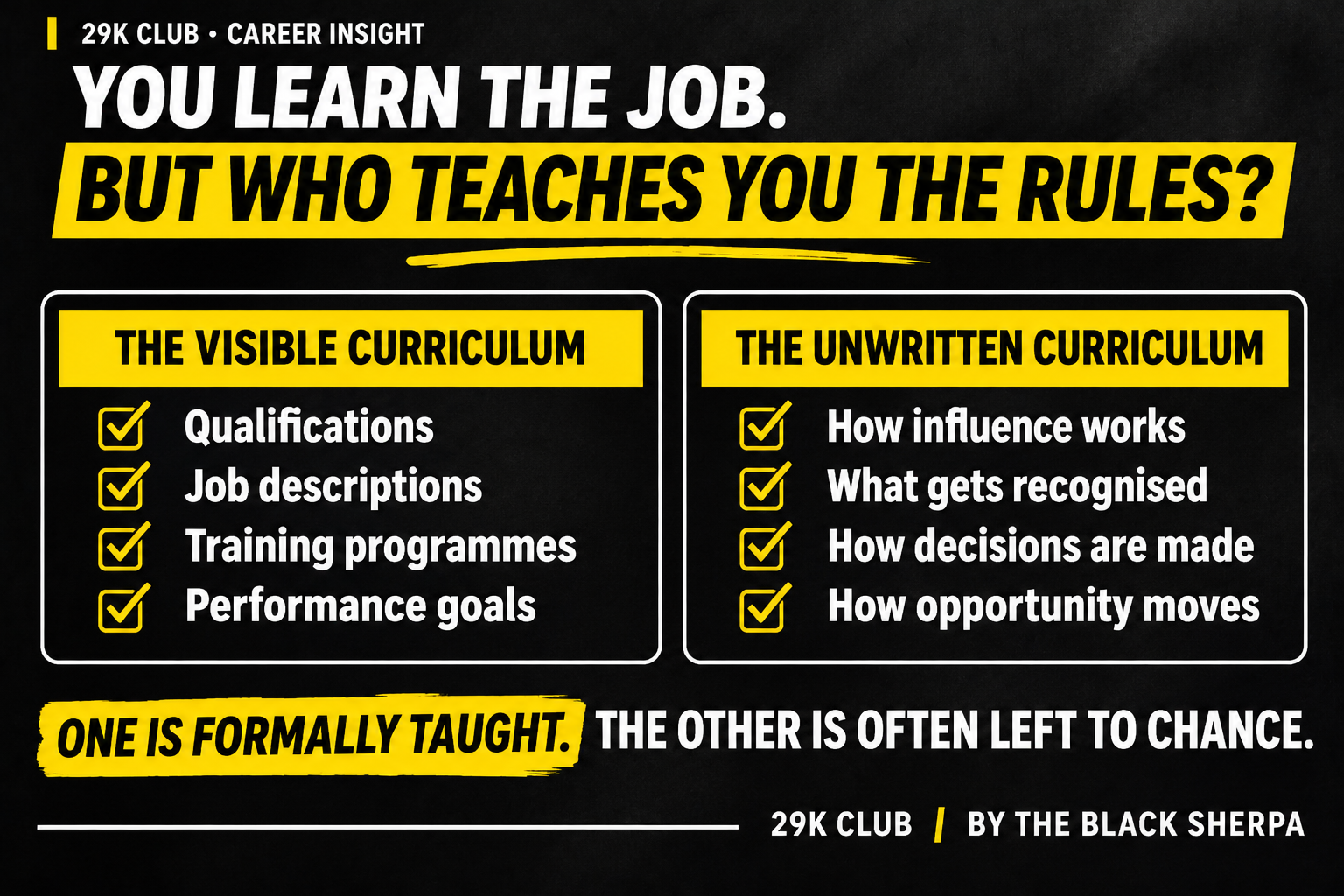
Every organisation teaches people how to do their jobs. Far fewer explicitly teach them how opportunity moves. When access to those unwritten rules depends on who you know, equally capable professionals can begin their careers with very different advantages
Most organisations have a visible curriculum.
Qualifications.
Job descriptions.
Training programmes.
Competency frameworks.
Performance goals.
These tell employees what the organisation formally expects.
But careers are also shaped by an unwritten curriculum.
How influence works.
Which assignments carry the most weight.
How leaders interpret potential.
How to communicate impact without appearing performative.
How to build relationships across boundaries.
When to challenge, when to adapt and how to read the room.
Some people enter work already familiar with these rules.
They may have parents, friends, mentors or sponsors who explain how organisations operate.
Others must decode them through trial and error.
Sometimes after an opportunity has passed.
This is why context is a form of access.
And access to context is not evenly distributed.
When mobility becomes an unwritten rule
One of the most important structural questions from Uday’s story concerns mobility.
International assignments are often treated as part of senior leadership development.
In many cases, that makes sense.
They can broaden perspective, build resilience, deepen cultural understanding and prepare leaders for greater complexity.
But there is a difference between valuing international experience and quietly treating mobility as a prerequisite for serious progression.
That difference matters.
Because not everyone can move in the same way.
Some people are caring for parents.
Some are raising young families.
Some are navigating health, immigration or financial constraints.
Some come from cultures or families where multi-generational responsibility is not an exception to plan around, but a normal part of life.
Uday’s reflection made this point powerfully.
Had international mobility been more possible for him, or had mobility been considered differently, his path may have accelerated towards CEO-level opportunities earlier.
That is not a failure of ambition.
It is a challenge to how ambition is sometimes recognised.
If senior progression depends too heavily on unrestricted mobility, organisations may unintentionally filter out people with exactly the kind of responsibility, loyalty and judgement they claim to value in leaders.
That is why this is not just a personal career story.
It is a question for HR leaders, CEOs, boards and talent teams.
When we define leadership potential, are we measuring capability?
Or are we sometimes measuring someone’s ability to organise their life around a model of
ambition that was never equally available to everyone?
Social mobility in the workplace is not only about getting people through the door.
It is about examining the hidden assumptions that shape who gets to keep climbing once they are inside.
Mobility can be valuable.
But it should not become the only way to prove ambition.
Merit versus representation
Uday spoke candidly about wanting his opportunities to be recognised as the result of his capability, experience and judgement.
He did not want people to assume he had been selected because his presence changed the appearance of a leadership team.
He also recalled an outstanding female colleague who worried that an organisational representation target might lead others to question whether she had earned her place.
This is one of the most loaded tensions in conversations about diversity in leadership.
People can support deliberate action to widen opportunity while fearing that the same action may be used to discredit them.
An organisation may be trying to correct an imbalance.
The person appointed may still worry that colleagues will interpret their progress as evidence of a lowered standard.
The usual debate asks us to choose between diversity and merit.
That is the wrong question.
A more useful question is:
Why are professionals from under-represented groups so often expected to prove that representation and excellence can coexist, while other appointments may receive less scrutiny through that lens?
Merit has never operated independently of access, visibility, opportunity, relationships and human judgement.
This does not mean every initiative is perfectly designed or communicated.
It means excellence has always existed more widely than opportunity.
The goal should be fairer access, meaningful standards and decisions that talented people can trust.
Not representation instead of excellence.
Representation alongside excellence.
People do not see the report. They see the room
During an earlier industry conversation about diversity and inclusion, some participants felt the pharmaceutical sector was already in a relatively strong position.
Uday looked at the faces on the screen and offered a different perspective:
“People don’t see reports. They don’t see data. They see people.”
Data matters.
Policies matter.
Organisational commitments matter.
Without measurement, organisations may struggle to identify gaps or know whether change is happening.
But employees also interpret what they can see.
Who leads the meeting?
Who gets promoted?
Whose ideas are treated as commercially important?
Who is trusted with consequential work?
Who remains visible as the organisational chart gets closer to the boardroom?
Representation is not the whole of inclusion.
But it is part of its evidence.
Getting different people into the room is only the beginning.
The next question is whether the room is willing to hear what they bring.
Representation changes the room. Inclusion changes what it can hear
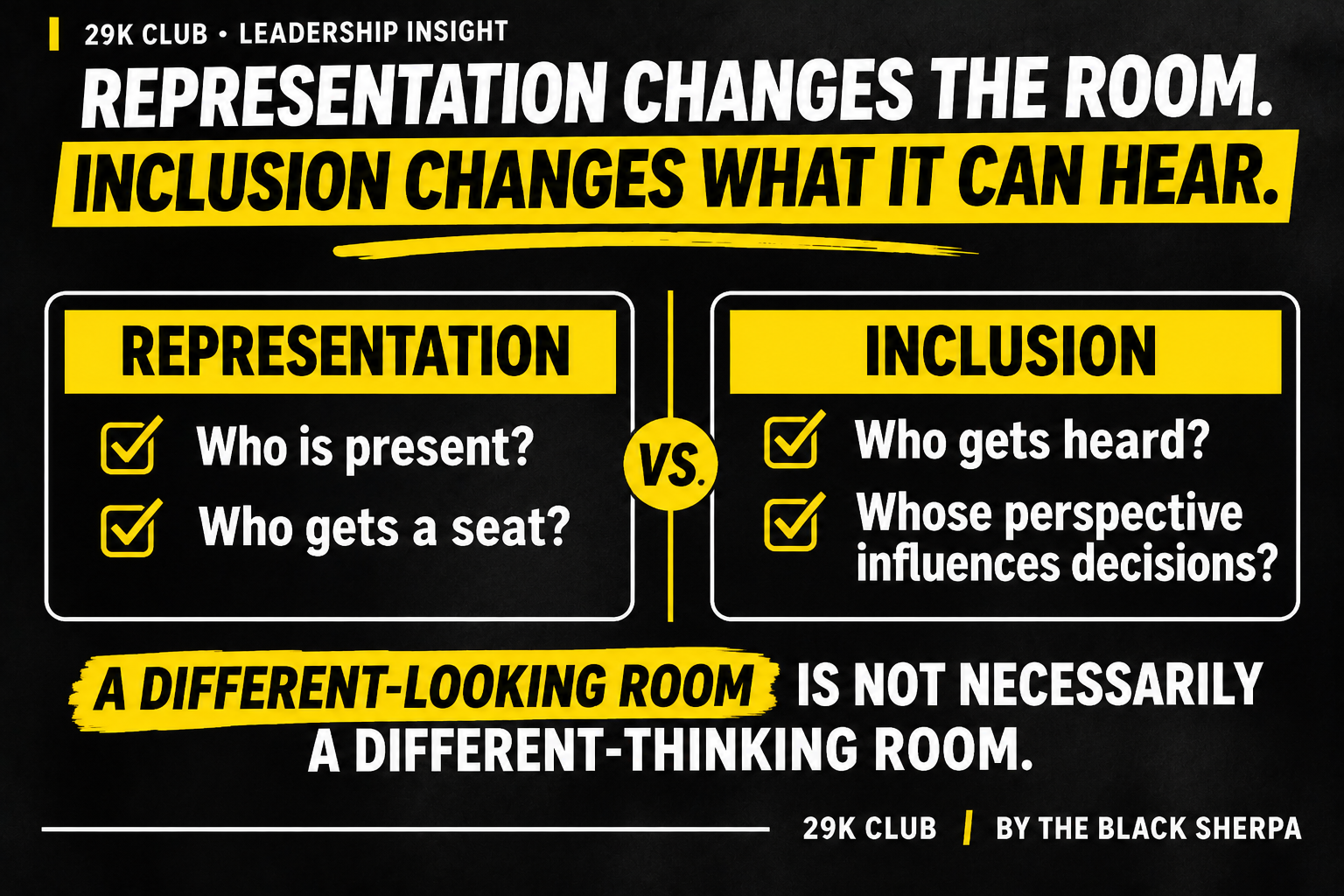
Representation changes who is in the room. Inclusion determines whether different perspectives are heard, valued and able to influence decisions. Organisations need to think beyond who gets a seat at the table
Uday described recruiting a legal leader from outside the pharmaceutical industry and encouraging colleagues to remain curious about what that person’s different experience could contribute.
That curiosity matters.
Without it, organisations can recruit difference and reward assimilation.
They invite new perspectives but judge them against familiar ways of speaking, behaving and thinking.
The appearance of the room changes.
Its boundaries do not.
Inclusive leaders ask:
What can this person see that the rest of us may be missing?
What has their sector, discipline, culture or lived experience taught them?
Are we listening for a genuinely different perspective… or only welcoming it once it has been translated into something familiar?
In life sciences, this is not only an internal culture issue.
The patients, healthcare professionals and communities served by the industry are diverse.
Organisations need enough breadth of thought and experience to understand the human lives behind aggregated data.
As Uday argued:
“It’s a business strategy. You’re not doing anybody a favour… and I don’t want any favours.”
Diversity in leadership should not be framed only as organisational generosity.
It can improve how organisations understand patients, serve customers, develop talent and make decisions.
Social mobility after entry
Opening the door matters.
But so does helping people understand what happens once they walk through it.
Employees need clarity about how opportunity moves.
Confidence to position themselves for it.
Relationships with people who can offer context, challenge distorted narratives and advocate fairly.
They need to understand not only how to do the work, but how the work is judged.
Not only how to perform, but how to make their contribution legible.
Not only how to enter the room, but how to build enough trust and credibility to shape what happens inside it.
Social mobility is not complete when someone gets the job.
It continues through access to:
Stretch assignments
Decision-makers
Useful feedback
Sponsorship
Visible work
Organisational context
Networks that extend beyond an immediate team
Without those things, entry can become a different kind of ceiling.
What happened after Uday left
The success of a 29k Club masterclass is not measured only by what happens during the hour.
It is measured by what people do afterwards.
After Uday left, the community continued talking.
One member said the session had recharged them during an extremely difficult period… even though nothing about their circumstances had changed.
Another reflected that Uday had not pulled the ladder up behind him.
A third recognised that qualities which might once have made him feel unconventional had become part of his strength.
The masterclass did not remove a structural barrier.
It did not create an immediate promotion or make a difficult workplace situation disappear.
It changed how some members interpreted what might still be possible.
Sometimes a conversation does not change your circumstances.
It changes your relationship with your circumstances.
That can be the beginning of action.
The kind of community we are trying to build
This is what I want the 29k Club to keep creating.
Not passive audiences.
Not people collecting notes from another event before returning to exactly the same habits.
A community where proximity to experience leads to action.
Where people hear the unseen context behind a career and use it to navigate their own with greater intention.
Where access to the unwritten curriculum is not determined by who someone happens to know, where they grew up or whether they entered work already fluent in its informal rules.
Where leaders can pay forward what they have learned without being expected to arrive with perfect answers.
Where members ask the questions beneath the acceptable questions.
And where inspiration is not treated as the final outcome.
It is treated as energy that must be converted into something useful.
Uday brought experience, intensity, openness and genuine joy.
The community responded by bringing its own experiences, doubts and ambitions into the conversation.
That exchange created something more valuable than a talk.
It created momentum.
And momentum matters only when we do something with it.
More leaders making their experience useful
Uday offered one powerful example of how senior experience can be shared responsibly and made useful to others.
This is not about expecting every leader to communicate in the same way.
His energy is uniquely his.
Other leaders will contribute through different personalities, styles and strengths.
Some may write.
Some may mentor privately.
Some may create opportunities within their organisations.
Some may speak publicly only occasionally.
Our industry is full of great characters with experiences worth hearing.
People who have navigated research, organisational change, commercial pressure, difficult career decisions, innovation, failure and significant responsibility.
Much of that learning remains inside private conversations, leadership meetings and bulging inboxes.
And even an important email can quickly disappear beneath dozens of others.
A thoughtful story shared online can travel differently.
Uday does not appear on LinkedIn every week. But when he does, there is usually a story or perspective worth taking the time to read.
Follow his journey.
Not because thoughtful leadership needs to be constant.
Because when he chooses to show up, he usually brings something worth engaging with.
The 29k Club offers another route.
A trusted forum where experience can meet honest questions.
Where difficult topics can be explored with curiosity, care and appropriate boundaries.
And where value is judged not only by what was said, but by what people choose to do next.
I believe many more people across life sciences would be willing to pay their experience forward in this way.
They may simply not have been asked.
Who has a perspective more people should hear?
Who has learned something that could make another person’s climb clearer?
Who has a story that deserves more space than another line in a crowded inbox?
Please connect me (yam@theblacksherpa.com).
The next conversation that moves somebody to act may already be sitting inside your network.
Questions for leaders and organisations
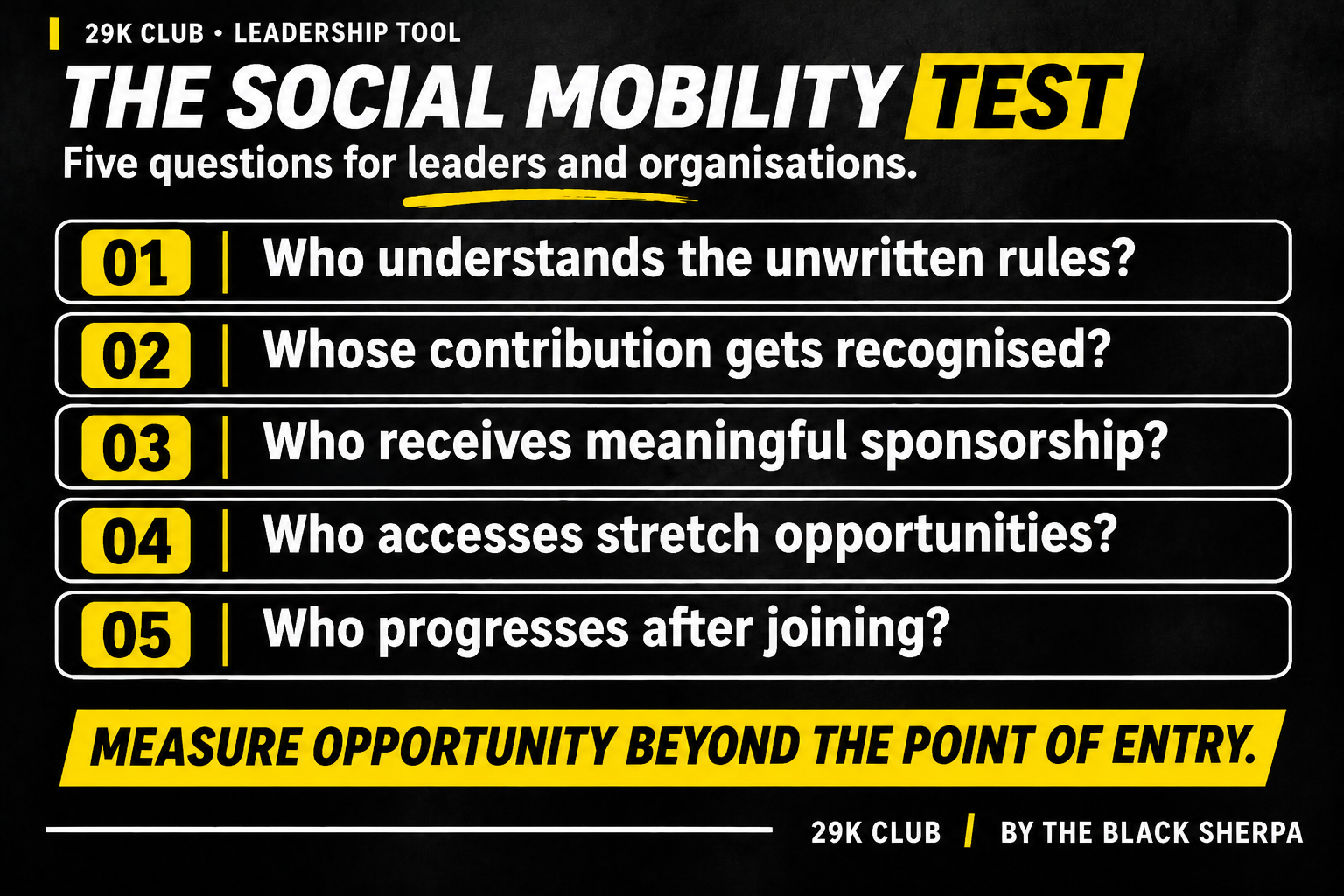
Social mobility doesn't end when someone gets the job. These five questions challenge leaders to examine who receives the knowledge, recognition, relationships and opportunities needed to progress once they're inside an organisation
Who understands the unwritten rules in your organisation… and who is still being asked to work them out alone?
Whose excellence is visible?
Who receives context before an opportunity appears?
Who has somebody willing to advocate when they are absent?
How do your talent systems treat family responsibilities and mobility?
And are you measuring social mobility only by who enters… or by who is able to progress once inside?
Getting through the door matters.
But it is not the same as knowing how the building works.
Context is a form of access.
Let us distribute more of it.
Climb steady 🖤
I’m Yam – Founder of The Black Sherpa
Founder | Strategist | Speaker | Host of The Black Sherpa Podcast
I founded The Black Sherpa to create a world where talent rises on merit and no one’s potential is held back by bias or barriers.
Through bold strategy, storytelling, and our flagship community, The 29k Club - I help professionals grow with confidence and support leaders to build cultures that truly live their values.
Let’s connect and build a future where inclusion powers performance, and leadership reflects the world we serve.