
Doing great work is the foundation, but it doesn't always guarantee recognition or progression. In Part 2 of our series, Uday Bose explores why excellence, visibility and relationships matter, how sponsorship can open doors, and what it takes to position yourself for your next big opportunity
A note on this conversation: Uday joined this 29k Club masterclass in a personal capacity, sharing reflections from his own career and leadership experience. His comments do not represent the official position of GSK or any current or former employer.
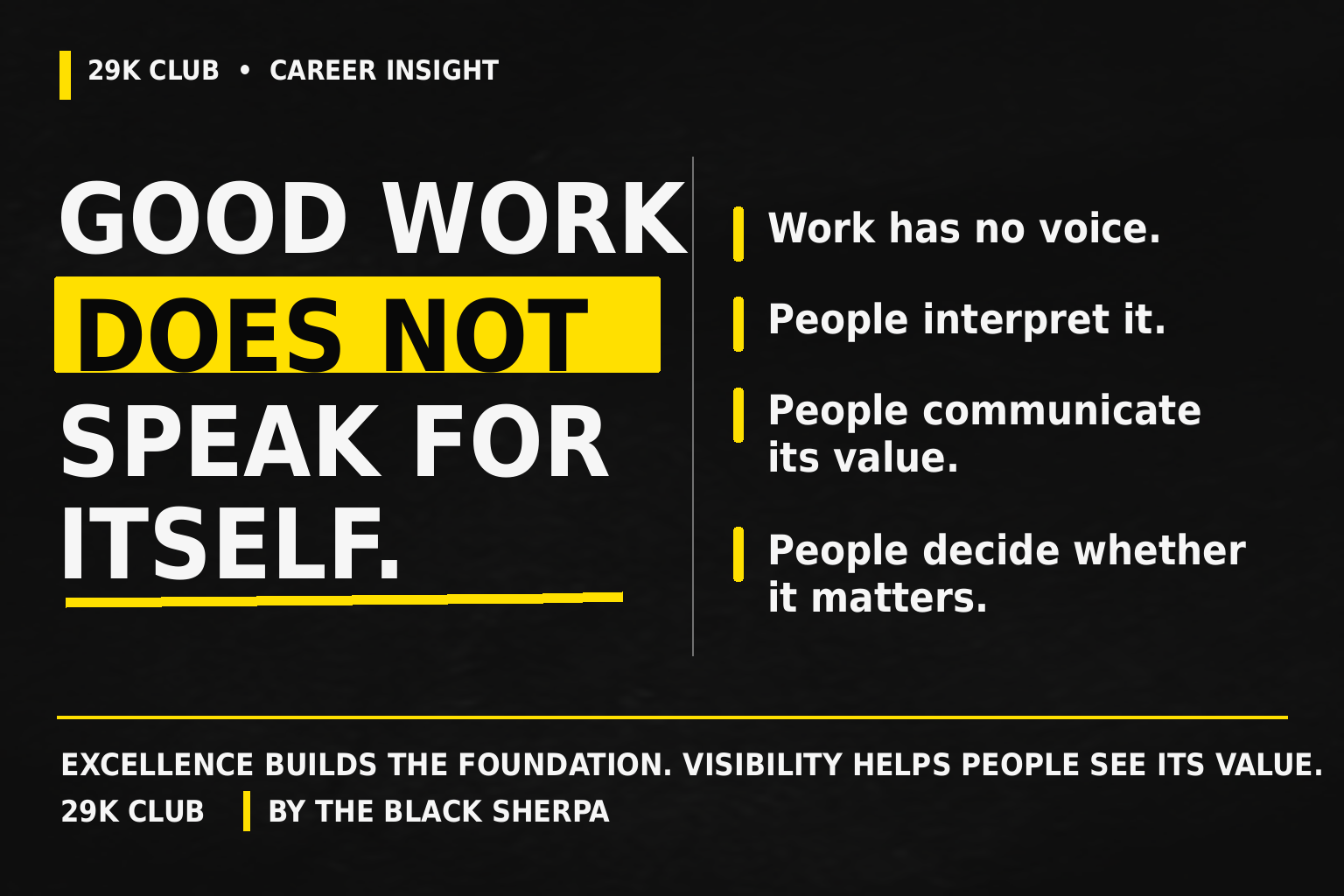
Good work does not speak for itself.
Work has no voice.
People interpret it.
People communicate its value.
People decide whether it is relevant to the problems and opportunities that matter.
That was one of the most practical truths to emerge from a recent 29k Club masterclass with Uday Bose.
Uday repeatedly centred excellence.
Not image.
Not networking as a substitute for substance.
Not visibility without credibility.
Be brilliant at what you do.
Build the skills.
Understand the work.
Earn trust through the quality of your contribution.
That is the foundation.
But excellence alone does not always create opportunity.
People also need to understand the value you bring.
Relationships matter.
Reputation matters.
And some of the most important conversations about your career will happen when you are not in the room.
Doing excellent work matters. But recognition also depends on whether others understand your contribution, recognise its value and communicate it when opportunities arise
Excellence comes first
Uday’s career began in health economics before moving through sales, marketing, and general management.
At one point, he was offered the opportunity to move directly into marketing.
He chose to spend time in sales first.
His manager believed he could succeed without it. Uday wanted the credibility of understanding the work before asking a sales team to follow his direction.
He wanted to know what it felt like to carry the bag.
To sit in front of customers.
To understand the pressure and practical reality behind the plans created elsewhere.
That decision reveals something important about excellence.
Excellence is not simply being good at the next role.
It is building enough substance to carry responsibility with credibility.
Sometimes self-doubt stops people from moving.
Sometimes it shows them what experience they genuinely want to build.
The skill is knowing the difference.
Your career may be discussed when you are absent
Uday offered unusually honest context about how talent conversations can unfold.
Somewhere in your organisation, your name may appear on a screen.
Someone may remember an old mistake.
Someone else may know your recent work well enough to add fair, current context.
Your career may be influenced by which voices are present… and whether anyone can provide a fuller picture.
This does not mean every unseen conversation is unfair, negative or political.
Talent, succession and performance need to be discussed. Those conversations are part of running an organisation responsibly.
The lesson is that reputation is built collectively, not only through personal performance.
Your work matters.
But people also need to understand your work.
Your reputation matters.
But reputations can become outdated.
Your network matters.
Not only because someone may open a door, but because someone may stop an incomplete judgement from closing one.
A sponsor is not always the person who creates an opportunity.
Sometimes they are the person who says:
“I know their work.”
“That is not the full story.”
“They have developed since then.”
“We should not define somebody by one moment five years ago.”
The practical response is not suspicion or performative networking.
It is to:
Be excellent at what you do
Make your contribution understandable
Build relationships before you urgently need them
Keep your reputation connected to your current work
Add fair context for other people when you have the opportunity
Progress should not only increase your access.
It should increase your ability to advocate accurately for others.
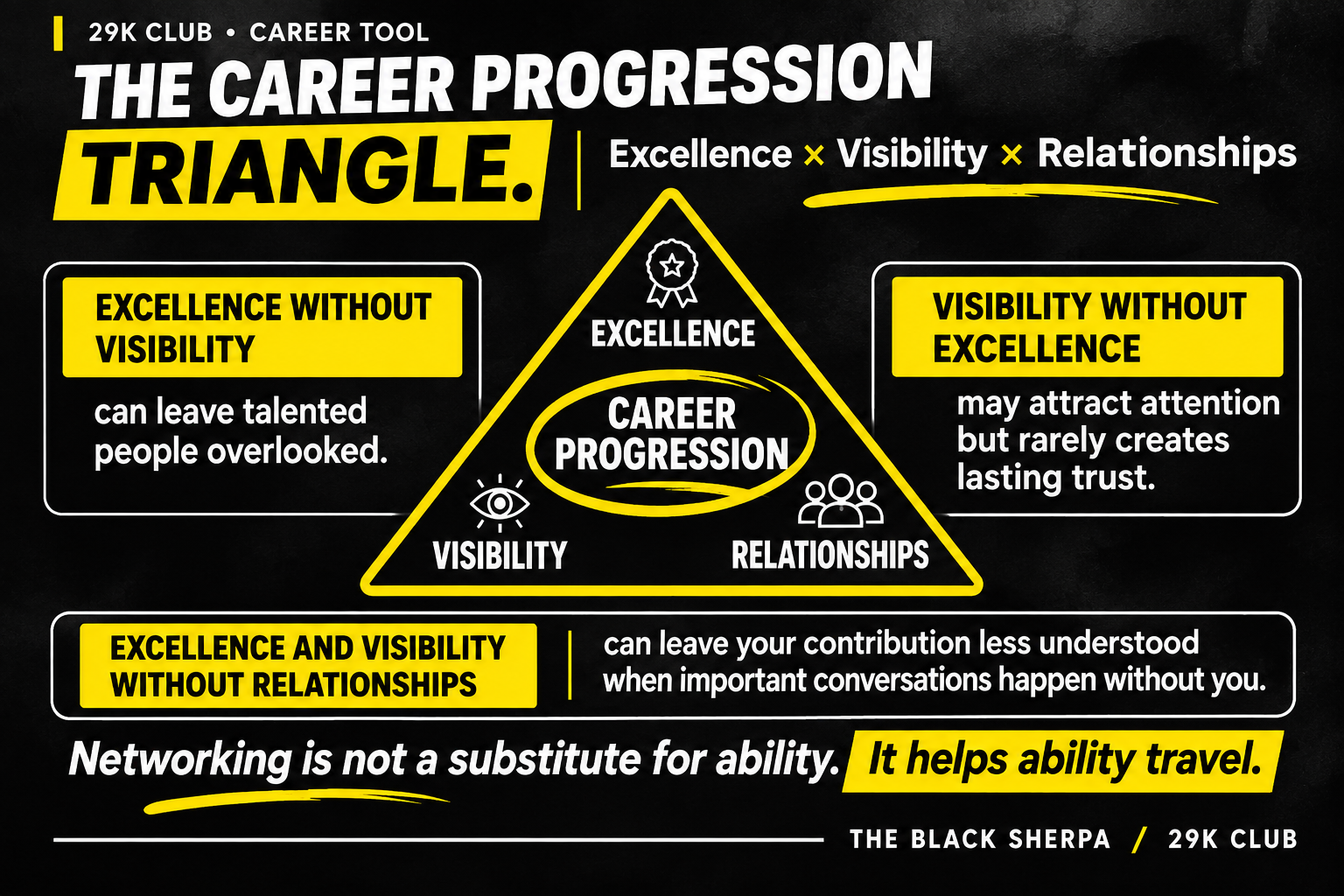
The Career Progression Triangle
Uday’s advice can be captured through one practical model:
Excellence × Visibility × Relationships
Excellence without visibility can leave talented people overlooked.
Visibility without excellence may attract attention but rarely creates lasting trust.
Excellence and visibility without relationships can leave your contribution less understood when important conversations happen without you.
Excellence builds credibility. Visibility helps others understand your contribution. Relationships help that understanding travel. Sustainable career progression often depends on all three
You cannot build lasting credibility through visibility alone.
But being excellent in isolation can limit your progression and impact.
Networking is not a substitute for ability.
It helps ability travel.
The strongest professional communities contain people who are genuinely invested in one another’s success.
People who celebrate your progress.
Challenge an incomplete judgement.
Recommend you when an opportunity appears.
Tell you when your inner voice is distorting the evidence.
And remind you what you are capable of when you temporarily forget.
You cannot become excellent entirely by yourself.
Other people teach you, stretch you, advocate for you and create the conditions in which your excellence can have greater impact.
Projecting yourself into a bigger future
One of the most valuable moments in the masterclass came from an early-career professional who openly said that she hoped to hold a role like Uday’s one day.
There was something powerful in that declaration.
She was not pretending to know exactly how she would get there.
She was allowing herself to project forward.
To see senior leadership not simply as somebody else’s achievement, but as a possible destination in her own career.
That kind of aspiration matters.
It is difficult to position yourself for a future you have never allowed yourself to imagine.
But she did not stop at ambition.
She followed it with a grounded question.
Had Uday ever felt pressure to project greater credibility than he possessed?
Had he hidden what he did not know?
At what point had he become comfortable enough to lead as himself rather than performing the version of leadership he thought other people expected?
The question opened the conversation beyond one person’s ambition.
It invited everyone to consider the personas we build to appear ready before we feel ready.
The strongest questions often begin with something personal and reveal something widely shared.
Uday did not suggest that confidence arrived all at once.
He spoke about being encouraged to fit in, keep his head down and avoid drawing attention to difference.
Progress sometimes required him to step outside that conditioning… to act on an idea and trust his judgement before certainty arrived.
But authentic leadership does not mean arriving fully formed.
You can be honest about who you are while recognising what you still need to learn.
You can aspire to a role while remaining curious about what the role demands.
You can project yourself into the future without pretending the distance between here and there does not exist.
That is where ambition becomes useful.
Not simply:
I want that title one day.
But:
What would I need to understand, practise and become ready to carry in order to serve well at that level?
Why were you chosen?
Another early-career question went directly to Uday’s appointment:
Why did GSK choose you when there must have been other brilliant candidates?
His answer was not a list of competencies.
He spoke about bringing energy, ideas and genuine belief in what the organisation could become.
He understood that the organisation was looking for change and made the value he could bring to that moment difficult to ignore.
He did not only demonstrate that he could perform the role.
He helped people understand what might become possible with him in it.
That is a different way to approach opportunity.
Do not only prove that you meet the requirements.
Help people see why your experience, energy and perspective matter now.
The dream job still requires preparation
There was something important in the way Uday spoke about the GSK UK General
Manager role.
He did not describe it as merely another senior appointment.
He described it as the dream job.
That detail matters because it stops the story becoming too heavy.
This was not only a conversation about barriers, sacrifice and hard truths.
It was also a conversation about joy.
About what it feels like when the work, the organisation, the timing and the person meet in a way that feels deeply energising.
But the dream job did not arrive in isolation.
It met years of preparation.
Years of functional experience.
Years of leadership across different organisations and markets.
Years of staying close to patients, customers and field teams.
Years of investing in his own development, including doctoral research while carrying significant professional and family responsibilities.
Years of choices that did not always follow the most obvious or linear path.
That is what made his answer to “Why you?” so valuable.
He did not imply that he controlled every outcome.
He did not pretend luck, timing or organisational need played no part.
But when the opportunity came, he had built enough substance to be ready for the conversation.
That is the practical lesson.
You cannot guarantee the dream job will appear.
But you can prepare so that when opportunity, timing and need meet, you are harder to ignore.
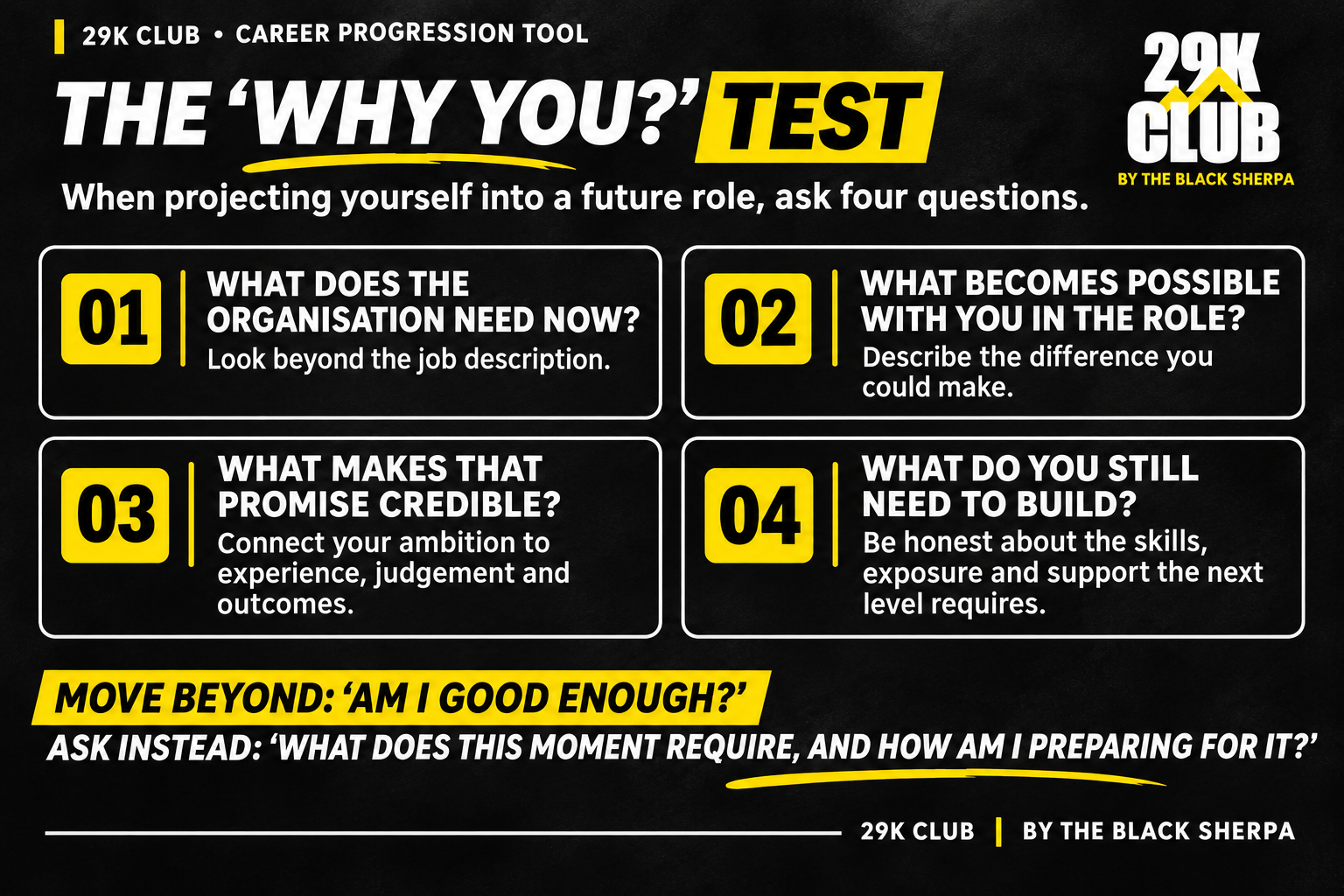
The “Why You?” Test
Before pursuing your next big opportunity, look beyond whether you're qualified. Understand what the organisation needs, the difference you could make, the evidence behind your ambition and what you still need to develop
When projecting yourself into a future role, ask four questions.
1. What does the organisation need now?
Look beyond the job description.
What is the real problem, transition or opportunity behind the vacancy?
2. What becomes possible with you in the role?
Describe the difference you could make without pretending nobody else could do the job.
3. What makes that promise credible?
Connect your ambition to experience, judgement, relationships and outcomes.
4. What do you still need to build?
Aspiration becomes more powerful when paired with an honest assessment of the skills, exposure and support the next level will require.
This moves the conversation beyond:
Am I good enough?
It asks:
What does this moment require, how am I preparing for it and why might I be able to help?
Preparation, timing and luck
It would be easy to turn Uday’s career into a simple lesson about hard work.
Work hard.
Invest in yourself.
Make brave choices.
Eventually, the right opportunity appears.
His story was more honest than that.
Uday made deliberate choices throughout his career.
He moved across functions.
He invested in his education.
He stayed close to patients, customers and frontline colleagues.
He positioned himself for opportunity.
But he also acknowledged timing, circumstance and luck.
Not every good decision produces an immediate reward.
Not every capable person receives the opportunity they deserve.
And not every career breakthrough can be traced back to a perfectly executed plan.
Positioning yourself for opportunity is not the same as pretending you can engineer your entire career.
It means building enough substance that when opportunity, timing and organisational need meet, you are ready to enter the conversation.
Five actions to take now
1. Strengthen your foundation
Identify the skill, experience or judgement that would make you more credible at the next level.
Do not chase visibility before building substance.
2. Make your contribution legible
Do the relevant people understand what you have delivered, why it mattered and how you think?
Do not assume they will join the dots themselves.
3. Build relationships before urgency arrives
Develop genuine connections across functions, levels and organisations.
Do not begin networking only when you need a role.
4. Understand what the organisation needs next
Look beyond your current job.
What problems are becoming more important?
What changes will the organisation need people to lead?
5. Become an advocate
When someone else’s name is discussed, add fair and current context.
Be the relationship you hope someone else will be for you.
Excellence remains the cornerstone.
But excellence needs visibility to be recognised and relationships to be supported.
That is not playing a game.
It is understanding how opportunity moves.
Continue the series:
I’m Yam – Founder of The Black Sherpa
Founder | Strategist | Speaker | Host of The Black Sherpa Podcast
I founded The Black Sherpa to create a world where talent rises on merit and no one’s potential is held back by bias or barriers.
Through bold strategy, storytelling, and our flagship community, The 29k Club - I help professionals grow with confidence and support leaders to build cultures that truly live their values.
Let’s connect and build a future where inclusion powers performance, and leadership reflects the world we serve.