
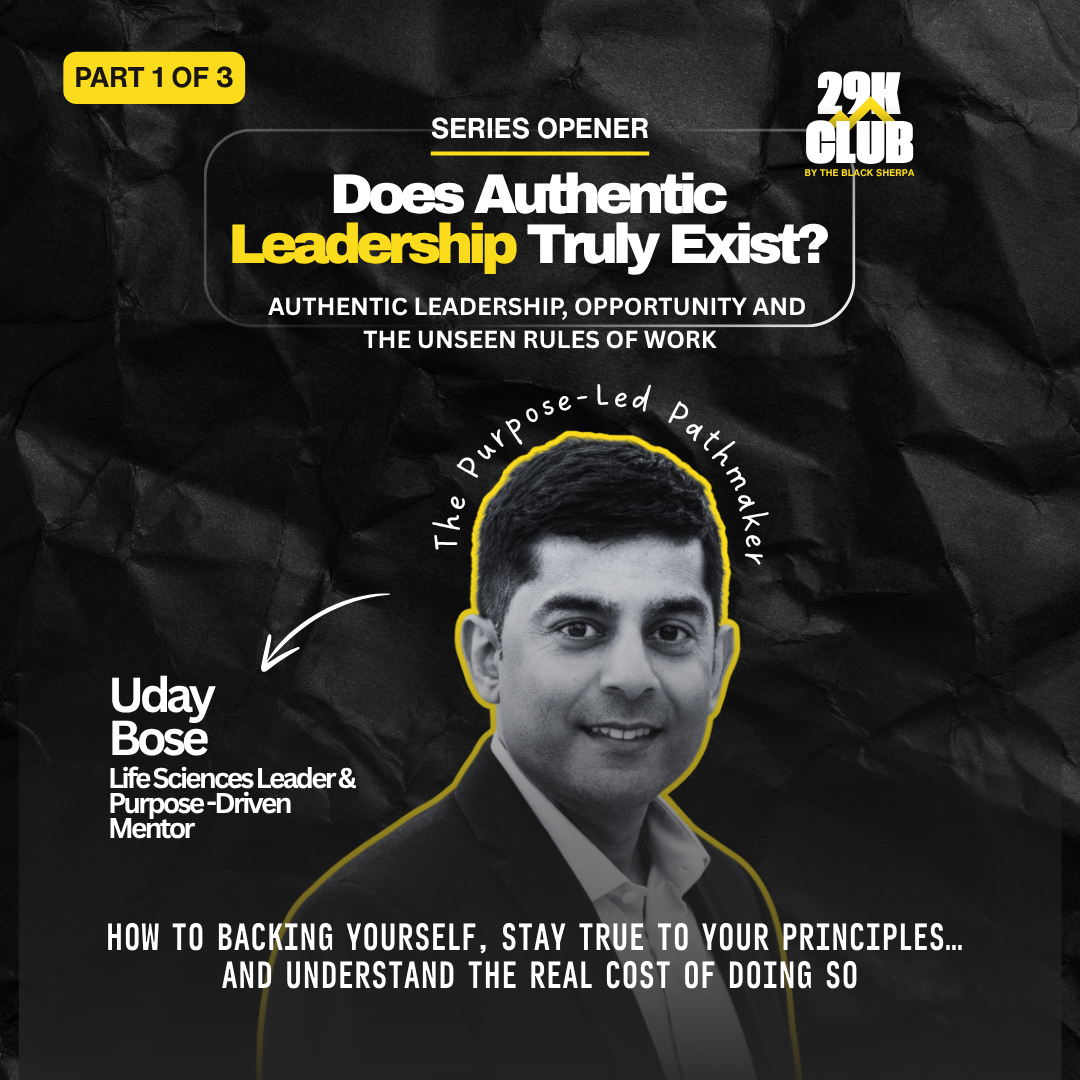
What does staying true to yourself really cost? In Part 1 of our three-part series, Uday Bose explores the choices, sacrifices and competing priorities behind senior leadership, and why career success isn't always about taking the most obvious path
A note on this conversation: Uday joined this 29k Club masterclass in a personal capacity, sharing reflections from his own career and leadership experience. His comments do not represent the official position of GSK or any current or former employer.
“What has authenticity cost you?”
It was the question that changed the conversation.
Not: what are the benefits of authentic leadership?
Not: how can leaders bring more of themselves to work?
What has it cost?
Because staying true to yourself sounds straightforward until a bigger role requires relocation, an organisational decision conflicts with your instincts or speaking honestly
could affect how people see you.
During a recent 29k Club masterclass, Uday Bose… at the time newly appointed General Manager of GSK UK… did not offer a polished formula for navigating those moments.
He spoke about the opportunities he did not take.
The role he did not get.
The family commitments that shaped his choices.
The discomfort of wondering whether progress in representation might cause people to question merit.
And the joy of arriving in a role that, in his own words, feels like the dream job.
This was authentic leadership at work without the slogans.
Not saying everything.
Not performing vulnerability.
Being willing to examine the difficult relationship between who you are, what you want and what progressing may require from you.
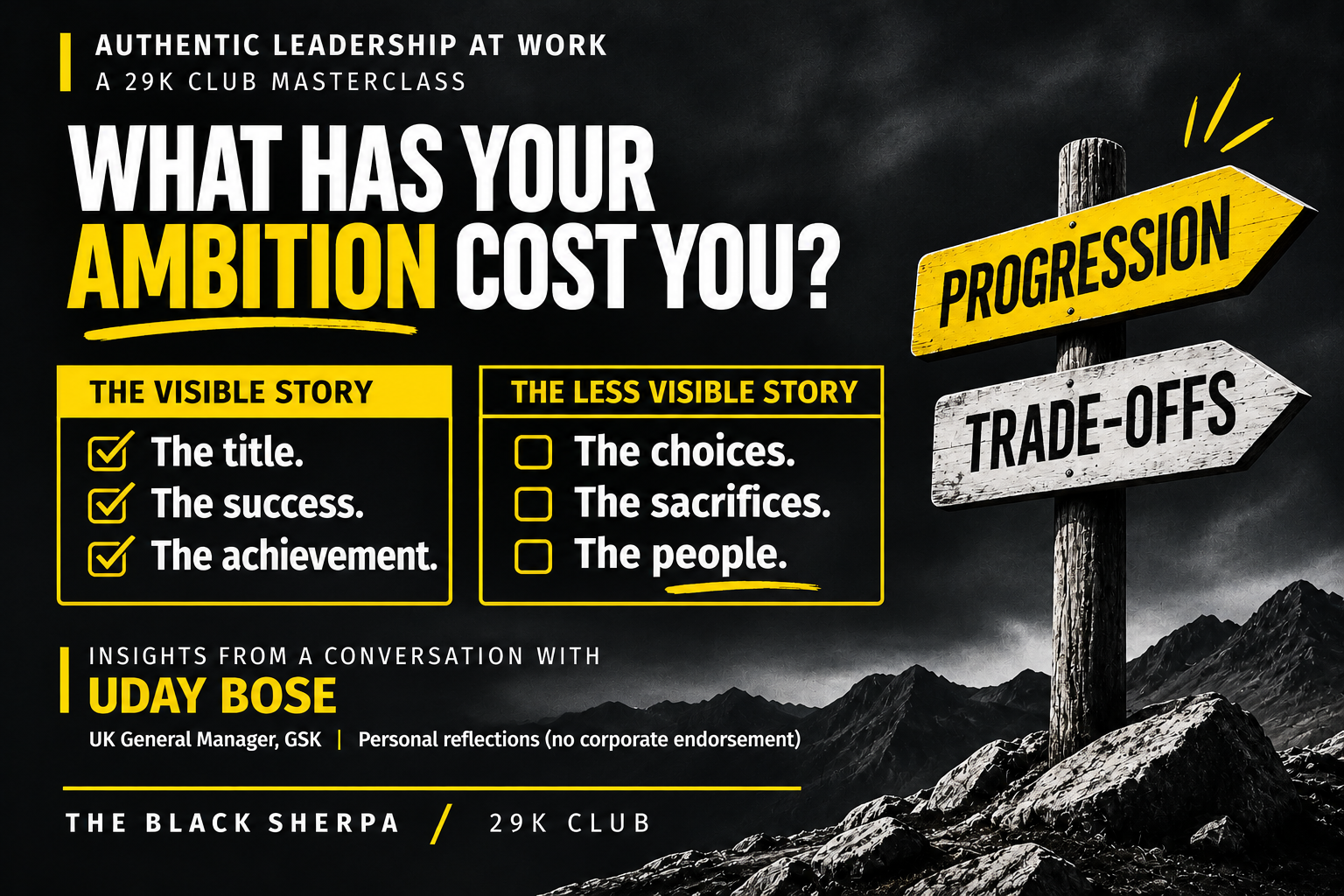
We celebrate the titles people achieve. We rarely see the choices, sacrifices and people behind them. What has your ambition cost you?
The energy behind the title
Uday’s career has spanned health economics, sales, marketing, global leadership and general management.
He has worked across American, French, German, Japanese and British pharmaceutical organisations. He has built an oncology business unit, led through Brexit and the pandemic, and completed a doctorate exploring shared leadership and research and development effectiveness.
Those achievements are visible.
What is harder to capture on a CV is the energy behind them.
Uday has a zest for life and work that is difficult to manufacture.
He speaks with an intensity that makes people lean in… not because he dominates the room, but because he appears genuinely invested in the conversation and the people inside it.
There was no sense that this masterclass was simply another obligation in a crowded senior-leadership diary.
He was happy to be there.
Excited to meet the community.
And clearly energised by the opportunity to make what he had learned useful to others.
People can usually tell the difference between a leader who has agreed to appear and one who has chosen to be present.
Uday chose to be present.
He laughed. He listened. He welcomed difficult questions. He spoke openly without losing the judgement or boundaries expected of someone in his position.
Warmth without losing seriousness.
Intensity without making the conversation about himself.
Confidence without pretending everything was inevitable.
Success without rewriting the journey as a perfect plan.
The result was not simply that people listened.
They wanted to contribute.
That is a leadership skill in its own right.
The title belongs to one person. The journey rarely does
The professional choices Uday described were never made in isolation from the people closest to him.
His commitment to his mother influenced the opportunities he was prepared to pursue earlier in his career. Later, decisions about international roles and years of commuting were shaped by his responsibilities as a husband and father.
His family were not background characters in the story of his success.
They were part of how he defined success.
We often celebrate the individual appointment and miss the family decisions, shared sacrifices, encouragement and practical support that made the route possible.
When the GSK opportunity emerged, Uday initially saw the scale of the role and questioned whether it could really be meant for him.
His wife responded more simply.
She saw someone who had already led organisations, built businesses, navigated complexity and accumulated the experience the opportunity required.
Where he saw the intimidating size of the next step, she reflected the evidence of the steps he had already taken.
Sometimes the people who know us best do not inflate our confidence.
They return us to the facts.
They remind us that an opportunity can feel extraordinary without being accidental.
Something about the warmth with which Uday spoke about his family suggested that his success is not simply something they have observed from the sidelines.
It is something they have built around, carried and shared.
The title may belong to one person.
The journey rarely does.
When family responsibility becomes a structural career question
One of the most powerful parts of Uday’s story was not simply that family shaped his decisions.
It was that those decisions may have changed the speed, shape and height of his career.
Uday spoke about international opportunities he did not pursue permanently because of his family commitments.
And he shared a striking reflection.
Had those international routes been more possible for him, or had mobility been considered differently, his path may have accelerated towards CEO-level opportunities earlier.
That is not just a personal anecdote.
It is a structural observation.
In many organisations, international mobility is treated as a signal of ambition, flexibility and senior leadership potential.
For some people, that works. It creates breadth, perspective and valuable experience.
But when mobility becomes an unofficial gatekeeper to senior progression, it can disadvantage talented professionals whose lives are shaped by caring responsibilities, family obligations, health considerations, financial constraints, immigration realities or cultural expectations around multi-generational support.
That is not a lack of ambition.
It is a different set of responsibilities.
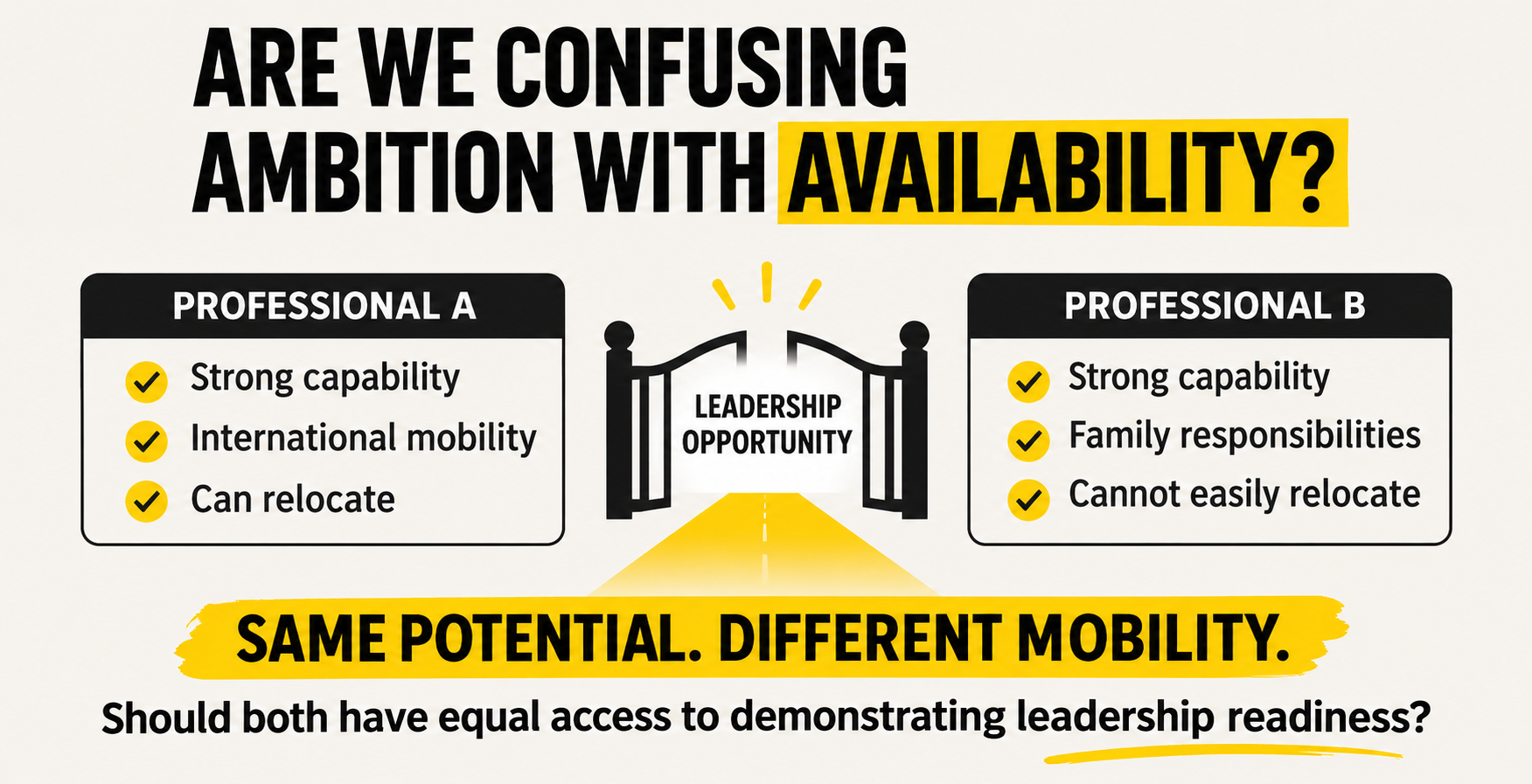
International experience can accelerate careers. But when mobility becomes an unofficial measure of ambition, capable professionals with different responsibilities may face unequal opportunities to progress
The question for organisations is not whether international experience has value.
It clearly can.
The harder question is:
How many definitions of leadership potential are built around one particular type of
life?
And how many talented people are slowed, overlooked or forced into impossible trade-offs because they cannot perform ambition in the narrow way the system has learned to
recognise?
For individuals, the question is just as difficult:
Which opportunities are you prepared to lose in order to remain aligned with what
matters most to you?
Uday did not tell that story with bitterness.
That mattered.
Because this was not a story about a career that failed to happen.
It was a story about a career that still climbed.
A career built through excellence, choices, relationships, timing, sacrifice and deep investment in the work.
The dream job matters too
For all the serious weight of the conversation, Uday also made something very clear.
The GSK UK General Manager role is his dream job.
That detail matters.
Because authentic leadership is not only about naming the cost.
It is also about being honest when something feels meaningful, energising and right.
You could hear it in the way he spoke.
The disbelief.
The gratitude.
The excitement.
The sense that this was not simply the next move on a leadership ladder, but a role he genuinely wanted to pour himself into.
That combination made the conversation richer.
It held both truths at once.
Some choices may have cost him.
Some routes may have closed or slowed.
And still, he has arrived somewhere that feels deeply aligned with who he is, what he values and the impact he wants to have.
Authenticity is not simply expressing your identity or speaking openly about your values.
It is deciding which compromises you can live with… and which might leave you successful on paper but disconnected from the person you intended to become.
The Authenticity Test
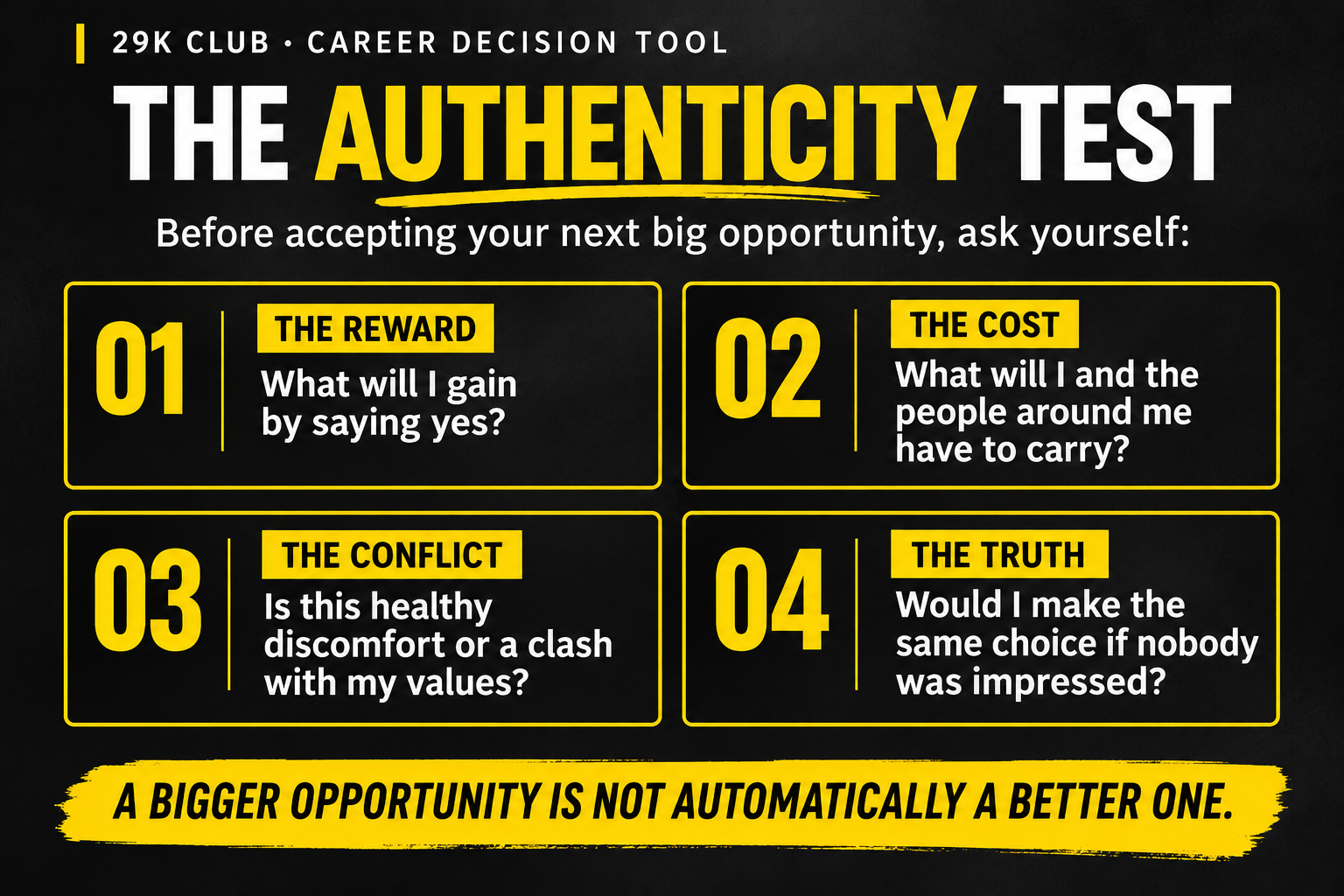
Before saying yes to your next big opportunity, consider what you'll gain, what it will cost, whether it aligns with your values and whether you'd still want it without the recognition
Before making a significant career decision, ask:
What would I gain from saying yes?
What would this choice require me or the people around me to carry?
Is this discomfort part of healthy growth, or does the opportunity conflict with
something fundamental?
Would I still recognise this decision as mine if nobody else were impressed by it?
There are no universal answers.
Authentic leadership requires judgement, not a script.
Authenticity is not equally safe for everyone
There is another truth that conversations about authenticity sometimes overlook.
Being fully visible is not equally safe, welcomed or rewarded in every workplace.
For some professionals, adapting language, behaviour or presentation has been a necessary form of protection.
Code-switching may help someone navigate expectations shaped by class, accent, race, disability, gender, age or organisational culture.
That does not automatically mean they are being dishonest.
It may mean they are reading the environment carefully.
The challenge is not to demand that everyone shows up in exactly the same way.
It is to create workplaces where fewer people feel they must continually edit themselves to be treated as credible.
Authentic leadership is therefore both personal and organisational.
Individuals must decide how they want to show up.
Leaders must examine what their environment rewards, discourages or quietly punishes.
When does influence become compromise?
One member asked Uday when adapting your approach to influence an organisation becomes a compromise of your principles.
It may have been the hardest question of the session.
Leadership requires influence.
Influence requires an understanding of audience, timing, context and incentives.
The same principle may need to be expressed differently to a colleague motivated by fairness, a commercial leader focused on performance or an executive accountable for organisational risk.
That is not necessarily inauthentic.
Changing the route does not always mean abandoning the destination.
The distinction is whether you are changing the language or changing the principle.
The Integrity Test
Ask:
Am I communicating this differently to make action more likely… or am I pretending not to believe it so that I remain accepted?
Strategic adaptation says:
How can I make this argument meaningful in this environment?
Compromise says:
Which part of this principle must I hide to remain comfortable here?
The line will not always be obvious.
That is why values, trusted relationships and reflective communities matter.
We need people who can help us test whether we are exercising judgement or gradually becoming silent.
Authentic leadership is not saying the same thing in the same way everywhere.
It is refusing to lose sight of what you are trying to protect, improve or change.
Why Uday made people want to do more
A title can make people pay attention.
Position can create interest.
But neither automatically creates connection.
You know the difference when you experience it.
Some people leave you impressed by them.
Others leave you thinking differently about yourself.
Uday did the second.
His energy was infectious, but it was not shallow optimism. It was grounded in choices, setbacks, discipline, family, responsibility and an acknowledgement that careers are never completely controllable.
He could talk about success without making success feel distant.
He could describe senior leadership without pretending senior leaders stop experiencing doubt.
He could engage with difficult truths without leaving the room feeling hopeless.
And he could talk about his dream job with the kind of joy that reminded everyone this was not only a conversation about barriers.
It was also a conversation about possibility.
That balance made the session genuinely inspiring.
Not because he told members everything would work out.
Because his story demonstrated that careers can remain open even when the route is
unconventional, progress is interrupted or personal choices narrow the obvious options.
Authentic leadership is not perfection.
It is alignment under pressure.
And sometimes the clearest evidence of it is not what a leader says about themselves.
It is how other people feel able to show up around them.
Continue the series:
Part Two: Progression - Excellence Is Not Enough: How Visibility and Relationships Shape Career
I’m Yam – Founder of The Black Sherpa
Founder | Strategist | Speaker | Host of The Black Sherpa Podcast
I founded The Black Sherpa to create a world where talent rises on merit and no one’s potential is held back by bias or barriers.
Through bold strategy, storytelling, and our flagship community, The 29k Club - I help professionals grow with confidence and support leaders to build cultures that truly live their values.
Let’s connect and build a future where inclusion powers performance, and leadership reflects the world we serve.