
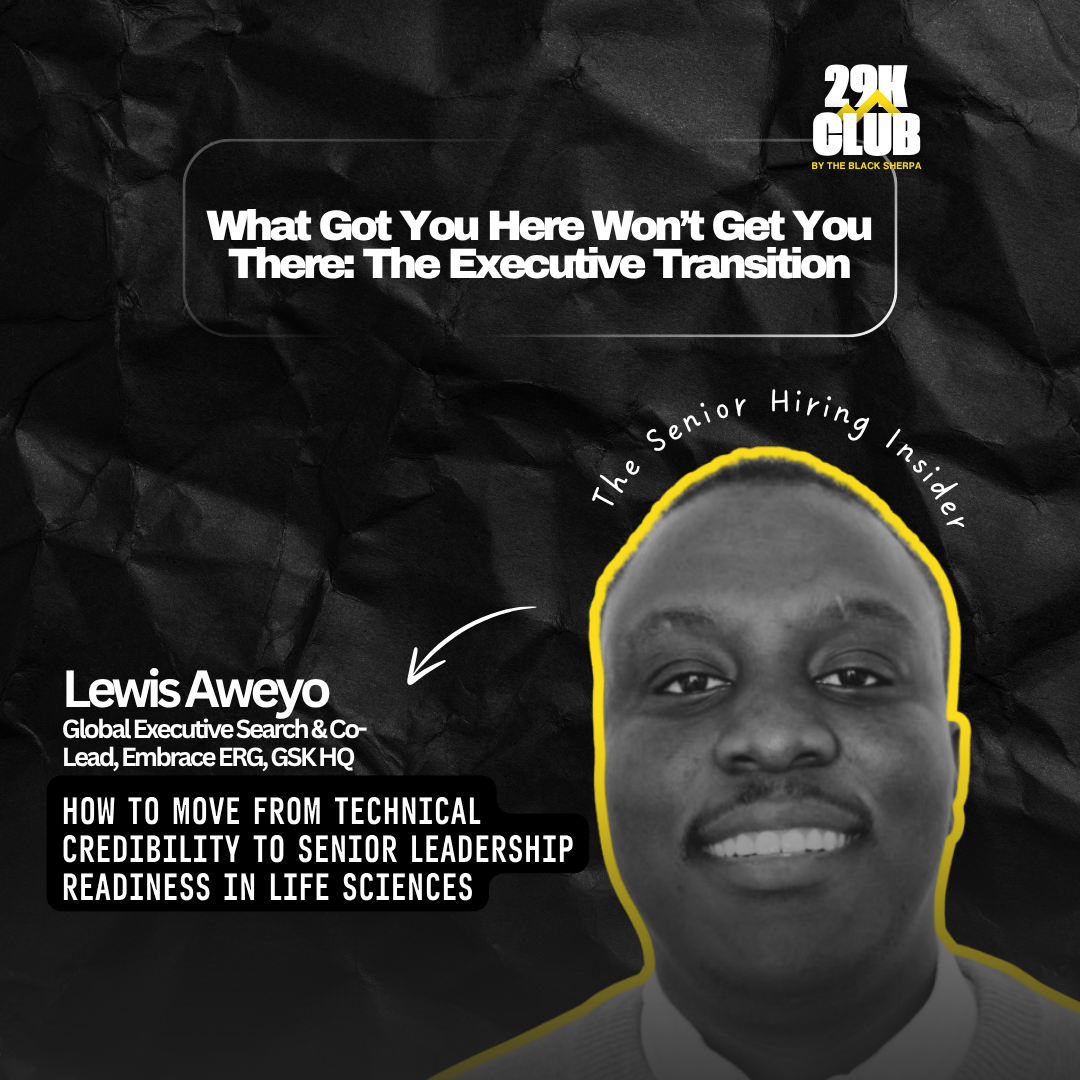
What got you here won't necessarily get you there. Lewis Aweyo shares insights from executive search on what separates technical credibility from senior leadership readiness, and why executive presence is about more than polish. Insights from his 29K Club masterclass
A note on this conversation: Lewis joined this 29k Club masterclass in a personal capacity, sharing insights drawn from his own career and experience in executive search.
His comments reflect his personal views and do not represent the official position of GSK or any current or former employer.
Halfway through an interview for a senior leadership role, a candidate stopped the hiring leader.
“You’re giving me your corporate self. Show me who you are”
It could have ended the interview.
Instead, it became one of the moments that distinguished him in a highly competitive process.
Why?
Not because he had the most polished answer.
Because, in that moment, he created trust.
The story, shared during a recent 29k Club masterclass led by Lewis Aweyo, exposed an uncomfortable truth about career progression:
You can be brilliant at your current job and still not have created enough evidence that you are ready for the next one.
You deliver. You understand your subject. Colleagues rely on you. Your performance reviews are strong.
Then someone says:
“You need to demonstrate more executive presence.”
Lewis offered a more useful interpretation:
“Sometimes, it is shorthand for: I have not seen enough evidence to trust you at the next level yet.”
That does not necessarily mean you are incapable.
It may mean that your judgement, influence or wider leadership impact has not been visible enough. It may also mean that the decision-maker’s view is being shaped by limited exposure, familiarity bias or an overly narrow idea of what leadership should look like.
The evidence that made you a credible technical expert is not always the evidence people use to choose a senior leader.
Why executive presence matters more as you progress
Most careers begin with a relatively clear exchange.
Learn the work. Perform it well. Take on more responsibility. Earn the next opportunity.
Technical expertise matters enormously during these stages. It establishes credibility and proves that you can deliver.
But the rules change as you approach senior leadership.
Lewis’s masterclass deck described senior management and executive leadership as rarefied air. Drawing on an APQC benchmark, he noted that senior managers and
executives represent approximately 5% of employees across industries. The number holding genuine executive power is smaller still.
At that level, nearly everyone under consideration is qualified.
They understand the industry. They have led launches, functions, programmes, markets or teams.
The question therefore moves beyond: Can this person do the work?
It becomes: Can we trust this person with ambiguity, influence, people and consequences?
That is a different test… and one many professionals are never taught how to prepare for.
Meet Lewis Aweyo: an insider in executive hiring
Lewis did not arrive in executive search through a carefully engineered career plan.
He trained as a scientist, then discovered that laboratory work was not for him. During an end-of-year conversation, he told his manager plainly that he hated the job.
He expected that honesty to end badly.
Instead, it opened a door into patient affairs.
That role later took him to the US, but it still did not feel right. He moved again… this time into recruitment, despite having no previous recruitment experience.
“You can learn,” he was told.
Today, Lewis works in Global Executive Search at GSK, leading executive hiring for ViiV
Healthcare and the Chief Patient Officer organisation globally. His experience includes VP,
SVP, C-suite, chair, non-executive and founding-leader appointments across pharmaceuticals, biotechnology, incubators and venture capital and private equity-backed organisations.
That nonlinear journey matters.
Lewis understands what it means to question a path that looks successful from the outside and build a career around work that genuinely fits.
His work also gives him direct experience of how organisations distinguish between several technically credible candidates.
His central message was simple:
Your technical skills may take you into middle management. Your leadership readiness determines whether you move beyond it.
How senior leadership hiring really happens
Senior appointments are often presented as a rational sequence of applications, interviews and assessment scores.
Drawing on his experience across executive search, Lewis described a messier reality.
Many senior opportunities are discussed privately before reaching the wider market. By the final stage, everyone is usually credible enough to perform the role.
Subjective questions then carry greater weight:
Do we trust this person’s judgement?
Can they build alignment beyond their formal authority?
Can they operate beyond their function?
How will they respond when the evidence is incomplete?
Can they represent the organisation under pressure?
Will they strengthen the people and culture around them?
Merit still matters.
But merit and perception operate together.
That creates a genuine tension. Judgement and trust are difficult to assess through a scoring sheet alone. Yet “gut feel” can also conceal affinity bias, familiarity bias and culturally narrow assumptions about what leadership should look or sound like.
Individuals benefit from making their impact easier to understand.
Organisations remain responsible for challenging biased decisions and building fairer assessment processes.
You cannot personal-brand your way out of every structural barrier.
The Leadership Readiness Shift
Lewis introduced a practical framework for understanding the executive transition.
It involves three shifts:
1. Specialist to enterprise leader
2. Credible to compelling
3. Producer to sponsor of talent
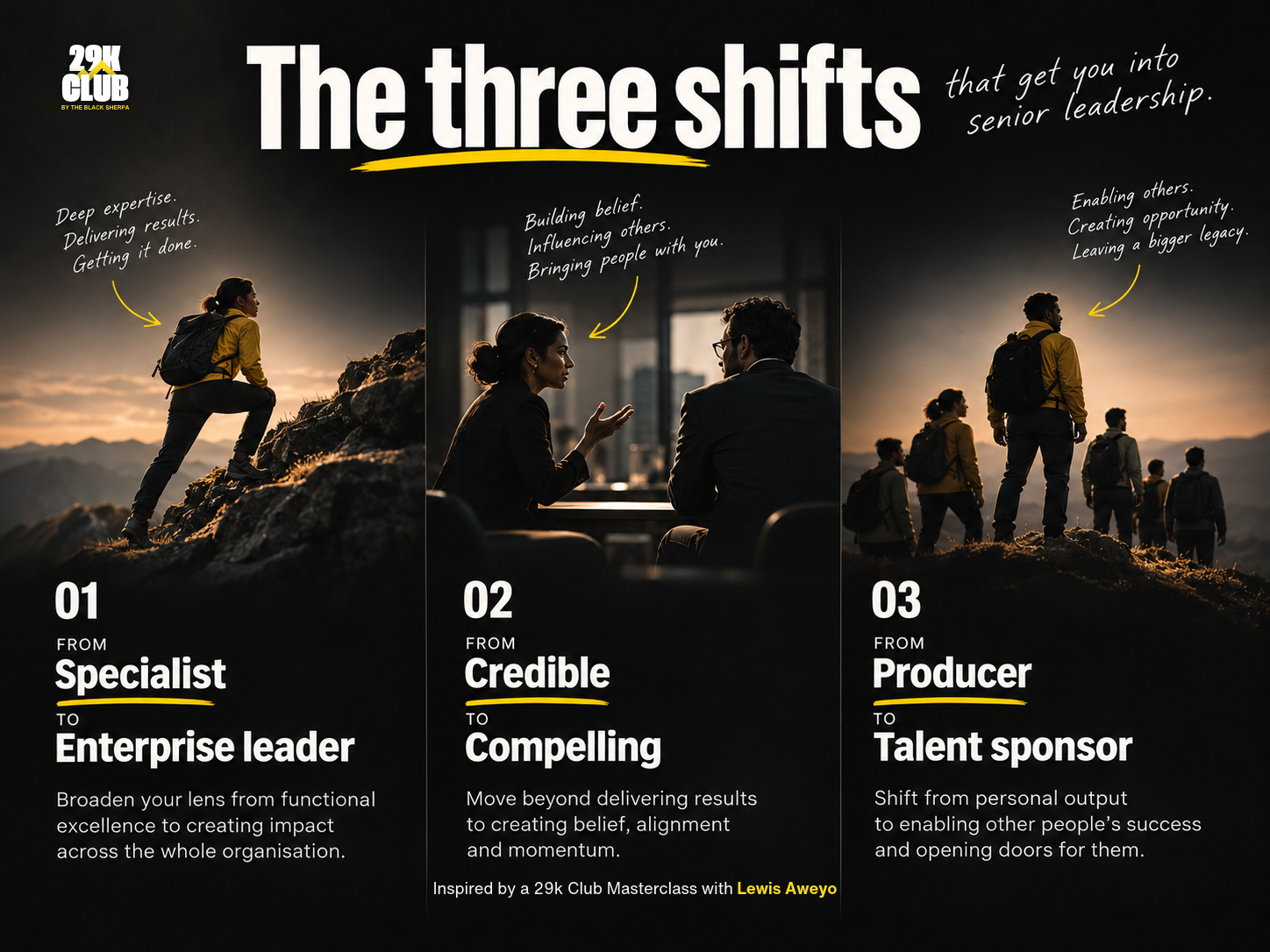
These shifts describe what changes for professionals pursuing executive leadership. They are not a hierarchy of professional worth
Deep specialists and individual contributors can create extraordinary organisational value without managing large teams.
Nor should executive presence require anyone to copy one personality, accent or culturally dominant leadership style. Calm may look different across individuals.
Confidence does not always sound loud.
The relevant evidence is judgement, impact, trust and the ability to create alignment… not resemblance to the leaders already in power.
Shift one: Specialist to enterprise leader
A specialist sees the organisation through the needs of their discipline.
An enterprise leader sees how functions, decisions and priorities connect.
They do not stop caring about their team. They stop treating their team as the centre of the organisation.
Instead of asking: “How does this help my function?”
They ask: “What creates the best responsible outcome for the organisation, its people, patients and wider stakeholders?”
Enterprise leadership is not unquestioning company loyalty.
Sometimes the most enterprise-minded action is to challenge a popular decision, expose a risk or slow the organisation down.
Lewis described enterprise leadership as the ability to influence beyond formal authority.
People do not move with you simply because they report to you.
They do so because they trust your judgement and understand the value of the direction you are proposing.
That might mean helping another function solve a recurring problem, connecting medical insights to an R&D or commercial decision, leading a cross-functional task force or contributing to a strategic decision outside your remit.
This is also why one sponsor may not be enough.
A senior advocate can recommend you. Another decision-maker may still disagree.
But when people across the organisation can describe how your work made them more effective, you develop something stronger than one endorsement:
An enterprise reputation.
Do not wait for a strategic title before demonstrating strategic thinking.
Shift two: Credible to compelling
During the session, Lewis asked one participant whether colleagues would describe him as credible or compelling.
He chose credible.
Why?
Because he completed what was required, on time and to a high standard.
That is valuable.
It is also what the role already expects.
Compelling leaders connect delivery to meaning.
They explain why a decision matters, what trade-offs are involved, who else will be affected and what becomes possible if people move together.
They shift from: “Here is what I achieved.”
To: “Here is what this makes possible for us.”
But compelling is not the same as charismatic.
Lewis described interviews in which confident, extroverted candidates told such engaging stories that he initially felt persuaded. When he reviewed the conversations afterwards, he
realised something important:
They had barely answered the questions.
Confidence without judgement creates risk.
Charisma without substance can disguise a lack of depth.
The goal is not to replace credibility with performance.
It is to make credible thinking easier for other people to understand, trust and act upon.
The leadership one-percenters
When every finalist is qualified, small signals become decisive.
Lewis referred to these as the one-percenters:
A concise answer rather than a ten-minute explanation
A company-wide perspective rather than a functional defence
A candid failure rather than a polished rescue story
Evidence of voluntary commitment rather than reliance on hierarchy
A clear trade-off rather than a perfect but unrealistic answer
A memorable point of view rather than corporate language
Small changes in how you communicate, make decisions and influence others can strengthen the evidence of your leadership readiness
Lewis learned this personally during a conversation with a chief executive.
He had been explaining an issue for several minutes when the executive interrupted:
“Stop. Just tell me this.”
It was a humbling reminder that senior communication is not about proving how much you know.
It is about identifying what the other person most needs to understand.
Before an important conversation, ask:
What is the decision?
What does this person need from me?
What are the two or three points that matter?
What can I remove without weakening the message?
Executive communication is not saying less for the sake of brevity.
It is removing what prevents the important point from landing.
The six signals of executive readiness
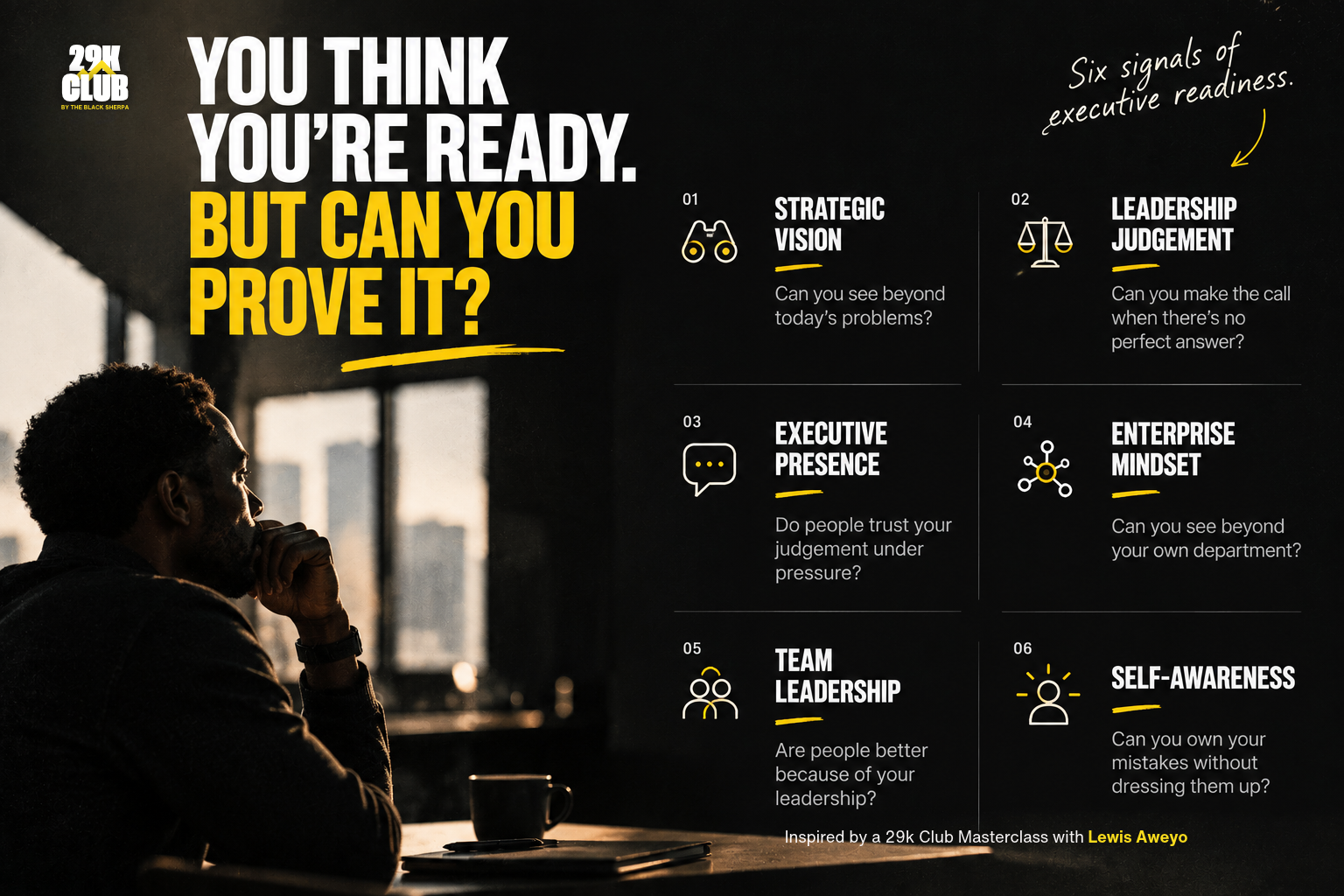
Lewis identified six qualities senior interviewers may try to detect.
Strategic vision
Can you describe what success could look like in three to five years and connect it to organisational priorities, external change and measurable outcomes?
Leadership judgement
Can you make a defensible decision when there is no perfect option? Can you explain the trade-offs and consequences?
Executive presence
Can you communicate with clarity, composure and structure under pressure?
This should not mean rewarding one style of speech, personality or cultural expression.
The test should be whether your communication creates understanding and confidence in your judgement.
Enterprise mindset
Can you connect your work to the wider organisation and explain the value created beyond your function?
Team leadership
Do people become more capable because of your leadership?
Authenticity and self-awareness
Can you speak honestly about your values, limitations, mistakes and development without retreating into rehearsed corporate language?
Stop turning failure into a disguised success story
Ask an ambitious professional about failure and they may produce a highly polished answer.
They describe the mistake quickly, explain how they rescued the situation and finish with an impressive result.
The failure becomes another achievement.
Lewis encouraged the room to stay with the uncomfortable part for longer.
At senior level, questions about failure are testing whether you can accept responsibility, recognise when ego has influenced your judgement, notice the impact on others and
correct yourself while events are still unfolding.
One anonymised example involved a candidate who spoke openly about how ego had influenced an important decision.
The power of the answer was not the scale of the eventual recovery.
It was the question she had learned to ask herself:
“Am I doing this because it is right for the team, the business and patients… or because I want the gold star?”
That demonstrated more than retrospective reflection.
It revealed a process for governing herself when future pressure arrived.
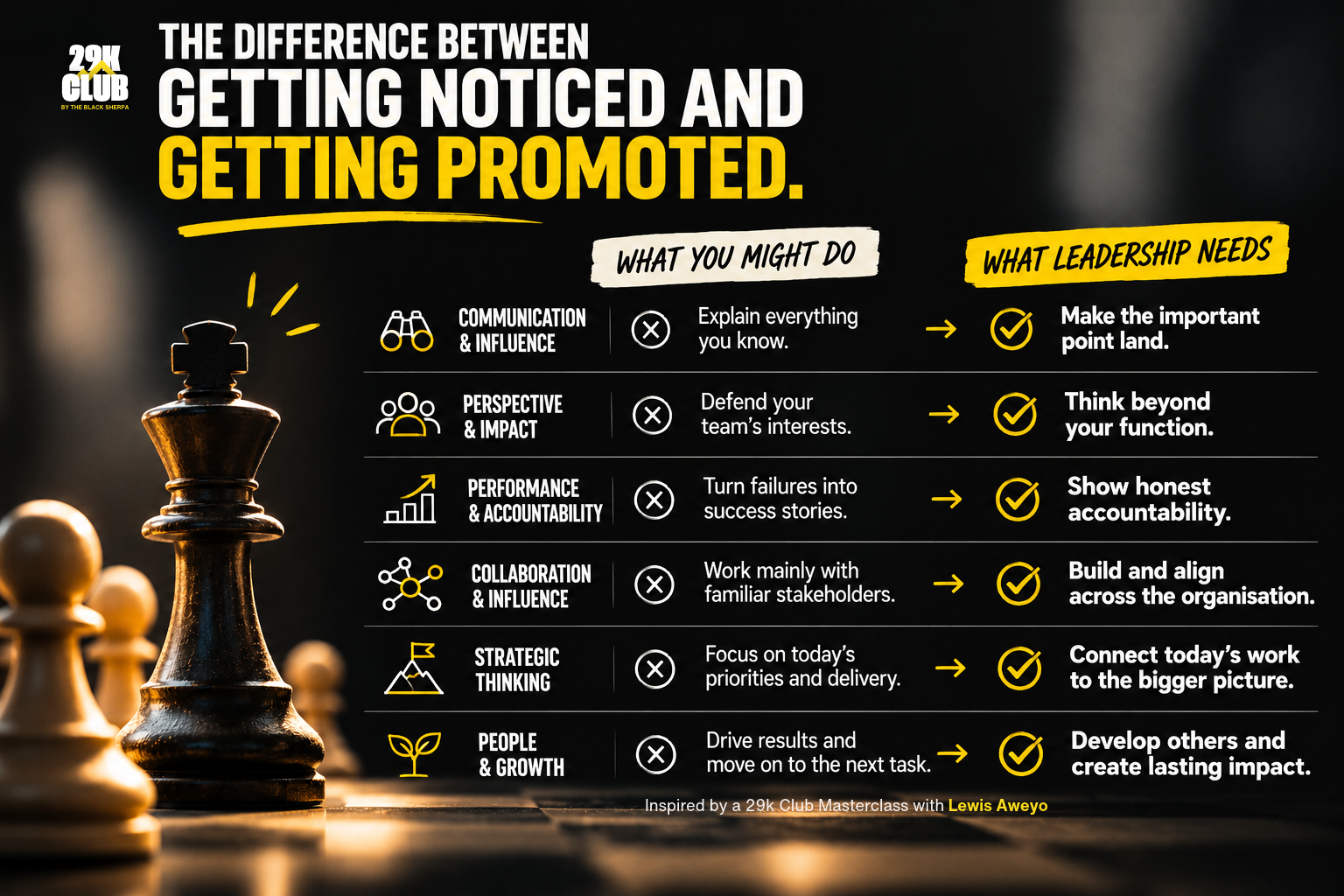
What separates strong performance from senior leadership readiness? These six practical examples highlight the subtle shifts in behaviour, judgement and influence that can make a difference
The Catch–Correct–Change model
Catch: When did you recognise that your behaviour or judgement was wrong?
Correct: What did you do while the situation was still live?
Change: What is now different in how you decide, communicate or lead?
Reflection after the damage is useful.
Executive judgement includes noticing yourself before the damage becomes irreversible.
Shift three: Producer to sponsor of talent
The producer is valued for what they personally complete.
The senior leader is judged increasingly by what other people achieve around them.
That requires a shift from doing the work to creating the conditions in which others can succeed.
A revealing leadership test is:
If someone interviewed the people around you, could they explain how your leadership made them better?
Could they describe a capability you helped them build, an opportunity you created, a difficult conversation that improved their performance or a moment when you stepped back and allowed them to lead?
The producer can point to completed work.
The sponsor of talent can point to stronger people.
The move from “I” to “we” does not require disappearing from your own story.
Speak only in “I” and you may appear unable to enable others.
Speak only in “we” and interviewers may struggle to understand your contribution.
Strong leaders explain what they personally saw and decided, how they enabled others and what the team achieved as a result.
Their impact travels through people.
Sponsors talk about you when you are absent
Lewis drew a clear distinction:
Mentors talk with you. Sponsors talk about you.
A mentor helps you think.
A sponsor uses their credibility when you are not in the room.
But sponsorship is not simply finding a senior person and asking them to advocate for you. Advocacy becomes stronger when that person has evidence of your judgement, aspirations and impact.
Lewis suggested asking a more challenging question:
“If a role opened in your leadership team today, would you hire me?”
Then ask why.
The answer may reveal more than months of general career conversation.
Your LinkedIn profile should answer: “Who are you?”
Lewis explained that when he presents a candidate, the question is rarely limited to what they have done.
Decision-makers want to understand: “Who is this person?”
Lewis reviewed his own LinkedIn profile and realised that he sounded like a “corporate robot”.
Read your LinkedIn About section and ask:
1. 2. 3. 4. 5. Could this have been written about 500 other professionals?
Does it explain how I arrived here… not only where I have worked?
Can a reader identify what matters to me?
Does it show the impact I want to create?
Could someone explain who I am after reading it?
You do not need to manufacture vulnerability or share parts of your life you would rather keep private.
You need enough humanity for someone to remember the person behind the credentials.
Leadership is not the only valid destination
One of the most important moments came when a participant questioned whether organisations push technical experts towards people management because it remains the
main route to greater status and pay.
Lewis recognised the problem.
He had once been told that further progression required managing people, despite not being sure that he wanted the responsibility. Looking back, he believed he had taken on
leadership before he was ready.
He also shared an anonymised example of someone who reached a senior role and later realised that the reality of the position did not fit the work or life they wanted.
That is not an argument against ambition.
It is a warning against pursuing a title without investigating the reality attached to it.
Before chasing the next level, ask:
What does an ordinary Tuesday in that role involve?
What pressures follow the title home?
How much time is spent leading people rather than doing the work I enjoy?
What will I need to stop doing?
Whose life, beyond my own, will this decision affect?
A title can represent progress and still take you further from the life you want.
Career progression is not only the process of moving upwards.
Sometimes it is the process of getting closer to yourself.
Five actions that build leadership readiness
Lewis closed with five practical moves:
Get honest feedback: Ask what you need to demonstrate more consistently… not simply what you already do well.
Find and challenge a sponsor: Be clear about your aspirations, then ask what evidence they would need before advocating for you.
Hone your narrative: Build a coherent story linking your experience, values, strengths and future contribution.
Be seen as a strategist: Propose an idea, lead a task force or step into work that exposes you to enterprise-level decisions.
Push beyond your comfort zone: Choose a challenge that builds a senior leadership skill: speaking up, managing conflict, making an unpopular decision or accepting accountability for uncertainty.
Key insights to save
Technical expertise establishes credibility; it does not automatically create leadership readiness
Executive presence should be evidence of judgement… not resemblance to a dominant leadership style
Senior hiring combines merit, perception, advocacy and trust
Enterprise leadership includes responsible challenge, not unquestioning loyalty
Being compelling is not the same as being charismatic
Strong failure stories demonstrate real-time self-awareness, not a perfect recovery
Sponsors advocate when you are absent, but they need evidence they can defend
Team leadership is measured through the growth and performance of other people
Deep specialists and individual contributors do not need to become people managers to create significant value
A senior title is not success if you do not want the work or life attached to it
The conversations that change careers
The masterclass was supposed to last an hour.
It ran well over.
Not because Lewis Aweyo had more slides.
Because the questions kept coming.
What does executive presence look like if you're an introvert?
Can being compelling become dangerous when charisma outweighs substance?
What happens when one senior leader believes in you, but another doesn't?
Are we pushing brilliant specialists into management simply because we haven't created better alternatives?
And what happens when the career you've worked so hard to build starts costing you the life you actually want?
These aren't questions you'll find neatly answered in a leadership textbook.
They're the questions that emerge when ambitious professionals have the opportunity to challenge assumptions, share experiences and learn from people who've seen how things really work.
Lewis brought years of executive search experience into that conversation. But what made the session valuable wasn't simply what he knew.
It was what happened when his experience met the questions, perspectives and ambitions of the people in the room.
We're incredibly grateful to Lewis for his generosity, candour and willingness to share insights that aren't always accessible to professionals navigating their careers.
And that, ultimately, is what we're building through the 29K Club.
A community where experienced leaders share perspectives that open doors. Where career conversations go beyond polished advice. And where professionals across life sciences help one another navigate the realities of work.
Through expert-led masterclasses, weekly group mentoring and genuine connections, we're helping members build three things that matter:
Clarity. Confidence. Community.
Because career progression isn't just about what you know.
Sometimes, it's about the conversations you get to be part of.
The unwritten rules of work shouldn't remain unwritten.
What evidence are you creating?
Would colleagues describe you as credible… or compelling?
Who would advocate for you when you're not in the room?
And are you pursuing senior leadership because you want the work… or because you inherited somebody else's definition of success?
Choose one shift. Create the evidence.
Want to be part of conversations like this?
Join the 29K Club and learn alongside ambitious professionals and experienced leaders who believe career growth shouldn't depend on knowing the right people or having access to the right rooms.
Climb steady 🖤
I’m Yam – Founder of The Black Sherpa
Founder | Strategist | Speaker | Host of The Black Sherpa Podcast
I founded The Black Sherpa to create a world where talent rises on merit and no one’s potential is held back by bias or barriers.
Through bold strategy, storytelling, and our flagship community, The 29k Club - I help professionals grow with confidence and support leaders to build cultures that truly live their values.
Let’s connect and build a future where inclusion powers performance, and leadership reflects the world we serve.