
Confidence Isn’t the Problem. Trust Is.
Reflections from a Black Sherpa 29k Club Masterclass with Mira, Trust Leadership Coach, Former Chief People Officer, helping leaders build trust deliberately
You don’t have a confidence problem
You’ve just been taught to look for it in the wrong place
Most people spend years trying to feel more confident…
before they speak up, before they go for it, before they take the risk.
But what if confidence was never the thing you were missing?
“Confidence is a myth.”
“Fake it till you make it?… it might get you through a moment… but it won’t sustain you.”
“We are often taught to doubt ourselves before we learn to trust ourselves.”
You’ve been here before.
Camera on.
Senior people in the room.
You’ve got something to say.
You know you do.
But your brain runs the check:
Is this right?
How will this land?
Do I sound credible?
And just like that…
The moment passes.
The real problem (and it’s not confidence)
Most of us have been told:
👉 “You just need to be more confident.”
In reviews.
In interviews.
Before stepping into leadership.
It’s become the default diagnosis.
But in this Black Sherpa 29k Club masterclass, Mira reframed it:
👉 Confidence is a state.
👉 Self-trust is the foundation.
Confidence rises and falls.
Self-trust stays.
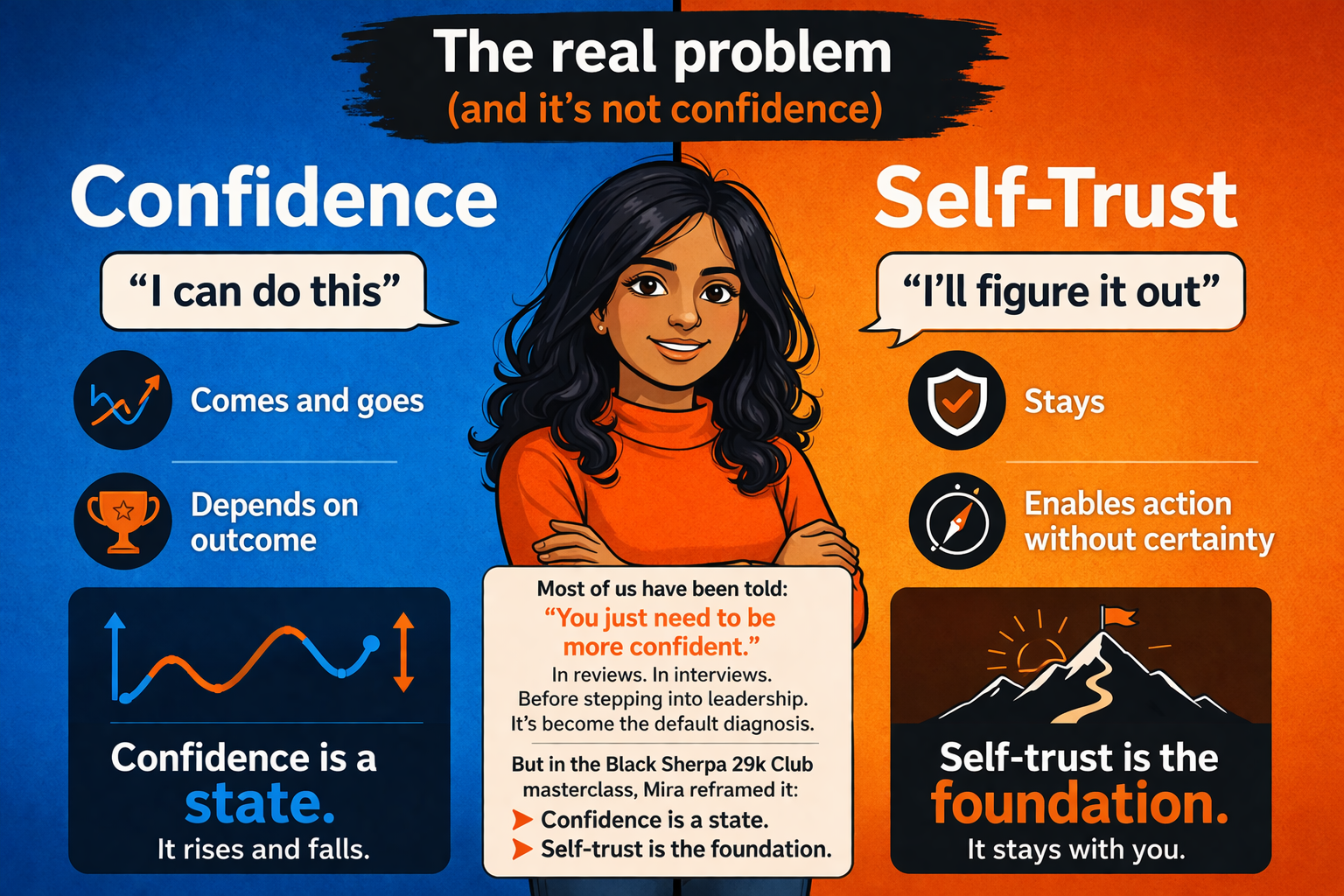
Confidence Vs Self Trust
The uncomfortable truth: we’ve been conditioned this way
Mira started with something deeper:
“We are often taught not to trust ourselves.”
From a young age, we’re conditioned to:
be cautious
look for danger
question unfamiliar people
seek approval from authority
Even well-meaning advice: “be careful,” “play it safe” - trains us to look outward for certainty.
Not inward.
Then we enter environments that expect:
confidence
decisiveness
leadership presence
Without ever teaching us how to trust ourselves first.
So we adapt.
We perform.
We “fake it.”
And over time… it becomes exhausting.
The hidden tension: external vs internal validation
Most of us were never taught to measure ourselves internally.
We were taught to ask:
“What does my manager think?”
“How did that land?”
“Was that good enough?”
Rarely:
“Am I proud of that?”
“Did I show up how I wanted to?”
“Do I trust the way I handled that?”
So we build careers based on external signals.
And slowly…
We lose the ability to trust our own.
The myth of confidence (and why it burns people out)
Mira put it simply:
“Confidence is that layer everyone expects… the best version of you, all the time. But where does the real you go?”
Confidence, as we’ve been taught, is fragile:
a good day → it’s there
tough feedback → it disappears
new environment → it resets
So we chase it.
But here’s the shift:
Confidence says: “I can do this.”
Trust says: “I’ll figure it out.”
That’s the difference.
Confidence depends on certainty.
Trust allows movement without it.
Sometimes… what we call confidence is actually privilege
This was one of the most important moments in the session.
Two people. Same outcome.
One challenges it.
One accepts it.
Why?
Because one assumes:
👉 “This can be questioned.”
The other assumes:
👉 “This is just how it is.”
And that’s where the insight lands:
Sometimes what we label as confidence… is actually privilege.
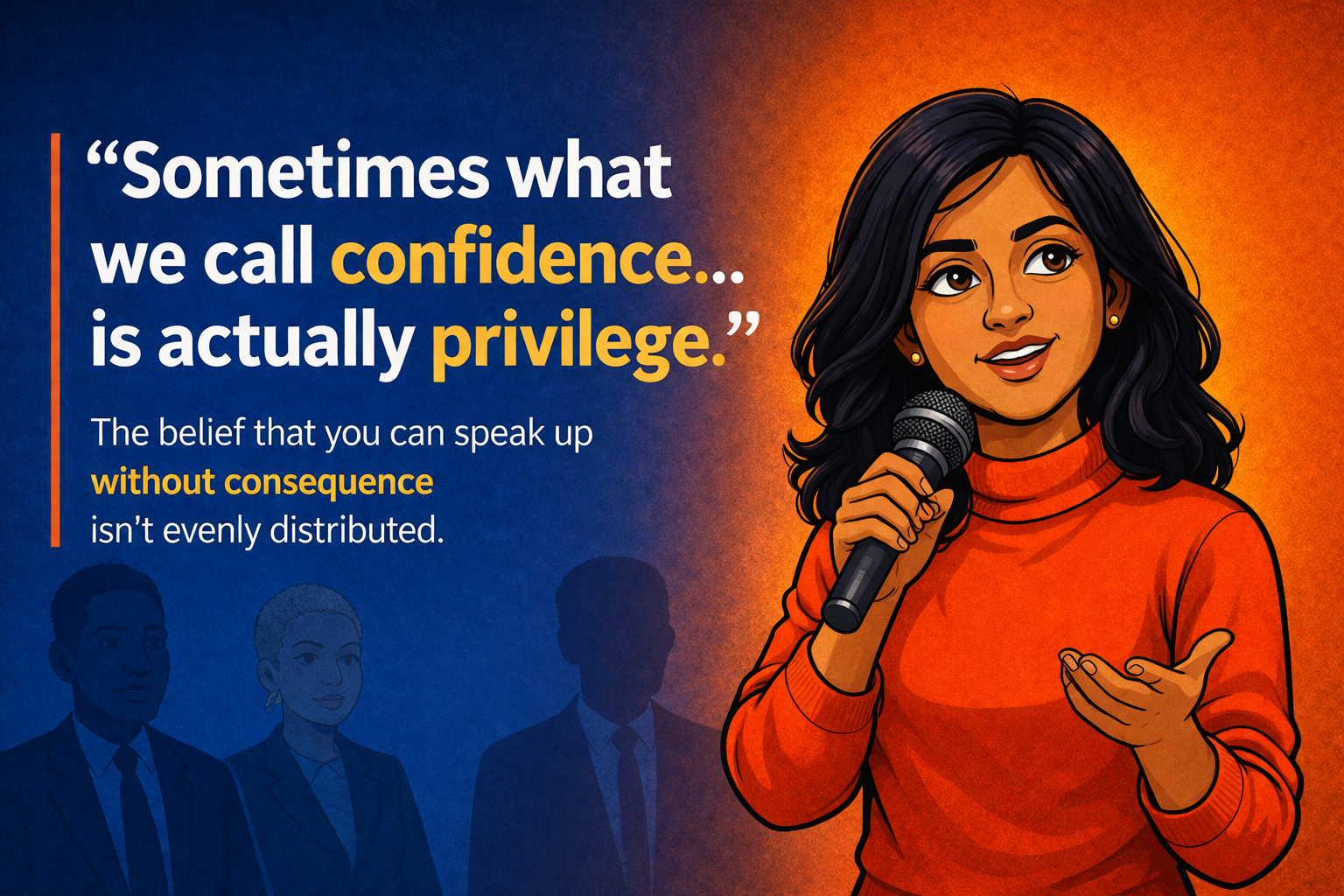
The belief that you can:
speak up
challenge
push back
…without consequence isn’t evenly distributed.
This isn’t about dismissing effort or ability.
It’s about recognising that the starting point — the belief that you can act — isn’t the same for everyone.
In some rooms, speaking up is encouraged.
In others, it’s remembered.
It’s not always about courage.
Sometimes… it’s about consequence.
The part we don’t talk about: masking
So what do people do?
They adapt.
They become:
slightly more polished
slightly more careful
slightly more filtered
Until one day…
They’re performing a version of themselves they don’t fully recognise.
From the outside:
they’re delivering
progressing
“doing well”
But internally:
they’re second-guessing
overthinking
waiting to feel ready
And that gap…
It grows.
The trust life cycle (and where things break)
Mira introduced a simple but powerful model.
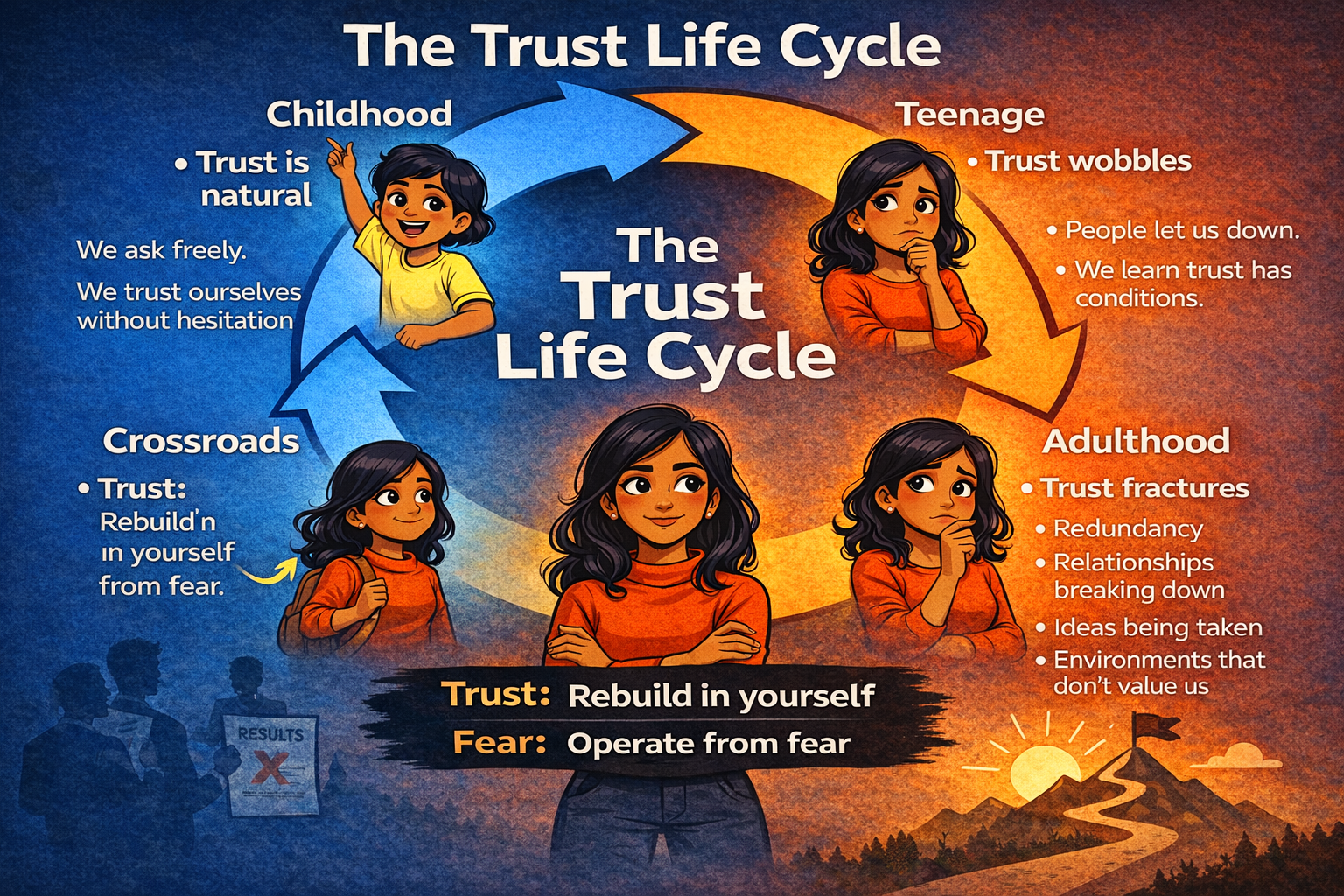
1. Childhood — Trust is natural
We ask freely.
We trust ourselves without hesitation.
2. Teenage years — Trust wobbles
People let us down.
We learn trust has conditions.
3. Adulthood — Trust fractures
Life happens:
redundancy
relationships breaking down
ideas being taken
environments that don’t value us
We protect ourselves.
Masking.
Filtering.
Hesitating.
4. The crossroads — Trust or fear
At some point, we choose:
👉 Rebuild trust in ourselves
👉 Or operate from fear
Mira called this:
“Your internal restructure.”
A human reminder: we’re not born doubting ourselves
There was a moment in the session that grounded this.
A reflection on children.
Open.
Curious.
Trusting.
No hesitation. No filter.
Just honesty.
Watching children is a reminder:
Self-trust isn’t something we build.
It’s something we lose… and have to relearn.
Trust is built in tiny moments
Mira said it clearly:
“Trust is a choice.”
Not a feeling.
Not a personality trait.
A decision.
And that decision is built in small moments:
You say you’ll go for a walk… and you go
You say you’ll follow up… and you do
You say you’ll show up… and you show up
Rebuilding self-trust doesn’t look like a breakthrough.
It looks like:
speaking once when you would have stayed quiet
applying before you feel ready
leaving an environment that doesn’t feel right
Small moves.
Big signal.
“You are the constant”
This line stayed with people:
“In every situation… you are the constant.”
Every team.
Every environment.
Every outcome.
You are the only consistent factor.
Not the cause of everything.
But the only part you can control.
And that’s where the leverage is.
The reality of trust in the workplace
One question challenged the idea of “leading through trust”:
👉 Does it lower standards?
Mira’s response:
Avoiding hard conversations is what breaks trust.
If something isn’t addressed:
people notice
standards slip
trust erodes
The reframe:
👉 Don’t think “difficult conversation”
👉 Think “honest conversation”
Feedback isn’t always a gift
We’ve all heard it.
But the truth is more nuanced.
Badly timed.
Uninvited.
Poorly delivered.
That’s not helpful.
That’s noise.
Feedback matters.
But how, when, and whether it’s given determines whether it helps or harms.
Rebuilding self-trust after being knocked
This landed hard.
Because everyone recognised it.
Rebuilding self-trust doesn’t look like:
👉 a big moment
👉 a sudden shift
👉 instant confidence
It looks like:
1. Identify where it broke
2. Understand the impact
3. Accept what happened
4. Plan how to rebuild
5. Act in small ways
6. Celebrate progress
And remember:
Confidence says: “I can do this.”
Trust says: “Even if this goes wrong… I’ll handle it.”
What most people get wrong
They wait to feel confident before acting
They treat hesitation as lack of ability
They outsource judgement to others
They confuse silence with safety
And it keeps them stuck.
Why this matters
When self-trust is low:
people hesitate
opportunities are missed
ideas stay unspoken
burnout builds
At an organisational level:
performance slows
accountability drops
culture becomes surface-level
When self-trust is strong:
decisions accelerate
conversations improve
people show up fully
The point isn’t that this is easy.
The point is that it’s available.
The Black Sherpa 29k Club difference
Most workplaces don’t create space for these conversations.
Because they’re:
messy
hard to measure
uncomfortable
But they’re the difference between:
👉 surviving your career
👉 and owning it
This is why the 29k Club exists.
Especially for those navigating environments where:
the rules aren’t always clear
feedback isn’t always direct
opportunities aren’t always visible
Because growth requires:
👉 Clarity
👉 Confidence
👉 Community
A simple but powerful exercise
Mira left us with this:
👉 If you trusted yourself fully… what would you be doing right now?
Write it down.
Then ask:
what’s stopping me?
what’s in my control?
what’s the first step?
About the Speaker
Mira Magecha is a former Chief People Officer turned Trust Leadership Coach and founder of Trust Lab.
In a world where trust in institutions, leadership, and systems is declining year after year, Mira’s work focuses on the invisible…but powerful role trust plays in leadership, decision-making, and influence.
She works with senior leaders and underrepresented talent to build self-trust as the foundation for visibility, performance, and impact.
Having spent years operating at executive and board level… often as the only Brown woman in the room… Mira brings deep lived experience of navigating power, politics, and pressure at the highest levels of organisations.
In this 29k Club masterclass, she challenged one of the most common narratives in professional development:
👉 Confidence isn’t the goal
👉 Self-trust is the foundation
A shift that reframes not just how we show up… but how we lead, decide, and move when certainty isn’t guaranteed.
Connect with Mira
Website: www.trustlabhq.com
LinkedIn: Mira Magecha
The leadership challenge
Sit with this:
Is this really a confidence problem… or a trust decision I’m avoiding?
Where am I waiting to feel ready instead of choosing to act?
What would change if I trusted myself just 10% more this week?
Where am I waiting for confidence… when trust would already be enough?
The goal isn’t to become fearless.
The goal is to trust yourself enough to move anyway.
Because the people who progress…
Aren’t always the most confident.
They’re the ones who decide:
👉 “I’ll go first.”
Climb steady 🖤
I’m Yam – Founder of The Black Sherpa
Founder | Strategist | Speaker | Host of The Black Sherpa Podcast
I founded The Black Sherpa to create a world where talent rises on merit and no one’s potential is held back by bias or barriers.
Through bold strategy, storytelling, and our flagship community, The 29k Club - I help professionals grow with confidence and support leaders to build cultures that truly live their values.
Let’s connect and build a future where inclusion powers performance, and leadership reflects the world we serve.