
With Kai-Nneka Townsend (Leadership Resilience & Burnout Consultant) and Sharon Pickering (Human Factors & High-Performance Systems Expert) A Black Sherpa 29k Club Masterclass
“Stress is not a personal failing. It is a measurable performance risk.”
“Resilience is not just pushing through no matter what happens.”
“How many of you feel like change is happening to you, rather than with you?”
It’s Early. Cameras Flicker On.
Some people are mid-coffee.
Others look like they’ve already been in meetings for hours.
Slack notifications still pinging.
Half-term chaos in the background.
Someone apologises for noise. Someone else laughs it off.
A mechanical digger is drilling through rock somewhere in the distance.
No one says it out loud yet.
But you can feel it.
Everyone is carrying something.
This Wasn’t a Polished Webinar. And That’s Why It Worked.
Kids off school.
A mum arriving mid-session to take over childcare.
Real life bleeding into the workspace.
No perfect conditions.
And that’s why it landed.
Because stress doesn’t show up when things are calm and controlled.
It shows up:
in between school runs
during high-stakes meetings
in career transitions
in the quiet pressure to “keep it together”
For many… especially those balancing responsibilities across work, family, and community… the load doesn’t just add up.
It multiplies.
You don’t always call it stress.
Sometimes it looks like overthinking.
Sometimes it’s irritability.
Sometimes it’s just feeling… off.
But underneath it all, it’s the same thing:
Too much. For too long. Without enough support.
The Reality We’re All Navigating (But Rarely Say Out Loud)
Before frameworks. Before slides.
One question:
“What are your top stressors right now?”
The answers came quickly:
Money
Workload
Health
Career uncertainty
Kids
Change
One word echoed louder than the rest:
Change
Relentless change
And then the question that shifted everything:
“How many of you feel like change is happening to you, rather than with you?”
That silence?
Recognition.
What Happens If We Ignore This?
Because this isn’t isolated.
34% of UK adults report high or extreme stress
42% of workers globally feel burned out
53% say too much change is happening at once
And that’s just what’s reported.
But numbers don’t fully capture what this actually feels like.
It often looks like:
The high performer who suddenly feels “off” but can’t explain why
The leader absorbing pressure from above and below with no release valve
The person doing everything right… and still feeling behind
When It’s Not Just Work
For some people, stress is about workload.
For others…
It’s about visibility.
Being the only one in the room.
Representing more than just yourself.
Feeling like you don’t get the same margin for error.
Carrying expectations that were never written down.
And for many, it’s both… layered on top of expectations shaped by identity, access, and environment.
So when someone says:
“Just be more resilient”
…it doesn’t always land as advice.
It can land as pressure.
What Should We Leave Behind About Resilience?
One question cut straight through the noise:
“What parts of resilience should we be throwing in the bin?”
It got a laugh.
But it landed.
Because a lot of what we’ve been taught about resilience… isn’t helping.
Push through no matter what
Handle it yourself
Don’t show weakness
For many, this hasn’t always been a choice.
It’s been a way of navigating environments that weren’t built with them in mind.
But over time, that approach can become something else:
It can become isolation with good branding… even if it once served a purpose.
Kai-Nneka said it plainly:
“Resilience is not just pushing through no matter what happens.”
Because when resilience becomes silent endurance…
The cost often shows up later.
A Better Way: The FLOW Framework
F – Focus on your why
L – Lose the excess
O – Optimise your resources
W – Weave sustainable habits into daily life
It’s simple.
But in the moments that matter… most people don’t have something simple to return to.
FLOW gives you that.
Not a perfect system.
A practical one.
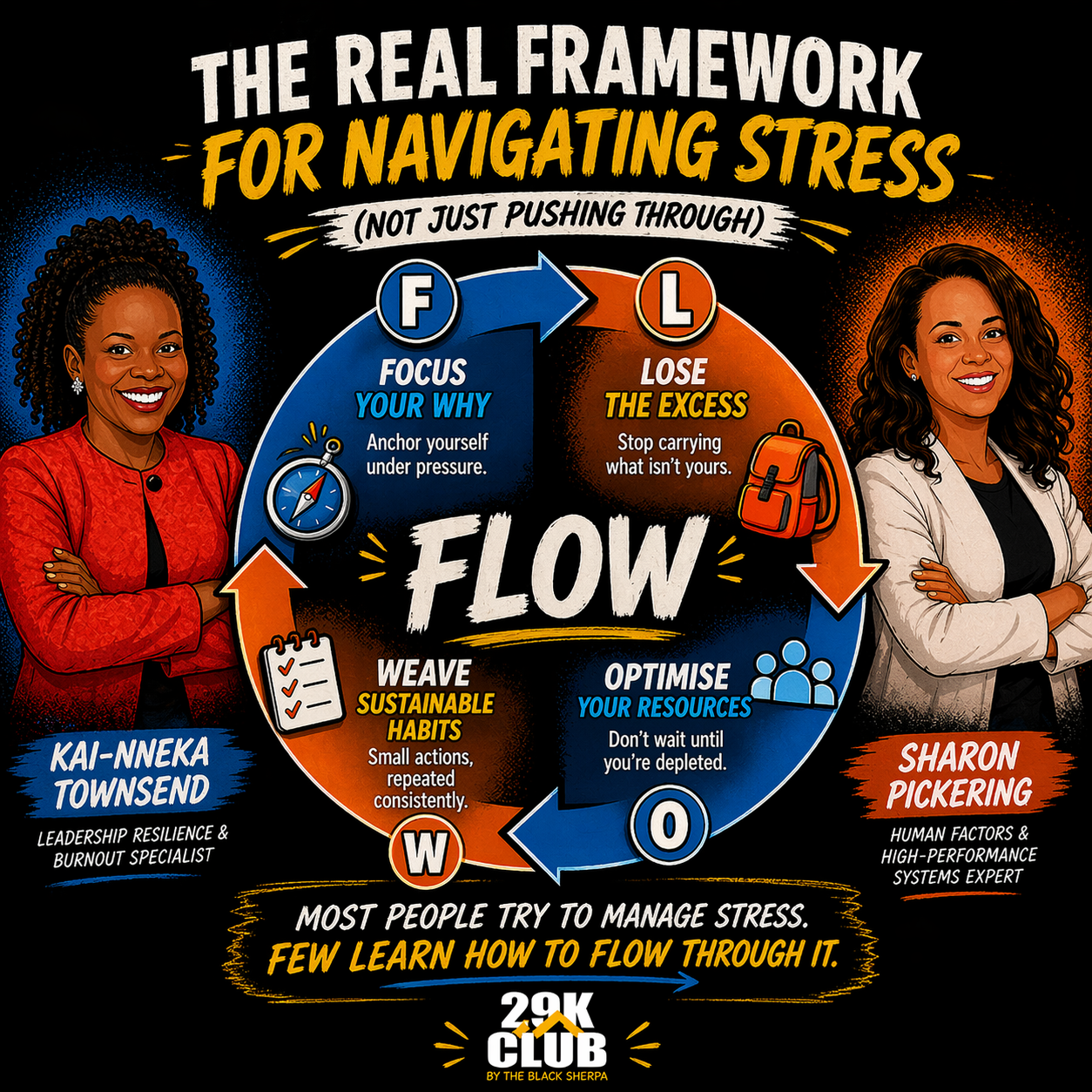
FLOW is a decision-making tool for high-pressure moments. It helps you anchor to what matters, release what doesn’t, optimise your capacity, and keep moving with intention.
F: Focus on Your Why (Your Anchor in Chaos)
“When everything feels urgent… nothing is clear.”
When we’re under pressure, our attention contracts.
We don’t think expansively.
We narrow.
We react.
We lose perspective.
Your why isn’t motivation.
It’s an anchor.
A reference point when everything else feels unstable.
It helps you zoom out before you zoom in.
Reconnect to what actually matters — not just what’s loudest.
Because without that anchor…
Everything feels important.
And that’s where overwhelm begins.
L: Lose the Excess (Stop Carrying What Isn’t Yours)
Participants were asked to list five stressors.
Then categorise them:
What can I control?
What can I influence?
What do I have no control over?
Something shifted.
One person realised they’d been stressing for weeks about something they couldn’t change.
Another realised they had more control than they initially thought.
Nothing about their situation changed.
But the weight did.
Kai-Nneka captured it simply:
“You’re spending cognitive resource that you don’t even have.”
Nathan reflected:
“Why carry the stress of something you can do nothing about?”
Most people aren’t overwhelmed because there’s too much.
They’re overwhelmed because everything feels like theirs to carry.
Letting go isn’t avoidance.
It’s intelligence.
Flow Isn’t Smooth. It’s Movement.
Flow is often misunderstood.
It’s not calm.
It’s not control.
It’s not perfection.
It’s movement.
Like a river.
It meets resistance.
It adapts.
It keeps going.
The goal isn’t to remove pressure.
It’s to stop getting stuck in it.
O: Optimise Your Resources (You Are the System)
“You’re not just working in the system… you are the system.”
This is where the conversation shifted.
Because the challenge isn’t always access to support.
It’s identity.
The question wasn’t asked loudly.
It showed up in hesitation.
In how people framed things.
But when it came out, it was direct:
“How do you ask for help… without feeling like you’re failing?”
That’s the real barrier.
Not capability.
Not opportunity.
Permission.
Sharon reframed it:
“Put your own oxygen mask on first.”
Not as a solo act.
But so you can stay present, capable, and effective within the systems you’re part of.
Because if you’re not resourced…
You can’t support anyone else.
Most people don’t struggle to access help.
They struggle to allow themselves to need it.
W: Weave Sustainable Habits
“Small, consistent practices that compound over time.”
Not dramatic overhauls.
Not perfect routines.
Not waiting for the right moment.
Just small actions.
Repeated.
Because if it doesn’t fit into your real life…
It won’t stick.
Sustainable performance isn’t built in breakthroughs.
It’s built in patterns.
A simple way to use it
Next time pressure hits, pause and ask yourself:
What actually matters here?
What am I carrying that isn’t mine?
What do I need to stay effective?
What’s one small action I can take?
Nothing about your situation needs to change immediately.
But your relationship to it can.
FLOW looks simple.
Applying it consistently under pressure…
is where the real work begins.
And that’s the difference.
Most people understand frameworks.
Very few are able to use them
when it actually matters.
When Someone Is Struggling… What Do You Actually Do?
One of the most important questions came from the room:
“If you spot someone heading for burnout… what should an intervention look like?”
The instinct is often to fix.
To step in.
To solve.
But that’s not always what helps.
Kai-Nneka offered a different approach:
Start with what you’ve noticed
Stay curious
Don’t assume it’s just work-related
Co-create the next step
Check back in
And importantly:
Leaders play a role… but not all drivers of burnout sit within their control.
Because one conversation won’t fix burnout.
But it can change direction.
What Do Boundaries Actually Look Like?
Another question grounded everything:
“How do you set boundaries when everything feels urgent?”
Because this is where theory often breaks.
Kai-Nneka brought it back to something practical:
Start with what you need to function well.
Not what looks good.
Not what sounds balanced.
What actually allows you to show up consistently.
And yes… boundaries can flex.
But if they disappear completely…
That’s often when things start to break down.
Where Organisations Get This Wrong
Most organisations respond to stress too late.
When performance drops.
When engagement dips.
When someone finally speaks up.
But by then…
You’re not managing pressure.
You’re often managing the consequences.
Why This Matters Beyond the Individual
This isn’t just personal.
It’s organisational.
Because when stress is left unmanaged:
performance drops
engagement dips
people disengage
talent leaves
This is where Rise by KCL comes in.
They focus on helping leaders and organisations build resilience earlier… particularly in environments where pressure is constant and stakes are high.
If today’s session resonated, it’s worth exploring their work:
Because this isn’t about fixing individuals.
It’s about creating environments where people can perform… and sustain it.
What Changes When You’re Not Doing This Alone?
At one point, the conversation shifted.
Not because of the framework.
Because someone shared something real.
And instead of silence…
There was recognition.
Heads nodding.
Chat lighting up.
That moment matters.
Because that’s where isolation starts to break.
The Questions People Didn’t Say Out Loud
Not every question made it into the chat.
But you could feel them:
“Is it just me?”
“Why does this feel harder for me?”
“How long can I keep going like this?”
And maybe the biggest one:
“Is it me… or is it the system?”
This session didn’t answer everything.
But it made those questions visible.
If Nothing Changes…
Six months from now…
You might still be carrying the same things.
Still pushing through.
Still hoping it eases.
But your energy is lower.
Your patience is shorter.
Your thinking is slower.
Not because you’re not capable.
But because you’ve been running without resourcing.
What This Changes
After this session, three things should feel different:
You stop seeing stress as a personal weakness
You start questioning what you’re carrying
You recognise support as part of performance
What This Looks Like Tomorrow Morning
Remove two things that aren’t yours
Ask for help sooner
Pause before reacting
Reset before pushing through
The Truth About Resilience
“Resilience is not a fixed trait. It’s a sliding scale.”
Some days you’ll have more.
Some days you won’t.
That’s not failure.
That’s human.
The 29k Club Difference
In many workplaces…
These conversations don’t happen consistently… or safely.
Here…
They do.
Because clarity, confidence, and community aren’t just ideas.
They’re how people actually grow.
Leadership Challenge
If nothing changes after this…
Then this was just another good session.
What are you carrying that isn’t yours?
Where are you pushing through instead of asking for support?
What is one small thing you can do this week to better resource yourself?
You don’t need to carry everything on your own… even if it sometimes feels like you have to.
But you do need to decide what you keep carrying.
And more importantly…
who you carry it with.
Climb steady 🖤
I’m Yam – Founder of The Black Sherpa
Founder | Strategist | Speaker | Host of The Black Sherpa Podcast
I founded The Black Sherpa to create a world where talent rises on merit and no one’s potential is held back by bias or barriers.
Through bold strategy, storytelling, and our flagship community, The 29k Club - I help professionals grow with confidence and support leaders to build cultures that truly live their values.
Let’s connect and build a future where inclusion powers performance, and leadership reflects the world we serve.