
Leadership Is for Everyone (Yes, Even You)
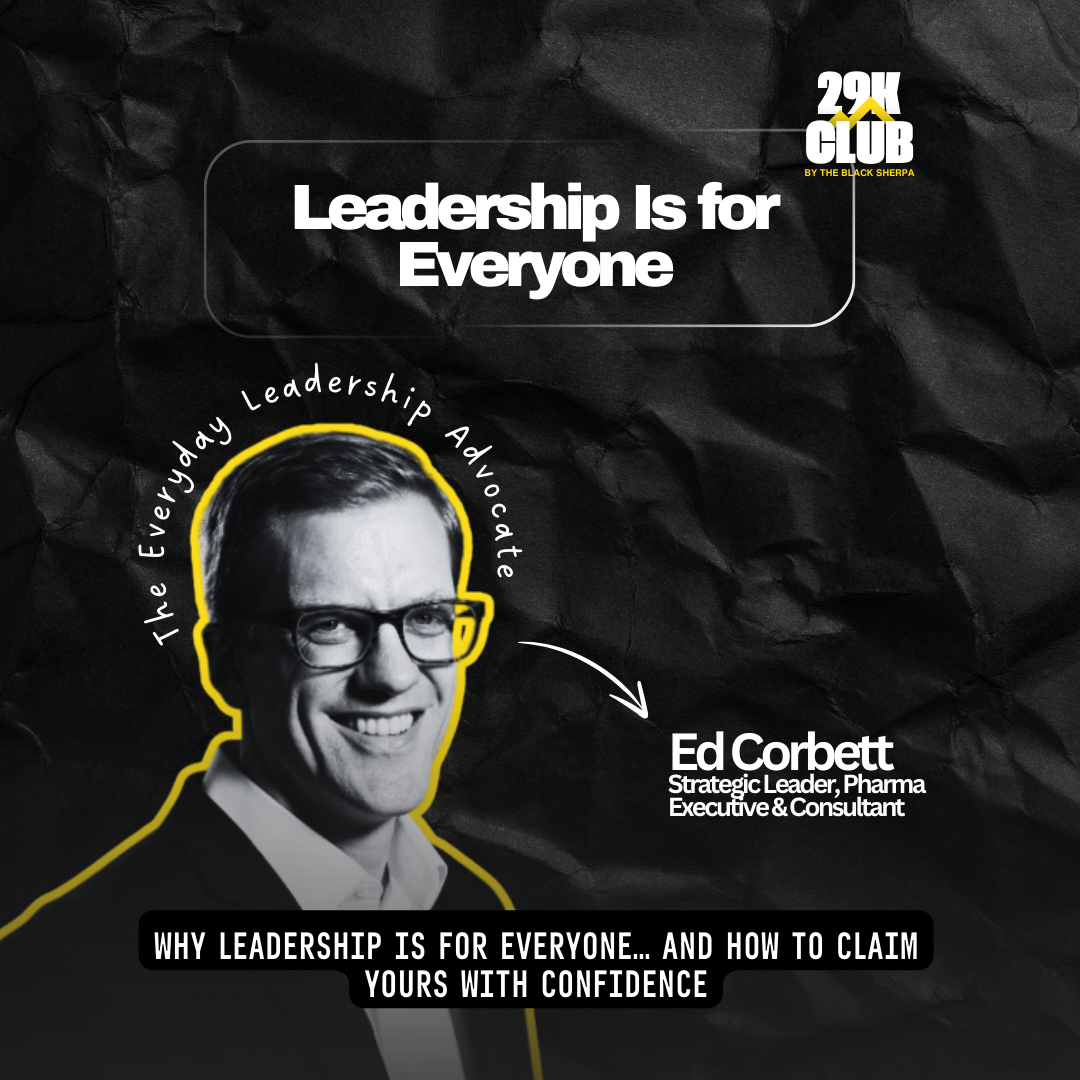
Ed Corbett — Strategic Leader & Pharma Brand Planning Expert (25 years’ experience)
A few lessons from my guy Ed Corbett on Leading Without the Title
“Leadership isn’t a title. It’s being up to something.”
“If he’s not going to do it, I’ll have a pop.”
“You’ve got two of these and one of these.”
“Age is just a number. A job title is just a name.”
That was the tone of the session.
Unpolished.
Human.
Honest about how leadership actually plays out… not how it’s described in books.
And crucially, honest about privilege, power, and risk.
Ed Corbett joined the Black Sherpa 29k Club to explore a deceptively simple idea:
Leadership is for everyone.
Not in a naïve, “we’re all equal now” way.
But in a grounded, real-world way… one that acknowledges different starting points, different risks, and different consequences for the same behaviours.
The myth most workplaces still sell us
Early in our careers, especially in large organisations, leadership is framed as something that comes later.
Later, when you’re promoted.
Later, when you have authority.
Later, when someone gives you permission.
Until then, the unspoken instruction is: be capable, be grateful, don’t rock the boat.
Yousef named something many people… particularly underrepresented professionals… recognise instantly:
“Sometimes in business there’s a sense of worshipping hierarchy.”
Hierarchy doesn’t just organise work.
It also decides whose voice feels “safe” and whose feels “risky.”
And when leadership is concentrated at the top, the cost isn’t always loud dysfunction. Often, it’s something quieter.
Ed described it like this:
“It wasn’t negative. It was just apathetic. You turn up, you turn the handle, you go home.”
That’s what happens when leadership is absent… not abusive, not dramatic, just missing.
And absence is rarely neutral. It creates drift, disengagement, and the slow erosion of meaning… especially for those already carrying the burden of caution.
The Leadership Vacuum Test (and why noticing it already counts)
One of the most powerful moments in the session came when Ed said:
“If you’re feeling ‘where are we going?’ and you can’t articulate it… that’s a leadership cue.”
This became what we can call The Leadership Vacuum Test.
When direction is missing, leadership is available.
But here’s where context matters.
Not everyone experiences that vacuum the same way.
For some people, naming it feels like initiative.
For others, it feels like risk.
That difference isn’t about confidence… it’s about consequence.
This is why leadership doesn’t have to begin with bold declarations or grand plans. Often, it starts with a question:
“Can I check… what are we actually trying to achieve here?”
That’s not dominance.
That’s sense-making.
And for many under represented professionals, sense-making is one of the safest and most effective ways to lead without being misread.
Agency here doesn’t mean responsibility for fixing broken systems.
It means choosing how you move within them.
Where Ed first saw leadership… and what privilege allowed him to see clearly
Ed reflected on his early career at MSD, working in a territory team with no formal leader.
Despite the lack of hierarchy, one person consistently shaped direction.
Why?
Not because of a title… but because she:
cared deeply about the territory
communicated clearly where the group was heading
listened patiently, especially to new joiners
made people feel safe to learn
Looking back, Ed could see the pattern clearly.
Later in the session, Yam named something important… and Ed didn’t shy away from it.
As a white, straight, middle-aged man with a stable upbringing, Ed holds forms of privilege that shape how leadership behaviours are received. He acknowledged this openly.
He didn’t claim shared lived experience where he didn’t have it.
He didn’t pretend assertiveness lands the same for everyone.
That honesty mattered… because advice about leadership is never neutral. It lands differently depending on who you are and how you’re seen.
The Care - Clarity - Commitment Loop (and why care is interpreted differently)
Ed’s stories revealed a leadership pattern many of us recognise intuitively:
People followed the colleague who:
visibly cared
created clarity
built shared commitment
This became the Care–Clarity–Commitment Loop:
Care – “This matters to me”
Clarity – “Here’s what we’re trying to do and why”
Commitment – “I’m in… and others lean in too”
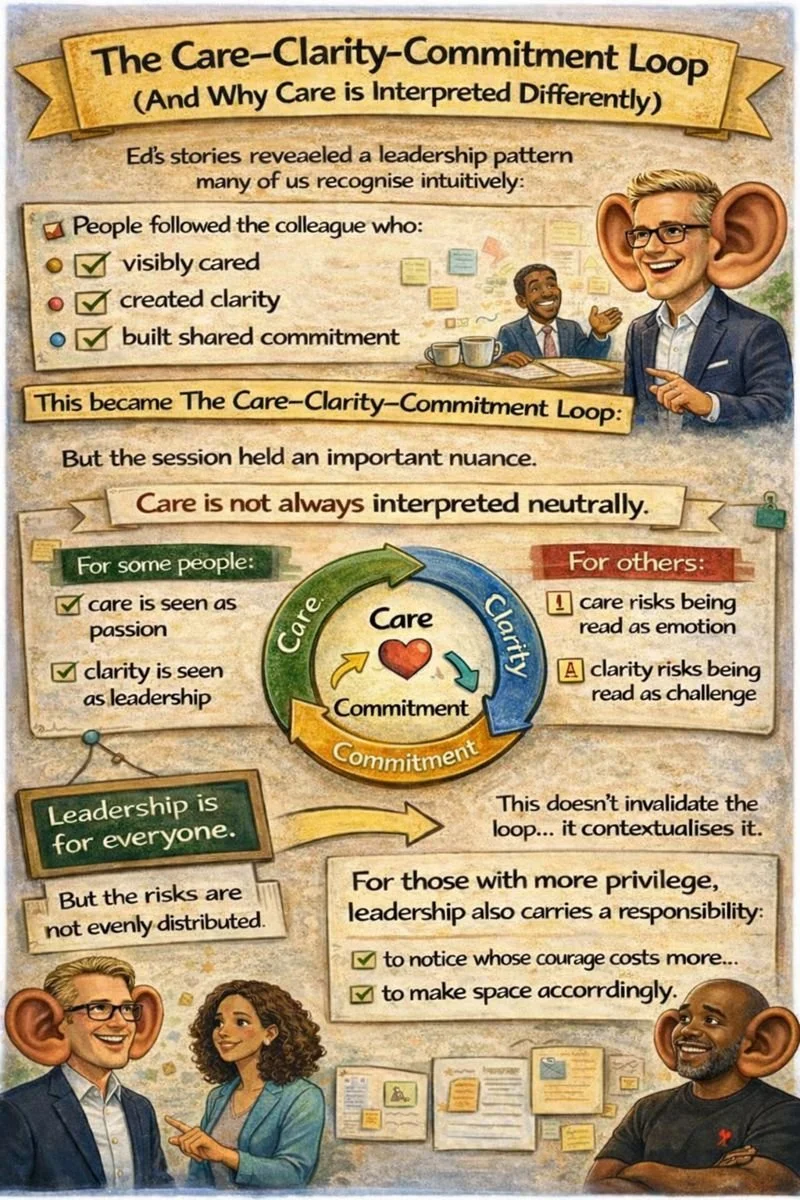
The Care–Clarity–Commitment leadership loop - the ears will make sense later, trust me
But the session held an important nuance.
Care is not always interpreted neutrally.
For some people:
care is seen as passion
clarity is seen as leadership
For others:
care risks being read as emotion
clarity risks being read as challenge
This doesn’t invalidate the loop… it contextualises it.
Leadership is for everyone.
But the risks are not evenly distributed.
For those with more privilege, leadership also carries a responsibility:
to notice whose courage costs more… and to make space accordingly.
The Timidity Trap vs. the Arrogance Myth (with context intact)
When Yam asked where people most often go wrong when leading without authority, Ed’s answer surprised some:
“Usually people don’t mess up by being too loud. They mess up by being too timid.”
This exposed a common myth:
“If I speak up, I’ll look arrogant.”
But Ed was careful not to frame timidity as weakness.
Timidity is often an intelligent response to risk… especially for people who’ve learned, through experience, that visibility can be costly.
This is the heart of The Timidity Trap vs. the Arrogance Myth:
Silence is often chosen as protection
But silence also has a cost… to teams, decisions, and careers
The work isn’t “be louder.”
It’s choosing where and how to be brave… not everywhere, not all the time.
Leadership doesn’t require abandoning self-protection.
It requires deciding when contribution matters more than comfort.
The Two-Ears Rule: listening as privilege-aware leadership
One of the most universally applicable insights of the session was Ed’s emphasis on listening:
“You’ve got two of these and one of these.”
This became The Two-Ears Rule.
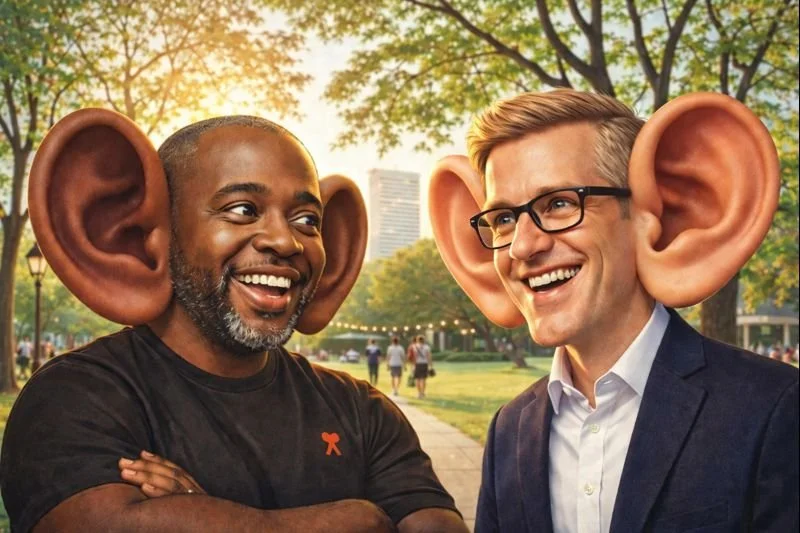
Two leaders. Four ears. One powerful reminder: listening is leadership
In unequal systems, listening is not passive.
It’s a form of leadership that:
lowers threat
builds trust
creates space for others
For people with more privilege, listening is a responsibility.
For people with less, it’s often a powerful way to lead without being exposed.
Leadership through listening doesn’t require permission… just intention.
And it doesn’t need to be perfect. Leadership almost always starts messy.
Why this conversation matters (especially here)
For underrepresented professionals, leadership advice often sounds like:
“Just be confident.”
“Just speak up.”
“Just act like a leader.”
This session did something different.
It:
acknowledged unequal risk
named privilege without defensiveness
avoided pretending systems are fair
still insisted on agency
Because while the system isn’t fair, disappearing inside it doesn’t change it either.
Leadership, as framed here, isn’t about posturing.
It’s about contribution, clarity, and care… applied thoughtfully.
The Black Sherpa 29k Club difference
This is why the 29k Club exists.
Not to pretend the mountain is flat.
But to help people climb it with context, community, and self-trust.
This session didn’t offer shortcuts.
It offered realism… and room to practise.
Your leadership challenge
Take a moment with these:
Where are you sensing a leadership vacuum… and what’s one low-risk way you could name it?
What do you care about enough to create clarity for others, even if it feels uncomfortable?
Where has self-protection quietly slid into self-silencing?
How can you practise the Two-Ears Rule as leadership this week?
Leadership doesn’t ignore privilege.
It navigates it.
And it begins the moment you decide your contribution still matters.
PS - A few books we couldn’t not mention
I couldn’t leave this train of thought without calling out a couple of the books that showed up… explicitly and implicitly in our conversation. Not as homework. More as useful companions if you want to go deeper.
Leadership: Plain and Simple - Steve Radcliffe
This was the backbone of much of Ed’s thinking.
Leadership isn’t a position… it’s being up to something
Direction matters more than authority
Start with what you genuinely care about, not what you think a “leader” should care about
Leadership lives in everyday moments, not big announcements
If you read one leadership book, this is a strong contender.
Hyperfocus - Chris Bailey
This came up in the context of attention, listening, and presence.
Focus is a leadership skill, not a productivity hack
Choose one or two things that really matter each day
Protect attention long enough to get into flow
Distraction isn’t a personal failure… it’s a design problem
In a world of constant noise, attention is influence.
Neither of these books offers shortcuts.
What they do offer is clarity… about what leadership actually looks like when the job title fades into the background.
Climb steady 🖤
I’m Yam – Founder of The Black Sherpa
Founder | Strategist | Speaker | Host of The Black Sherpa Podcast
I founded The Black Sherpa to create a world where talent rises on merit and no one’s potential is held back by bias or barriers.
Through bold strategy, storytelling, and our flagship community, The 29k Club - I help professionals grow with confidence and support leaders to build cultures that truly live their values.
Let’s connect and build a future where inclusion powers performance, and leadership reflects the world we serve.