
Purpose Under Pressure: Staying Human When the Stakes Are High
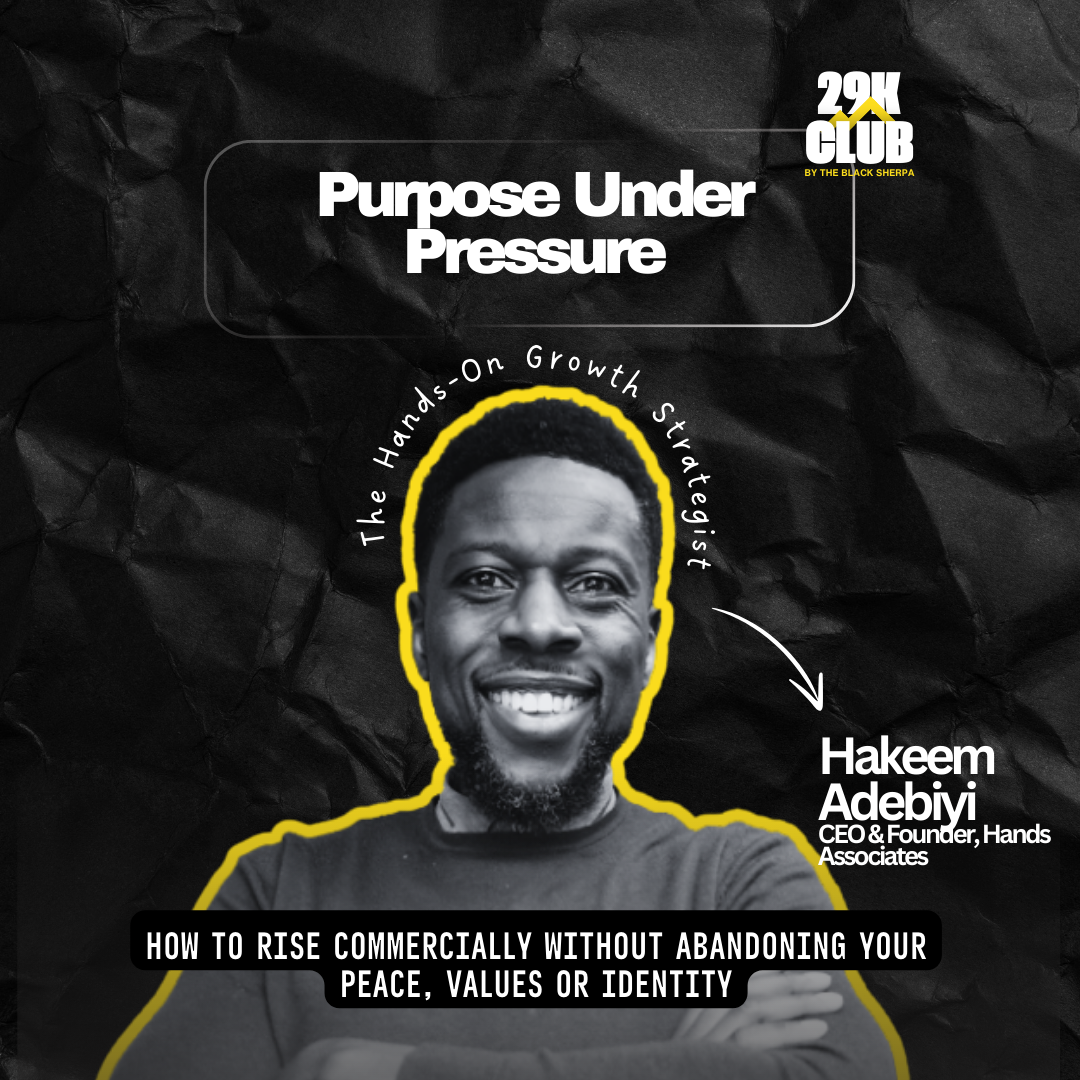
A Black Sherpa 29k Club masterclass with Hakeem Adebiyi, founder and CEO of Hands Associates, advising healthcare and life sciences leaders on strategy, leadership, and performance.
This wasn’t a session about doing more or pushing harder.
This wasn’t a session about doing more or pushing harder.
It was a mirror.
Not for output.
For identity.
A conversation about how capable, values-led people drift from themselves when pressure becomes the permanent backdrop to their working lives… not through collapse, but through quiet, professional compromise.
The conversation was led by Hakeem Adebiyi, founder and CEO of Hands Associates, and a long-standing advisor to leaders across healthcare and life sciences. Over several decades, Hakeem has worked at the sharp end of performance… as a former senior executive and as a trusted partner to organisations navigating growth, transformation, and intense commercial pressure.
But what made this Black Sherpa 29k Club masterclass different wasn’t a set of leadership tactics or performance frameworks.
It was the honesty.
Hakeem spoke from lived experience… of leading teams under scrutiny, of being accountable for outcomes that matter, and of learning (sometimes the hard way) where pressure sharpens judgement and where it quietly distorts it. He shared stories that many in the room recognised instantly, even if they hadn’t yet named them: moments where adaptation slipped into self-erasure, where integrity became something to “manage,” and where success began to feel oddly hollow.
Throughout the session, one idea kept resurfacing.
Pressure doesn’t usually break people.
It reshapes them.
Incrementally.
Professionally.
Often invisibly.
What unfolded over the hour was less a masterclass in leadership, and more a shared reflection on what it costs to stay aligned… and what becomes possible when people are supported to remain grounded while navigating demanding environments.
For a community built around clarity, confidence, and community, it was exactly the conversation that needed space.
“Bravery is staying in a job you no longer recognise yourself in”
“If you try to be someone else and it goes wrong, the only thing you’ll think is: if only I’d been myself.”
“Values aren’t broken in one moment. They’re eroded quietly.”
“I don’t want to be rich. I just want to never hesitate when my kids ask for shoes.”
“The relief you feel when you choose yourself will carry you further than fear ever could.”
These weren’t polished soundbites. They were lived truths… shared in real time, in a room full of people who recognised themselves in them.
This masterclass wasn’t about values as posters on a wall. It was about what happens when values are tested under pressure… in careers, leadership, money, identity, and belonging.
And why so many capable people don’t burn out because they lack talent… but because they’re quietly bending themselves out of shape.
When the session “ended”… and the real conversation began
Something telling happened when the recording stopped.
Nobody left.
The conversation deepened.
Stories surfaced about early career failures, bad managers, high‑pressure environments, shame, survival tactics, and the long shadows those experiences cast… even years later.
What emerged wasn’t advice. It was recognition.
This is what happens when people feel safe enough to tell the whole story… not just the highlight reel.
Values don’t usually break. They drift.
One of the most powerful insights from the session was how rarely values collapse in a single moment.
They erode.
Incrementally.
Quietly.
“Just a little push here. A little over the line there. Nothing huge. Until it wasn’t sustainable anymore.”
This pattern showed up again and again, and it’s worth naming because it removes shame and replaces it with awareness.
The Values Erosion Curve
Discomfort — This doesn’t feel right, but I can manage it
Normalisation — This is just how things work here
Self‑justification — I don’t agree, but I need to be pragmatic
Misalignment — I don’t recognise myself anymore
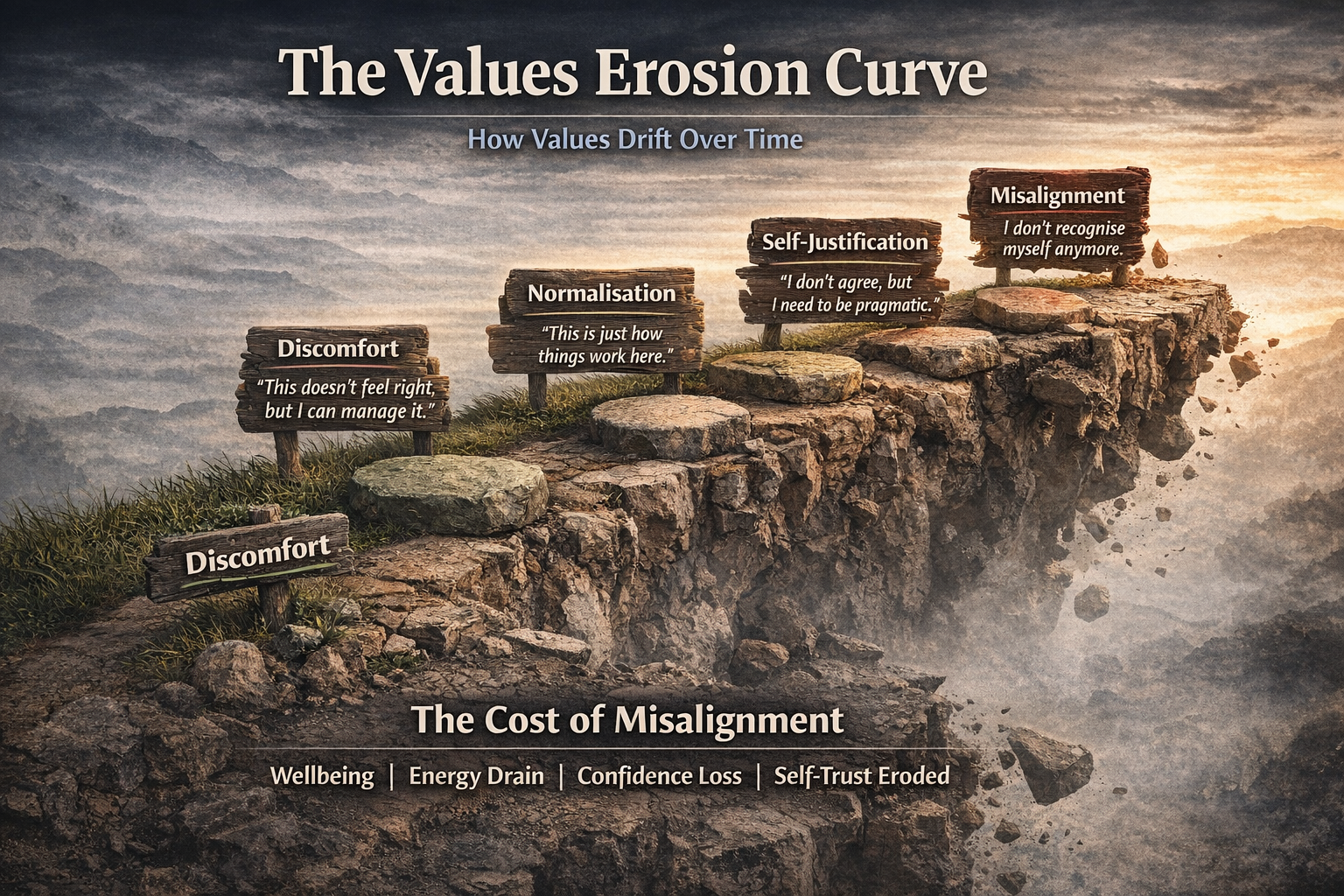
By the time people reach the final stage, the cost is already high… to wellbeing, energy, confidence, and self‑trust.
The relief described in the room wasn’t relief from work.
It was relief from misalignment.
The myth of the ‘work self’ vs the ‘real self’
Another theme that resonated deeply was the idea that we must fragment ourselves to succeed.
One reflection captured this perfectly:
“I’ve never had a work self and a real self. I’m the same person.”
Hakeem’s response was simple… and quietly radical:
Trying to be two people is exhausting.
And if success only comes when you’re pretending, the cost compounds every year you stay.
“If I don’t get the job or the promotion, I’d rather it be because of me… not a character I was playing.”
Authenticity wasn’t framed as vulnerability or oversharing.
It was framed as a long‑term career strategy.
Adaptation isn’t the problem. Unconscious adaptation is.
Pressure demands adaptation. That’s not the issue.
The danger lies in unconscious adaptation… when survival skills quietly become identity‑eroding habits.
Code‑switching, mirroring energy, flexing style… these can be powerful tools, especially for people navigating environments where they are under‑represented.
But there’s a cost when adaptation stops being a choice.
A useful distinction:
Conscious adaptation - intentional, temporary, values‑anchored
Unconscious adaptation - automatic, draining, identity‑blurring
A question that landed powerfully in the room:
If I stopped adapting in this way tomorrow, what would I be afraid of losing?
Pressure doesn’t just test performance.
It tests identity.
Integrity under pressure: focus on consequences, not character
When values are tested at work, conversations often collapse into judgement.
Hakeem offered a more practical path… one that protects both integrity and influence.
Instead of attacking character, focus on behaviour and consequence.
The Consequence Lens
Anchor back to stated values
Name the real‑world risks… ethical, legal, reputational, human
Make the cost of misalignment visible
This approach matters because pressure narrows judgement.
People don’t usually abandon integrity because they’re reckless. They do it because pressure distorts perspective.
Grounding conversations in consequence widens that view again.
As one voice in the room put it:
“I don’t want people being run out of good businesses by bad managers.”
I think that voice was me.
Failure, shame, and the leaders we become
One of the most human threads emerged around early career failure.
Not catastrophic failure.
The quiet dip. The early stumble. The period of self‑doubt no one sees.
Many leaders carry these moments silently, using success as proof that they’ve moved on.
Yet those experiences often shape the most grounded leadership instincts:
Patience with others
Sensitivity to context
Awareness of what struggle actually feels like
“Nobody talks about the dip. Everyone just shows the highlight reel.”
Pressure doesn’t just create resilience.
It also creates empathy… if we allow ourselves to learn from it.
A quiet pause
Take a moment to ask yourself:
Where am I pushing through something I haven’t fully processed?
What am I still trying to prove… and to whom?
What would change if I didn’t need to erase my past to justify my present?
Faith as an anchor when pressure distorts perspective
Late in the conversation, another thread surfaced quietly… not as instruction, but as grounding.
Faith.
Not as something imposed on others, but as something personal.
A place to return to when identity, ego, and pressure start pulling you in different directions.
Pressure has a way of narrowing our world… shrinking us to targets, titles, and outcomes.
For some, faith becomes a way of widening that perspective again.
A reminder that worth is not synonymous with output. That identity is bigger than role. That success is not the same as significance.
For others, that anchor may come from philosophy, tradition, community, or reflection.
What matters is having somewhere to stand when the stakes are high.
When pressure strips things back, faith can become less about certainty… and more about remembering who you are when the noise gets loud.
Pressure can forge diamonds… but it can also distort values
The session resisted easy conclusions.
High‑pressure environments can accelerate learning, sharpen judgement, and build confidence.
But without clarity and support, pressure also teaches the wrong lessons:
That endurance equals worth
That silence equals strength
That success requires self‑erasure (losing sight of who you are while trying to succeed)
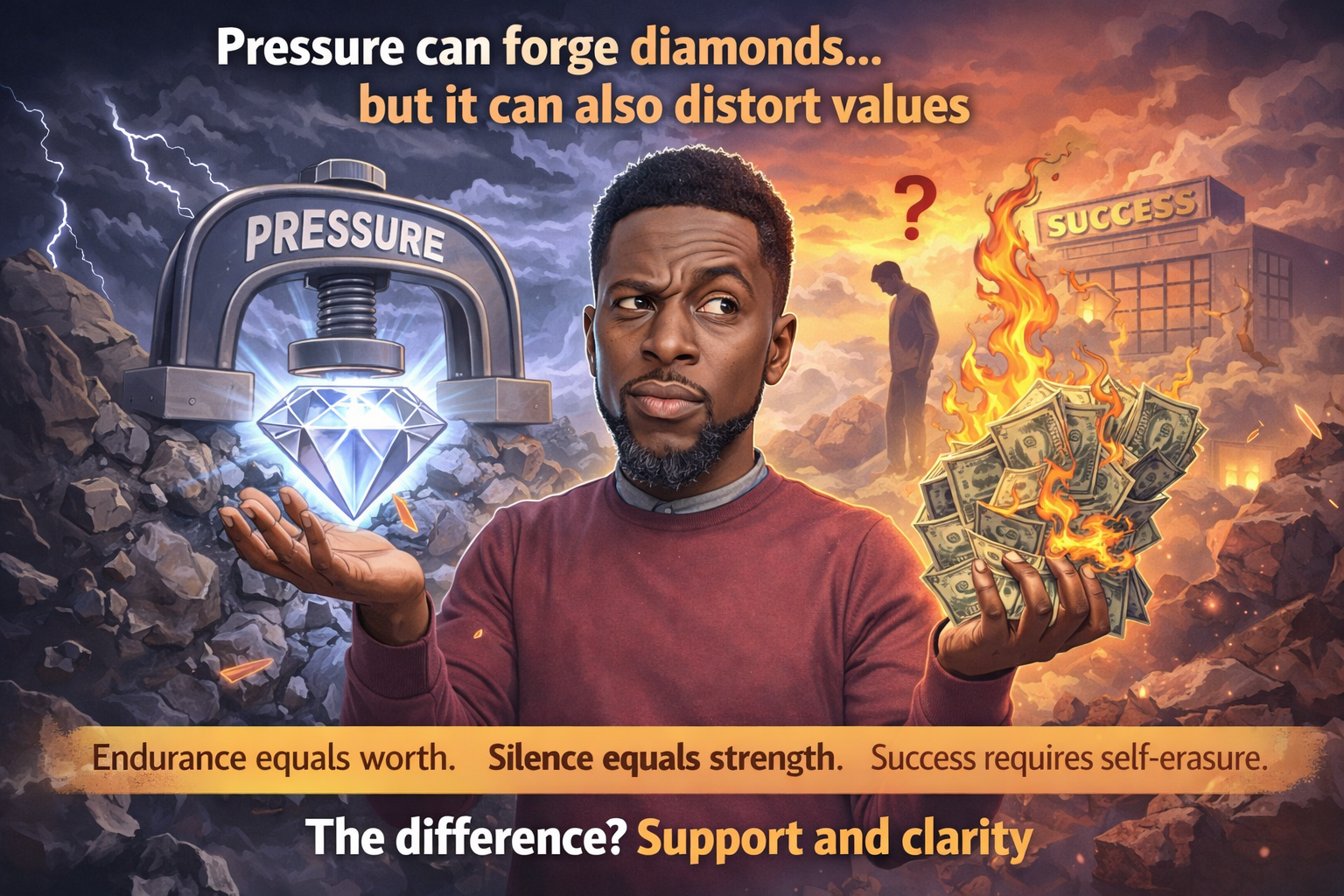
The difference isn’t pressure itself.
It’s whether people are supported to stay grounded while navigating it.
Redefining success: enough, not excess
Late in the conversation, the focus shifted from ambition to sufficiency.
Not how much more?
But what is enough?
Success was reframed not as excess or status, but as security and choice… the ability to meet responsibilities without fear, and to make decisions without self‑betrayal.
In a culture that constantly moves the goalposts, this was a grounding moment.
Success isn’t accumulation.
It’s alignment.
Key insights to carry forward
For individuals:
Notice discomfort early… erosion happens quietly
Adapt with awareness, not reflex
Let past struggles inform you, not haunt you
Anchor yourself to something bigger than the role you’re in
For leaders:
Don’t confuse pressure with performance
Address behaviour through consequence, not blame
Create environments where people don’t have to fragment to belong
Why this is the work of the Black Sherpa 29k Club
The 29k Club exists to offer clarity, confidence, and community… especially for under‑represented professionals navigating complex systems.
Not shortcuts. Not hype.
But honest conversations that help people climb without losing themselves.
This masterclass was a living example of that mission.
A leadership challenge
As you reflect, ask yourself:
Where is pressure shaping me… for better or worse?
What am I trading away without noticing?
What does success look like if I stay whole?
Climb steady 🖤
I’m Yam – Founder of The Black Sherpa
Founder | Strategist | Speaker | Host of The Black Sherpa Podcast
I founded The Black Sherpa to create a world where talent rises on merit and no one’s potential is held back by bias or barriers.
Through bold strategy, storytelling, and our flagship community, The 29k Club - I help professionals grow with confidence and support leaders to build cultures that truly live their values.
Let’s connect and build a future where inclusion powers performance, and leadership reflects the world we serve.