
Leading Through Uncertainty: Secrets of a Resilient Leader
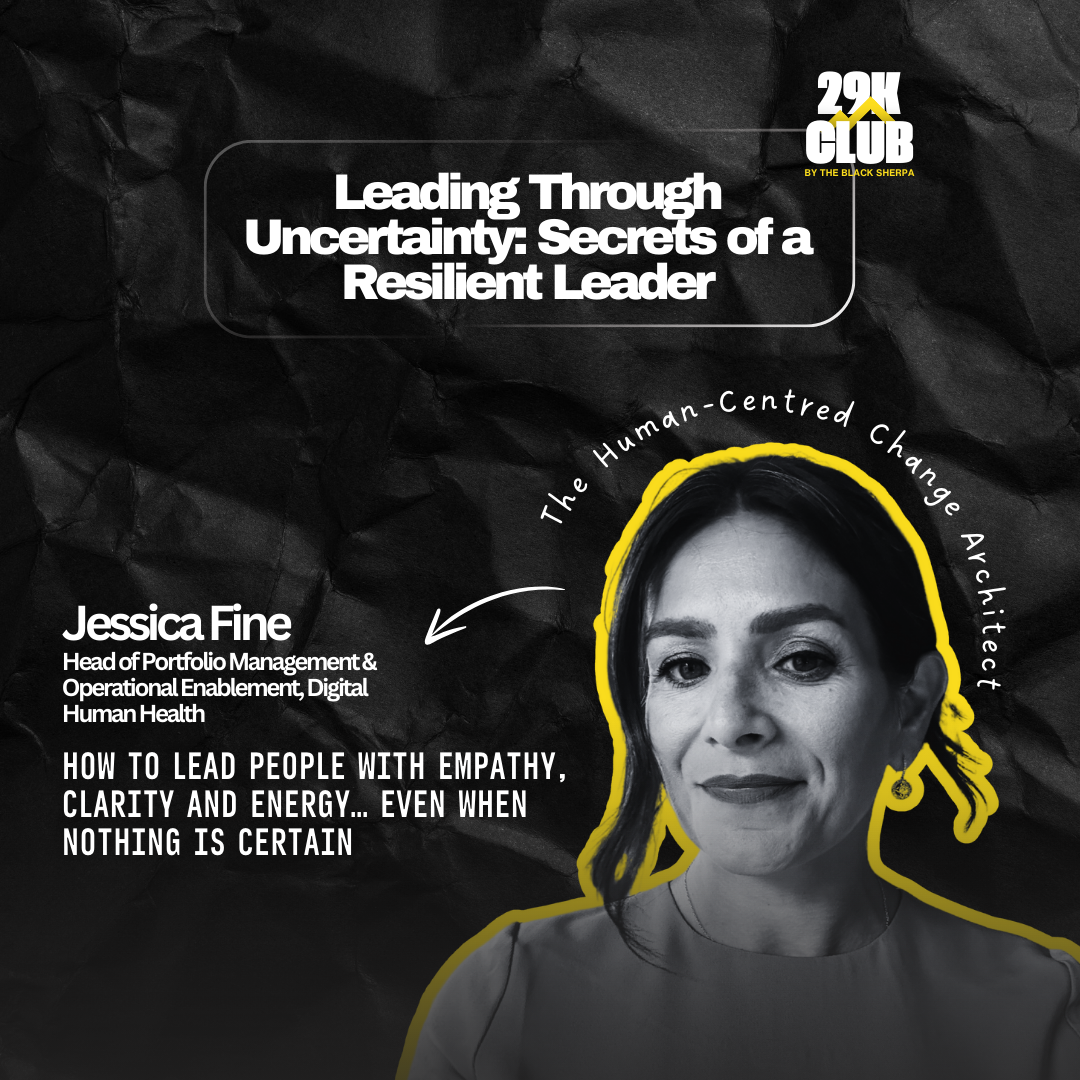
A Black Sherpa 29k Club masterclass with Jessica Fine, senior portfolio and operations leader at Merck, working at the intersection of digital, data, and commercial strategy.
Earned vulnerability, followership, and the courage to say “I don’t know”
“I don’t know.”
“I got it wrong.”
“I failed.”“Sometimes you have to stand still in the chaos.”
“Resilience isn’t a solo act.”
These weren’t lines from a leadership playbook or keynote deck.
They were said calmly, without performance, during the first Black Sherpa 29k Club masterclass of the year.
This session wasn’t about leadership theory.
It was about resilient leadership in practice… what it actually feels like to lead through uncertainty when answers are incomplete, pressure is constant, and people are looking to you for steadiness anyway.
Why resilient leadership matters right now
Across industries… particularly complex, regulated, and fast-moving ones, leaders are navigating:
constant organisational change
decisions made with imperfect information
teams asking for clarity before it exists
emotional pressure layered on top of delivery expectations
At the same time, familiar leadership myths still linger:
Strong leaders always know the answer
Vulnerability weakens credibility
Resilience means pushing harder
This conversation challenged all three… without blaming, grandstanding, or oversimplifying.
A human start: leadership without performance
The tone was set immediately.
There were jokes about tech not working. Stories about children struggling to return to school after the holidays. Honest reflections on how even experienced leaders feel disoriented after time away.
That mattered.
Because resilience at work isn’t built in big, dramatic moments.
It’s built in ordinary, human ones.
Jessica spoke openly about her career journey… from consulting to senior corporate leadership… and about intentionally stepping into roles without a playbook.
“I’ve probably never had a job description that fully made sense. But what I know I do best is lead through uncertainty.”
For many in the room, that reframed what leadership competence actually looks like.
The invisible tension of senior leadership
One of the most powerful… and least often articulated themes was this:
Senior leadership often means being a custodian of the truth.
Knowing more than you can share.
Seeing what’s coming before others do.
Holding information that, if released too early or without context, could create fear rather than focus.
Jessica was clear that this isn’t a privilege… it’s a responsibility.
And sometimes, a burden.
“I often feel like I know too much sometimes… and that can make it harder to keep going.”
This reframed seniority not as power, but as emotional load.
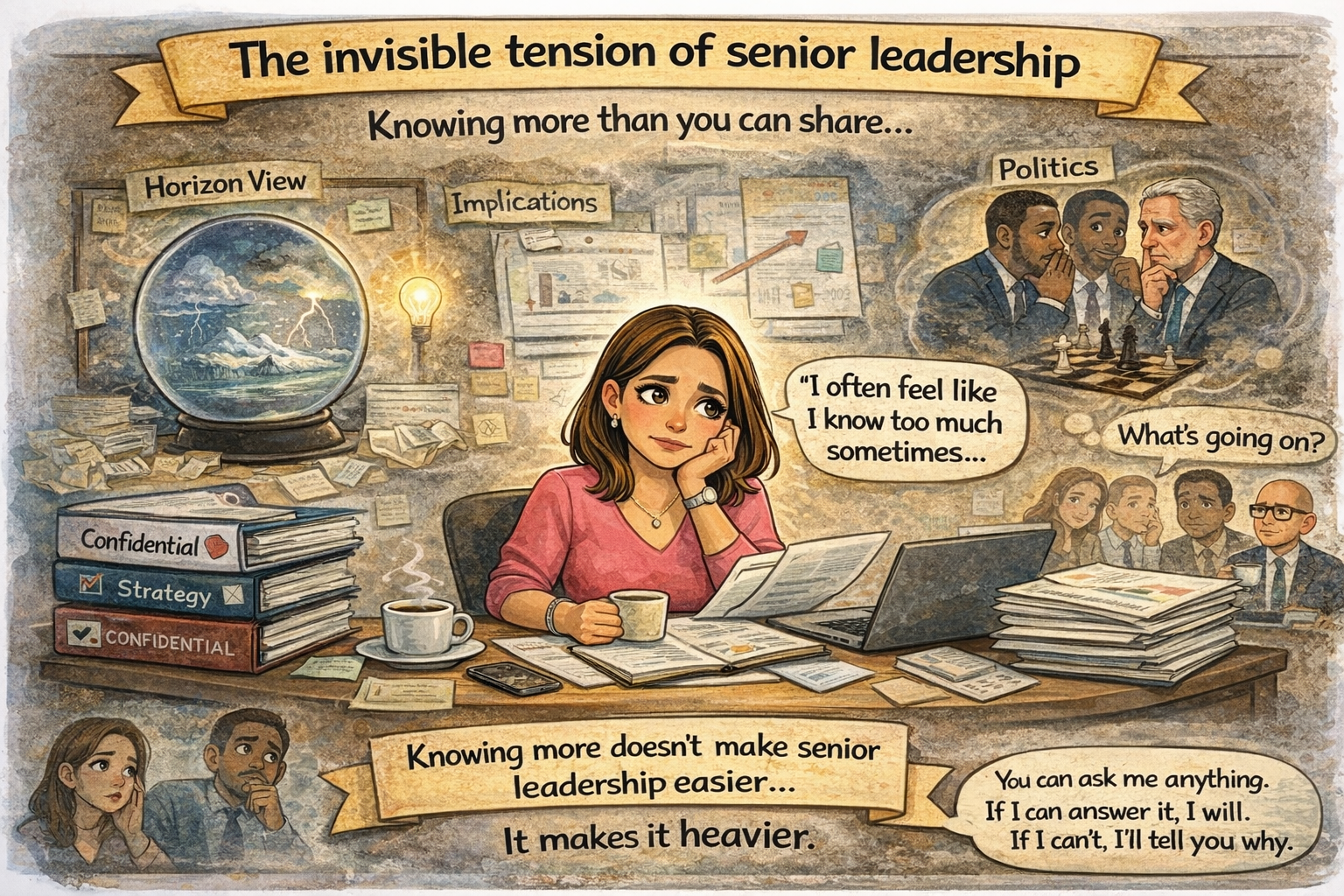
Jessica sits at the centre holding confidential information, showing senior leadership as emotional responsibility rather than power.
What mattered most was how deliberately she avoids letting that weight turn into fear, silence, or control.
“You can ask me anything. If I can answer it, I will. If I can’t, I’ll tell you… and I’ll tell you why.”
In environments where trust is fragile, this kind of transparency builds credibility… without overexposure.
Resilience isn’t “pushing through”
A core reframe from the session:
Resilience is not grit at all costs.
It’s not:
white-knuckling through change
exhausting yourself and your team
pretending everything is fine
Instead, resilient leadership requires rhythm.
Jessica shared a simple framework used during complex change:
Unfreeze → Change → Refreeze
Unfreeze: acknowledge the old way no longer works
Change: move forward in manageable increments
Refreeze: pause long enough for people and systems to stabilise
“If you don’t refreeze, you exhaust everyone.”
This applied not just to organisations, but to careers, personal transitions, and life outside work.
Resilience includes knowing when to pause, not just when to push.
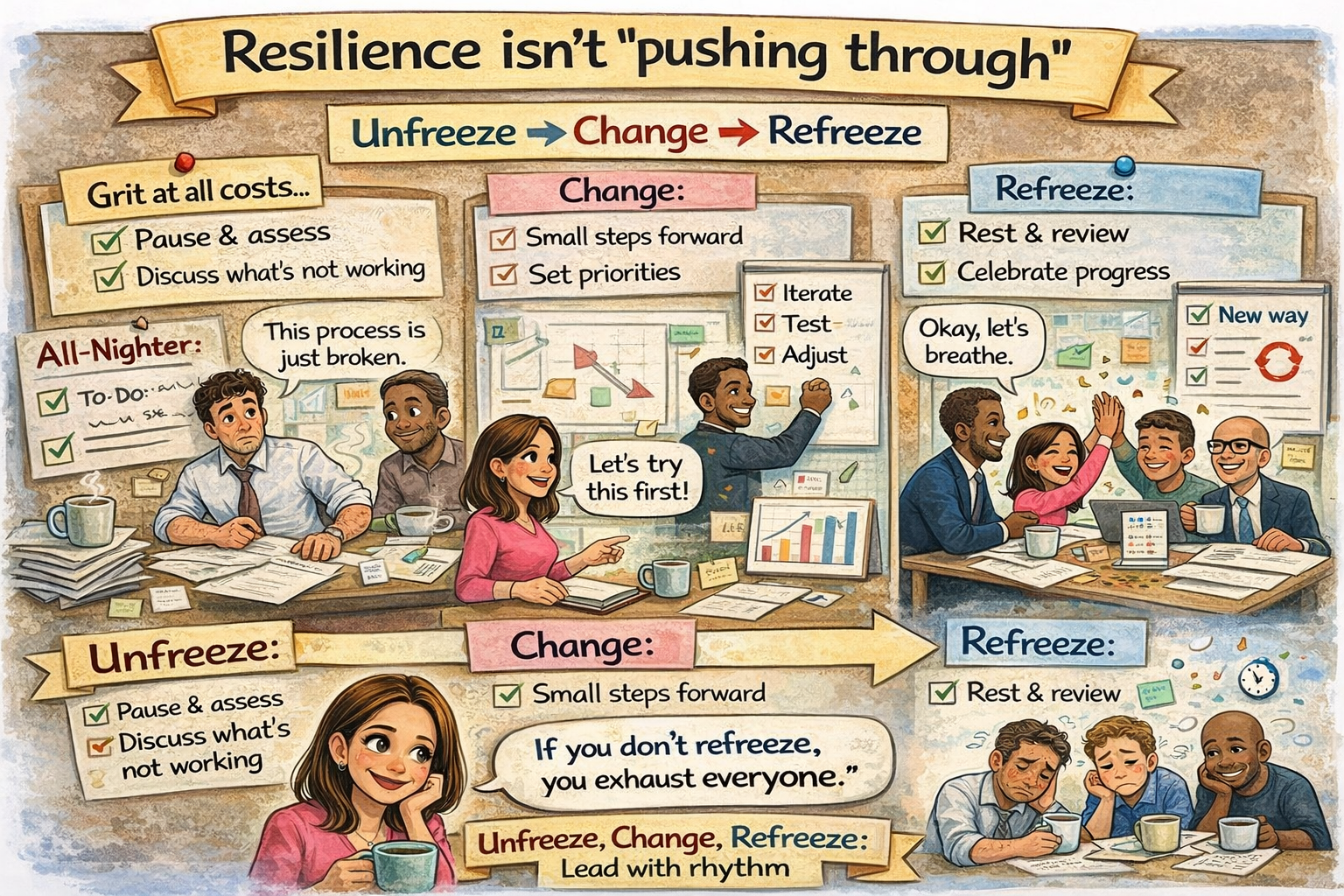
A cartoon showing a team moving through Unfreeze, Change, and Refreeze, illustrating that resilience comes from rhythm and pause, not burnout.
From self-doubt to earned confidence
When asked about a formative moment, Jessica shared an early consulting experience.
She was asked to lead a major pitch… and felt paralysed by self-doubt.
Why her?
Why would anyone listen?
A senior partner responded simply:
“We’ve asked you to do this because we believe you can.”
That moment didn’t remove doubt… but it changed how she related to it.
“I stopped telling myself I shouldn’t be in the room.”
Today, when uncertainty returns, she comes back to that truth:
If you’re here, someone believed you were capable.
Making the inner voice productive
The inner voice doesn’t disappear with seniority.
But it can be trained.
Jessica shared how she works with it:
drawing on past experiences (“Where have I solved something like this before?”)
narrowing focus to the next controllable step
trusting that clarity often comes after movement
“In three months, this will look different.”
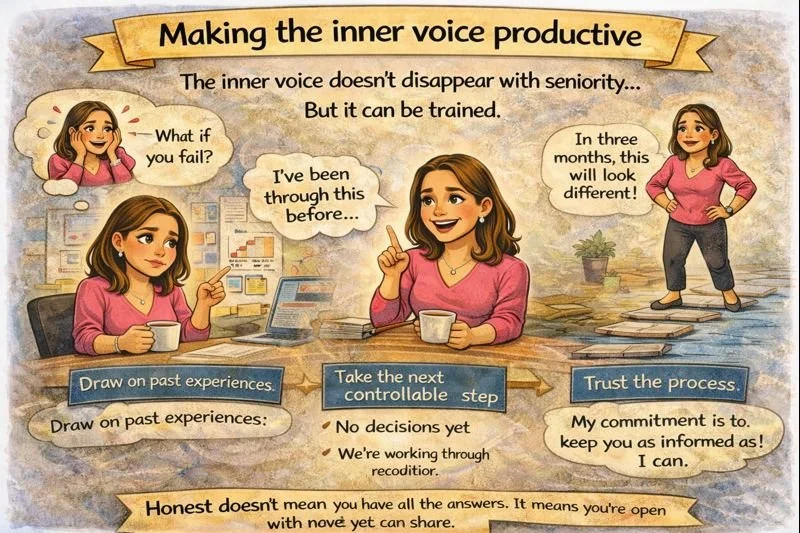
Multiple versions of Jessica reflect doubt, experience, and progress, showing confidence built through pattern recognition and small steps forward.
Her confidence doesn’t come from certainty.
It comes from pattern recognition… knowing she’s been through uncertainty before and survived it.
Leading without a playbook… and naming the stretch
One of the most impactful moments came when Jessica described stepping into a role where 50% of the brief was a stretch.
Instead of hiding that, she named it openly.
“I’ll support you where I’m strong… and I need you to support me where I’m not.”
The result?
trust deepened
people leaned in
credibility increased
This is earned vulnerability… honesty in service of the work, not emotional oversharing.
Mentor vs sponsor: a distinction that changes careers
A practical insight that resonated strongly was Jessica’s distinction between mentors and sponsors… often conflated, but fundamentally different.
Mentors are chosen and actively engaged. You bring problems, ask for perspective, and own the relationship.
Sponsors advocate for you when you’re not in the room.
“A sponsor is more like a Gandalf figure… they show up when you don’t even know you need them.”
For many professionals… particularly those navigating systems where access and advocacy aren’t evenly distributed, this clarity matters.
Leadership isn’t therapy… build an ecosystem
Another subtle but important thread was about boundaries.
Supporting people doesn’t mean carrying everything.
Leadership isn’t therapy.
Mentorship isn’t martyrdom.
Resilient leaders build support ecosystems:
mentors
sponsors
trusted peers
supervision and reflection spaces
So emotional load is placed where it can be held sustainably… not passed down to teams.
Followership: resilience is collective
At the heart of the session was a simple truth:
Resilience isn’t a solo act.
Jessica spoke about striving for followership, not hierarchy.
That means:
sometimes leading from the front
sometimes standing alongside
sometimes stepping back
“People should feel that walking together is better than standing alone.”
Followership is earned through trust, emotional intelligence, and consistency… not titles.
Key takeaways for leading through uncertainty
You don’t need all the answers to be credible
Transparency builds trust during uncertainty
Pause is part of progress
Vulnerability strengthens leadership when purposeful
Focus reduces overwhelm
Know the difference between mentors and sponsors
Build support outside the room you lead
Why this is the Black Sherpa 29k Club
This masterclass captured exactly why the 29k Club exists.
To create space for:
clarity when work feels noisy
confidence when self-doubt creeps in
community when leadership feels lonely
Especially for professionals navigating complex systems with uneven access to opportunity… and limited margin for error.
This wasn’t content for content’s sake.
It was a conversation people needed.
A leadership challenge
Ask yourself:
Where am I holding more truth than I can share… and how am I carrying it?
What could I narrow my focus on this month to reduce overwhelm?
Who do I need to walk alongside instead of carrying this alone?
Because resilient leadership isn’t about climbing faster.
It’s about climbing together.
Climb steady 🖤
I’m Yam – Founder of The Black Sherpa
Founder | Strategist | Speaker | Host of The Black Sherpa Podcast
I founded The Black Sherpa to create a world where talent rises on merit and no one’s potential is held back by bias or barriers.
Through bold strategy, storytelling, and our flagship community, The 29k Club - I help professionals grow with confidence and support leaders to build cultures that truly live their values.
Let’s connect and build a future where inclusion powers performance, and leadership reflects the world we serve.