
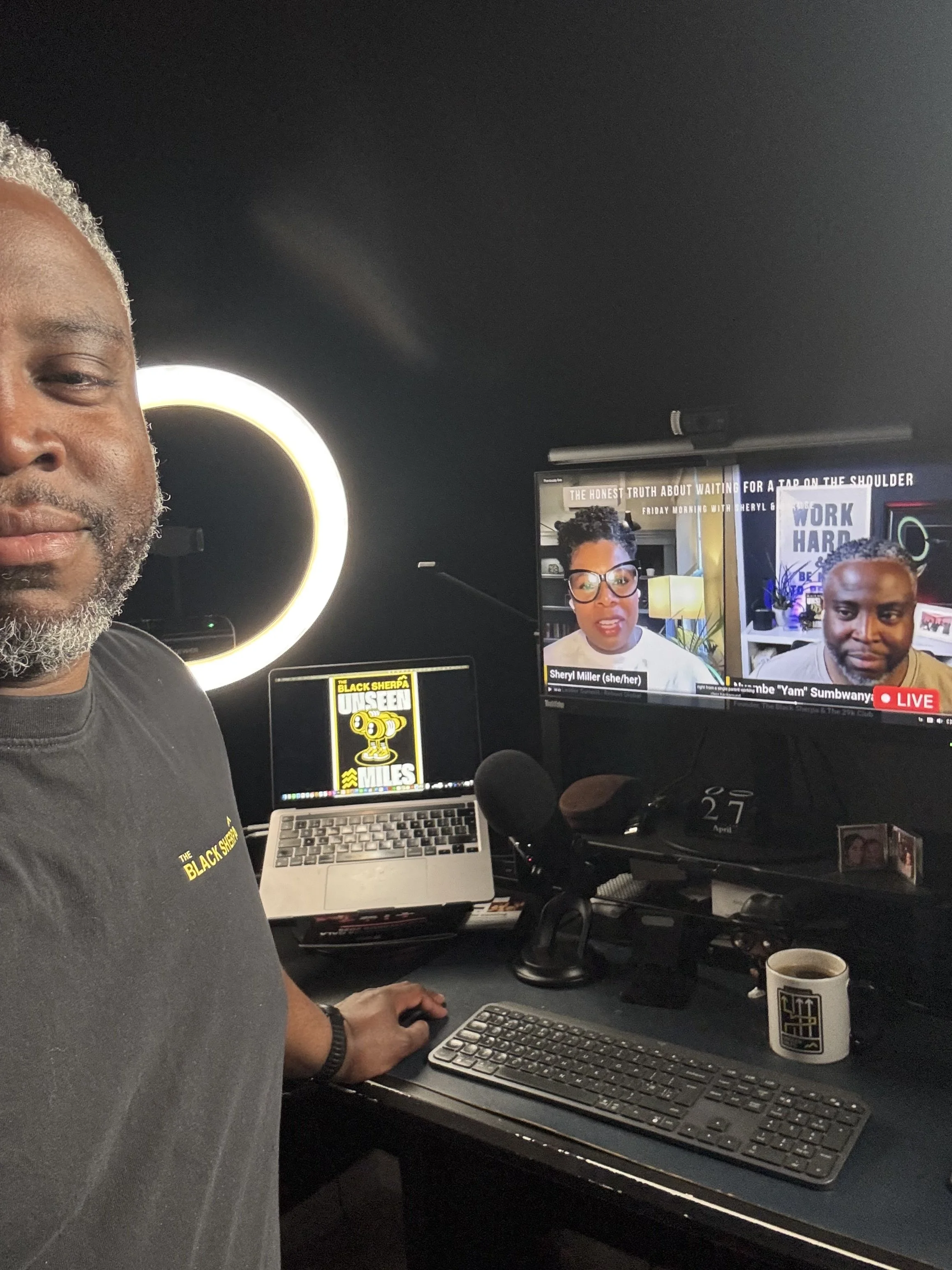
Yam, Founder of The Black Sherpa & 29k Club, watching back his LinkedIn Live with Sheryl Miller… refining his own craft in the same way he challenges others to
Reflections from my conversation with Sheryl Miller
“Hard work is the entry fee.”
“The problem isn’t the tap. It’s who gets seen.”
“The most important lessons about work aren’t written down.”
Like most UK conversations… we started with the weather.
It wouldn’t be right otherwise.
But it didn’t take long before we got into something far more real.
This was one I didn’t wait for
There are moments in your career where you can sit back and hope to be invited…
Or you can step forward.
This was one of those moments for me.
I reached out to Sheryl Miller to see if I could join her Friday LinkedIn Live one day.
And I’ll be honest… I was over the moon when she said yes.
Because if you’ve spent any time around Sheryl’s work, you’ll understand what that platform represents.
Every Friday at 8:30, she shows up.
Consistently.
Deliberately.
With intent.
Creating space for conversations that don’t just sound good…
But actually help people think differently.
And as someone building The Black Sherpa and the 29k Club, I’ve learned a lot from being in the audience.
So to step into that space… not just to contribute, but to pay something forward… meant a lot.
Because I benefit from people doing that in my world all the time.
And this only works when we keep that cycle going.
When digital meets real life
A few weeks before the session, I had the opportunity to meet Sheryl in person at the BPLS Summit.
That was a special moment.
It’s where I received recognition for my work as an inspiring leader in our industry… something I’m incredibly proud of.
But what stayed with me even more…
Was her.
Because we’ve all had that experience where someone shows up powerfully online…
And then in person, it doesn’t quite match.
This was the opposite.
The warmth.
The honesty.
The presence.
Everything she projects through the camera…
Was even more palpable face to face.
No switch.
No performance.
Just consistency.
And that matters.
Why this conversation matters
We spent most of the conversation unpacking something many people feel…
But very few people truly understand:
The tap on the shoulder.
That moment where:
a role appears out of nowhere
someone gets “invited” into an opportunity
a move happens quietly, behind the scenes
No advert.
No process you saw.
No obvious pathway.
Just a tap.
And if you’ve ever been on the outside of that moment…
You’ll know how it feels.
Because you’ve done the work.
You’ve delivered.
You’ve shown up.
You’ve stayed consistent.
And still… nothing.
So the question becomes:
What am I missing?
Insight #1: The tap isn’t the problem - access is
The tap on the shoulder is not going away.
And in some cases… it shouldn’t.
Because sometimes that tap reflects:
trust built over time
judgement observed in real moments
relationships developed intentionally
That matters.
But here’s the reality most people feel, but don’t always articulate:
Not everyone is positioned to receive the tap.
And that’s where the inequality lives.
Not always in the final decision…
But in the access before it.
Access to:
information
relationships
visibility
feedback
context
And to be clear… none of this removes the reality of bias or unequal access.
Some people are navigating a steeper climb.
The point isn’t to ignore that.
It’s to make sure you’re not left without tools while the system catches up.
Insight #2: Hard work is table stakes
“Put your head down and work hard.”
We’ve all heard it.
Many of us were raised on it.
And it matters.
But in most organisations:
Hard work is the entry fee. Not the differentiator.
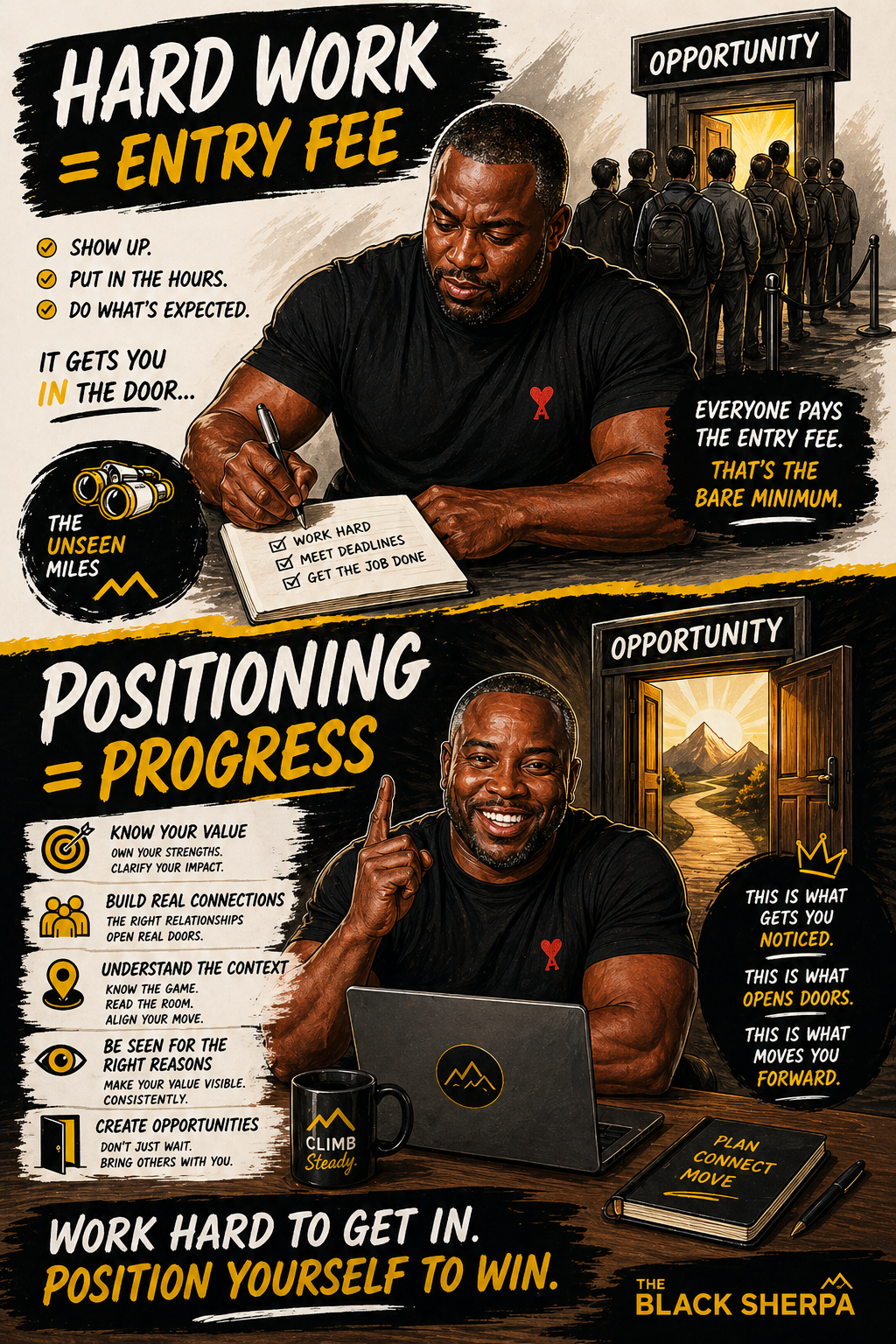
Hard work gets you in… positioning is what moves you forward
The people who move forward are doing something else alongside it.
They are:
connecting their work to what matters
building relationships with intent
making their value visible
understanding how decisions are made
If your head is down all the time…
You miss the context.
And context is where opportunity lives.
Insight #3: You’re not seeing the full picture (the unseen miles)
From the outside, progression often looks like luck.
But what you don’t see…
Is the unseen miles.
the conversations happening behind the scenes
the relationships built over time
the visibility created intentionally
the trust earned gradually
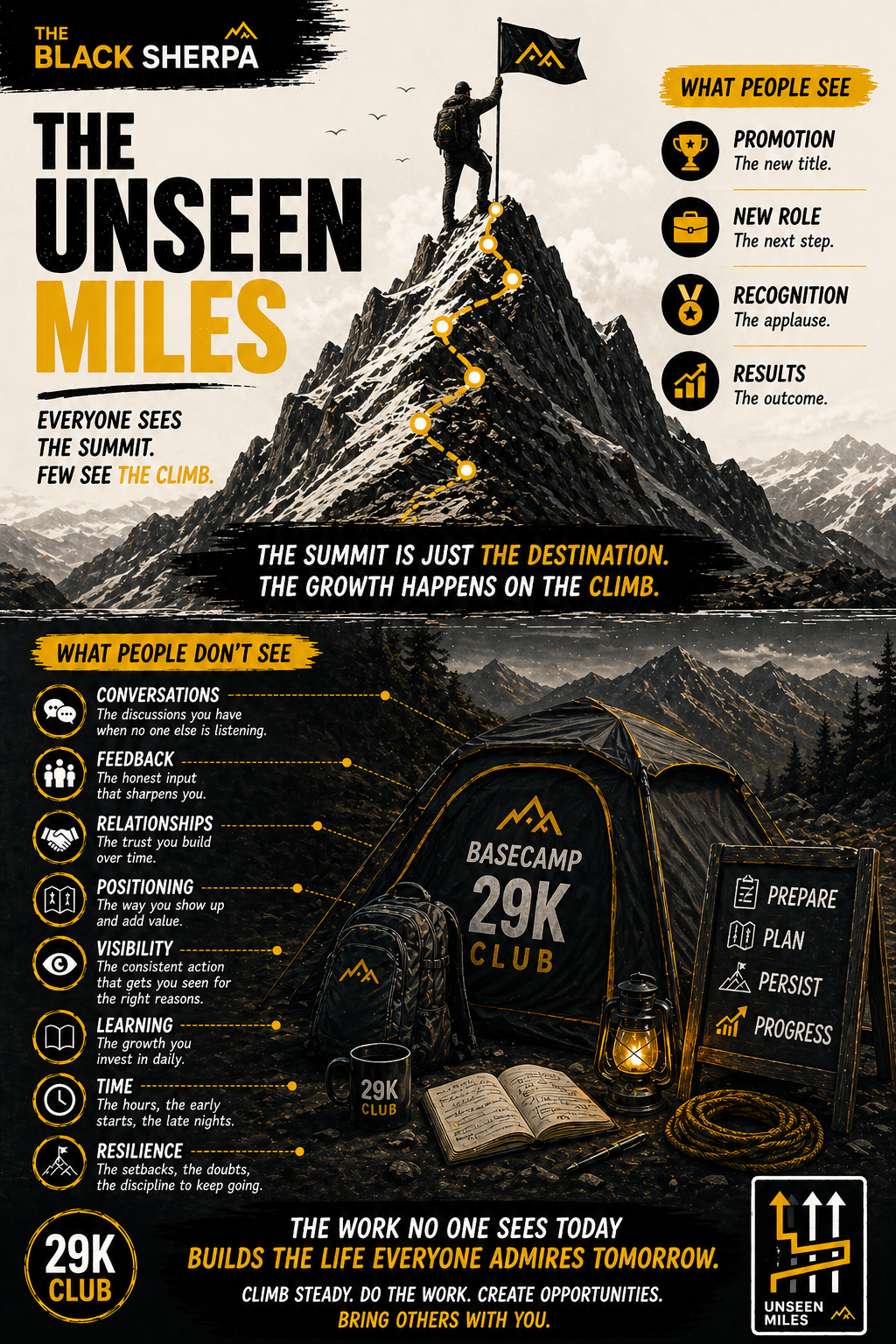
Everyone sees the summit. Few see the climb
If we don’t make those visible…
People are left guessing.
And guessing creates frustration.
Insight #4: Luck is real - but it’s not the whole story
Let’s say it clearly.
A big part of career progression is luck.
Who your manager is.
What project you land on.
Who sees your work… and when.
That’s not evenly distributed.
And for some people, those variables line up more often than others.
That’s not always fair.
But here’s the shift:
You can’t control luck.
But you can put yourself in more places where it has a chance to find you.
Insight #5: Asking for help is a career accelerator
The people who move forward faster…
Aren’t always the smartest.
But they are often the ones who:
bring others into problems early
ask better questions
don’t try to carry everything alone
For a long time, I didn’t do this well.
I thought competence meant independence.
But progress is a collective sport.
And learning how to involve others…
Changes everything.
Insight #6: Most people build relationships where it feels safe
Here’s what most people do:
They spend time with people who:
like them
support them
feel comfortable
And that matters.
But those people don’t always influence your outcomes.
A simple shift:
Map people across two dimensions:
influence (can they impact your outcomes?)
connection (do they know and support you?)
Then act intentionally.
Because the real shift is this:
Spending less time where it feels comfortable…
And more time where it counts.
And for some people, building those relationships comes with an added layer.
Navigating bias.
Managing perception.
Figuring out how to show up without losing yourself.
That’s real.
The goal isn’t to ignore that.
It’s to navigate it consciously.
Insight #7: It’s not always you - sometimes it’s the environment
There’s a harder question that doesn’t get asked enough.
If you’re consistently being overlooked in the same environment…
At some point the question shifts.
Not:
“What more can I do?”
But:
“Is this a place that recognises what I bring?”
Because sometimes the most strategic move…
Isn’t to adapt more.
It’s to reposition yourself entirely.
And not every organisation gets this right.
Some environments reward:
visibility over value
proximity over performance
familiarity over difference
You have to be honest about the system you’re in.
Insight #8: Safety, confidence, and visibility are connected
It’s one thing to know you should step forward.
It’s another to feel safe enough to do it.
For many people:
visibility feels risky
speaking up feels exposing
asking for more feels uncomfortable
That’s why confidence isn’t just mindset.
It’s environment.
It’s experience.
It’s having spaces where you can practise… without consequence.
Because confidence is built through doing.
Not just thinking.
The real work: positioning yourself for opportunity
If I strip everything back from this conversation…
It comes down to this:
Opportunities don’t just go to the best people.
They go to the best-positioned people.
And positioning isn’t one thing.
It’s a combination of three moves:
1. Clarity
Do you know:
what you want?
what you’re good at?
where you create value?
Because if you can’t articulate it…
No one else will.
2. Connection
Are you building relationships with:
people who understand your value
people who can influence your outcomes
Because opportunity flows through people.
3. Context
Do you understand:
how decisions are made
what gets rewarded
what success looks like where you are
Because effort without context is invisible.
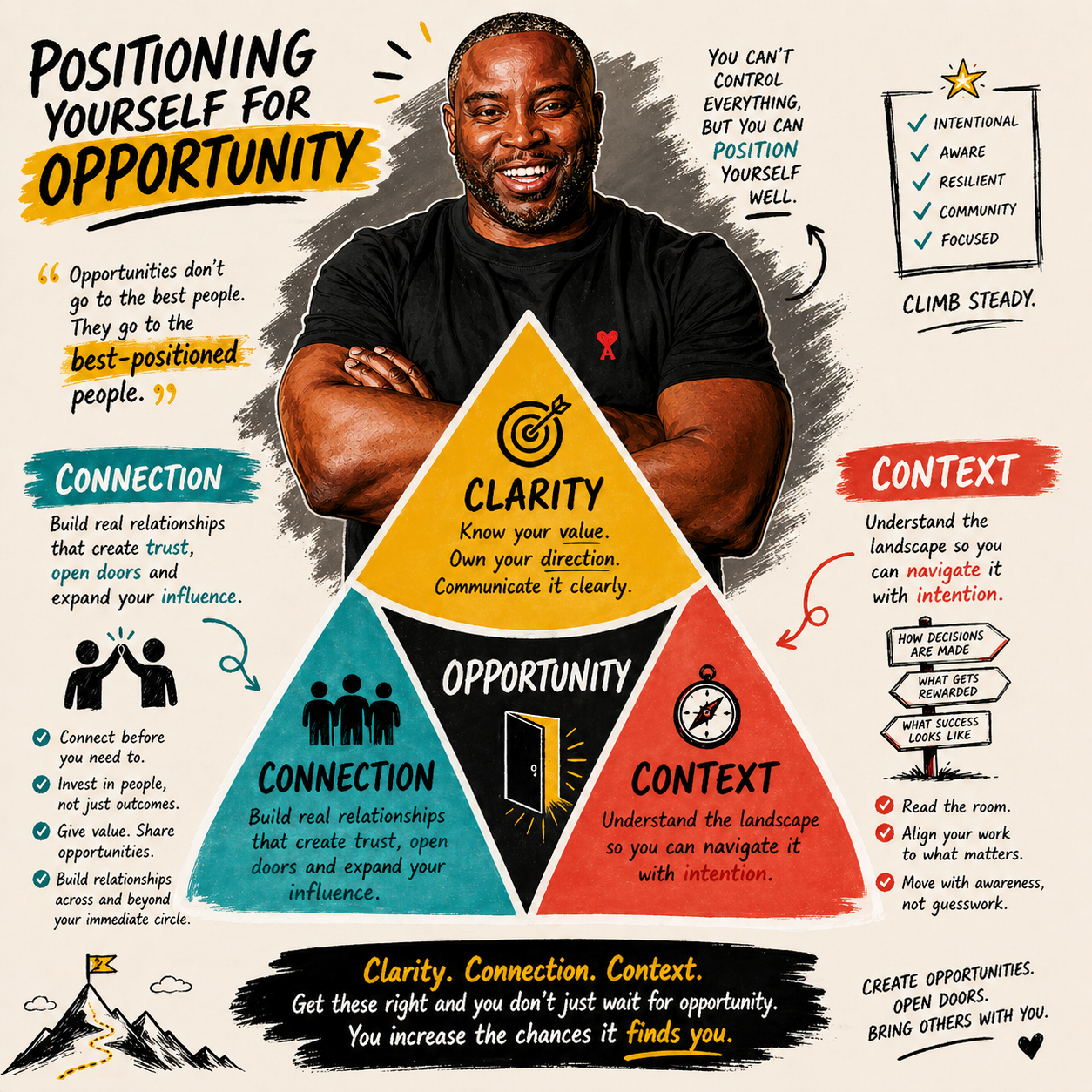
Opportunities don’t go to the best people… they go to the best-positioned
Clarity. Connection. Context.
Get those right…
And you don’t just wait for opportunity.
You increase the chances it finds you.
My perspective (and responsibility)
I’m in a position now where I can speak openly about things…
That many people inside organisations feel…
But don’t always feel able to say.
And I take that seriously.
This isn’t about playing the game blindly.
It’s about understanding the game well enough…
To choose how you show up in it.
Because there are a lot of good people…
Doing good work…
In systems that aren’t always easy to change.
Where I focus the work
It would be easy to position this purely as ED&I.
And that’s part of the conversation.
But it’s not the whole story.
At The Black Sherpa, the focus is:
People. Performance. Culture.
Because that’s where organisations engage.
And once you’re in that conversation…
It becomes impossible to ignore equity and inclusion.
Why spaces like this matter
This is why we built the 29k Club.
Because what I see every week is this moment:
“That’s not just me.”
And in that moment:
Clarity builds.
Confidence follows.
Action becomes possible.
Sheryl’s work (and why it matters)
If you’re not familiar with Sheryl’s work, it’s worth understanding the impact she’s having.
Through her platform, she focuses on supporting:
ERG leaders to lead with clarity and confidence
organisations to build employee networks that actually drive outcomes
communities to connect in ways that go beyond surface-level engagement
At its core, her work is about turning intention into impact.
Because most organisations want to create inclusive, connected, high-performing environments.
But the execution?
That’s where things get complex.
That’s where ERGs often sit in tension:
full of passion, but lacking structure
full of potential, but under-supported
full of lived experience, but not always connected to strategy
Sheryl sits right in that gap.
Helping leaders and organisations bridge it.
That makes her an incredible partner for:
organisations serious about culture and inclusion (not just the optics)
ERG leaders who want to move from activity → impact
HR and people leaders trying to connect strategy with lived experience
👉 If you want to explore her work: https://www.ergleader.com/
👉 And if you want to watch our full conversation: https://www.linkedin.com/events/7440082578445029376/
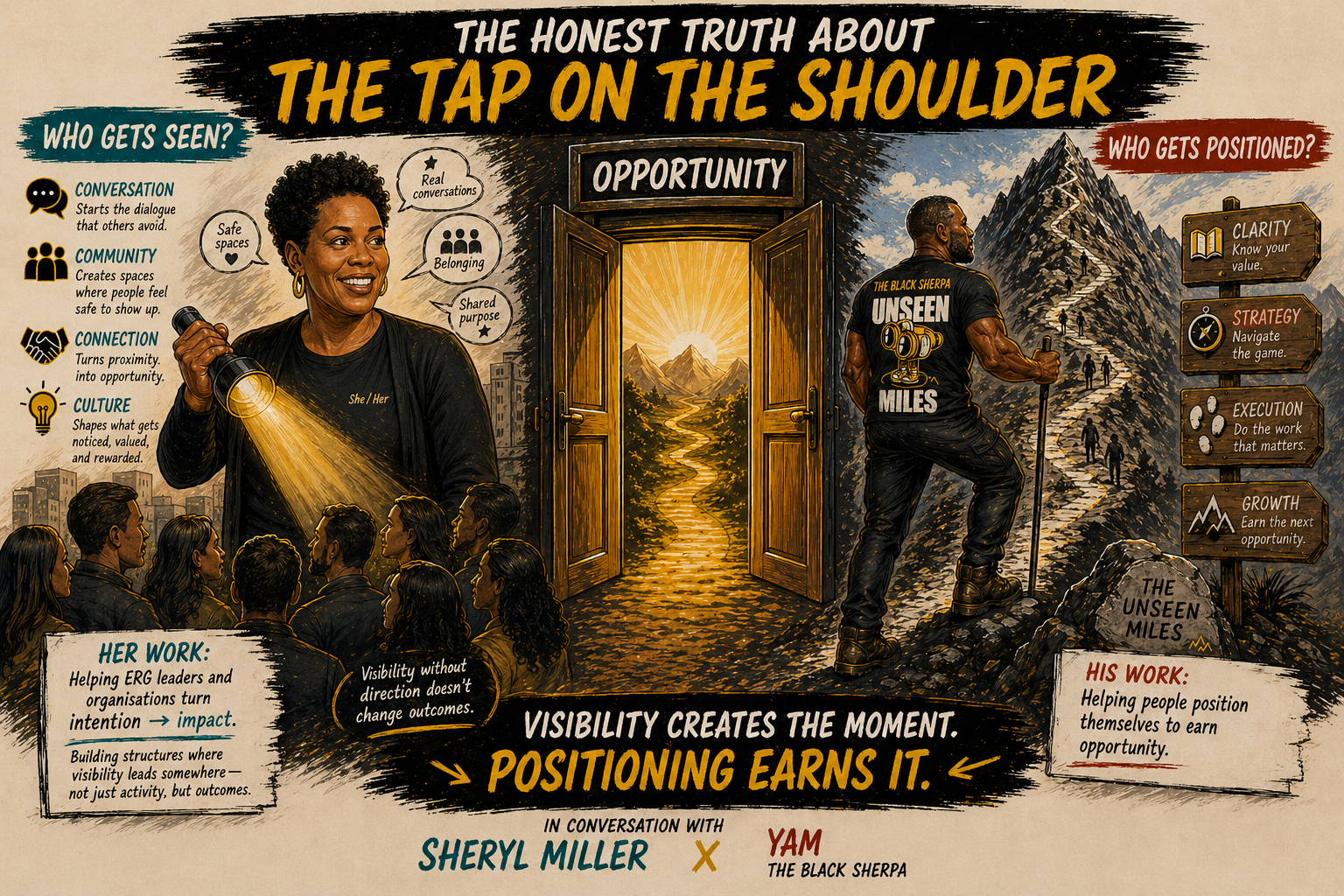
Visibility creates the moment… positioning is what turns it into opportunity
A final thought (and an open door)
If there’s one thing I’d leave you with, it’s this:
You can’t control whether you get the tap.
But you can control how well you’re positioned when it comes.
And that work matters.
If this is the type of conversation that would add value to:
your platform
your organisation
your community
Or even if you just want to explore it for yourself…
Feel free to reach out.
The challenge
If the tap on the shoulder matters…
What are you doing to position yourself for one?
If you’re a leader…
Who are you seeing… and who are you missing?
And if the most important rules aren’t written down…
Who are they really serving?
Climb steady 🖤
I’m Yam – Founder of The Black Sherpa
Founder | Strategist | Speaker | Host of The Black Sherpa Podcast
I founded The Black Sherpa to create a world where talent rises on merit and no one’s potential is held back by bias or barriers.
Through bold strategy, storytelling, and our flagship community, The 29k Club - I help professionals grow with confidence and support leaders to build cultures that truly live their values.
Let’s connect and build a future where inclusion powers performance, and leadership reflects the world we serve.