
Your Brand Isn’t About You
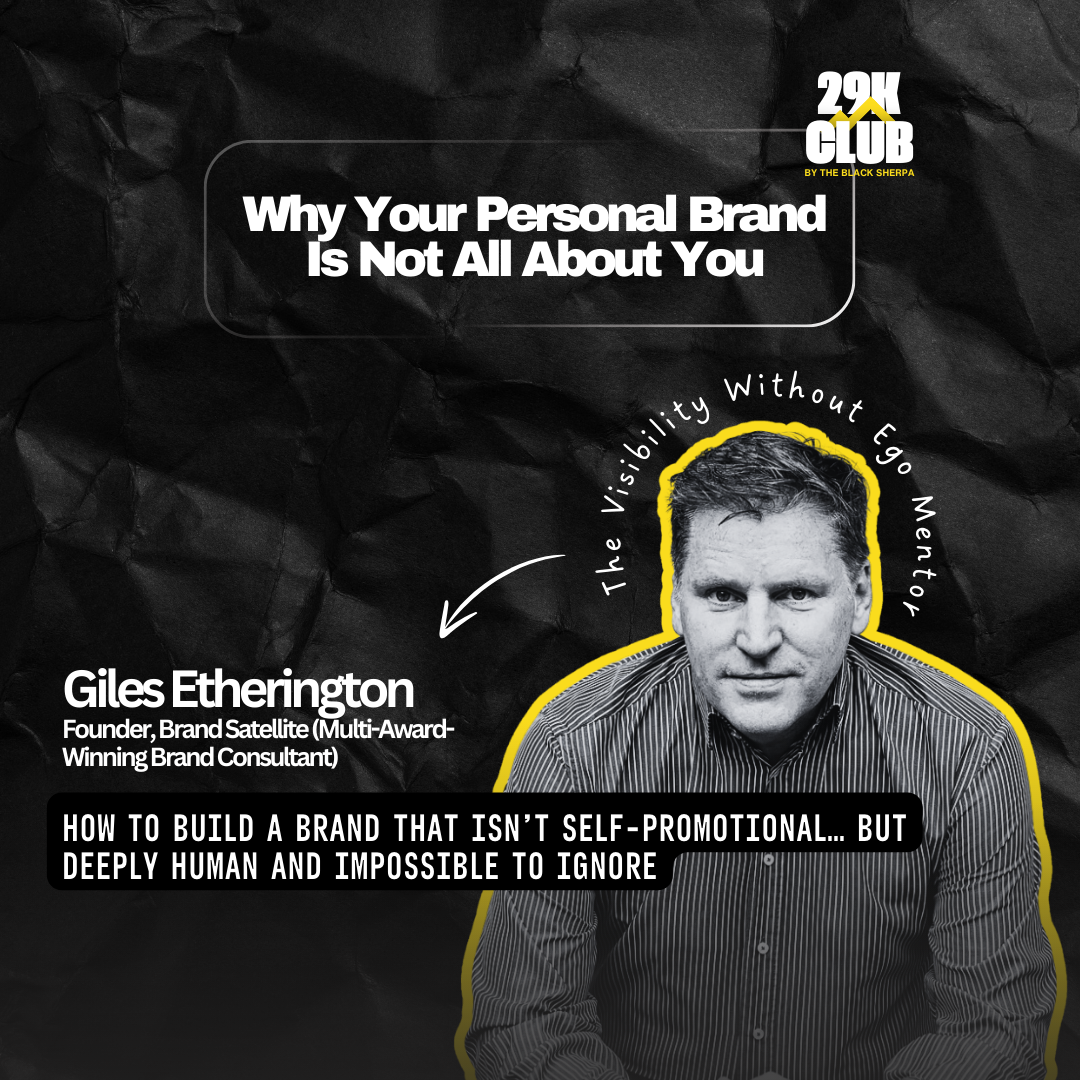
Masterclass with Giles Etherington | The Black Sherpa 29k Club
How Authenticity, Storytelling, and Community Shape Professional Reputation
“Your brand isn’t about you… it’s about the people you serve.”
“When you're inside the jar, you can't read the label.”
“People don’t buy what you do. They buy why you do it.”
Three lines that stopped the room.
Not because they were complicated.
Because they quietly dismantled a lot of what people believe about personal branding.
For many professionals… especially those navigating complex workplaces… the phrase personal brand can feel uncomfortable.
Self-promotional.
Performative.
Even a little inauthentic.
Yet reputation still shapes opportunity.
Promotions.
Projects.
Partnerships.
They often flow toward people who are trusted, remembered, and recommended.
In modern workplaces, reputation travels faster than ever.
Conversations happen in Slack threads.
Recommendations happen in private messages.
Decisions get made in rooms you’re not in.
And yet most professionals are never taught how reputation actually works.
Instead, we’re handed vague advice like:
“Build your personal brand.”
This Black Sherpa 29k Club masterclass set out to unpack what that actually means.
And more importantly:
How professionals can build a reputation that genuinely works for them.
The guide for this conversation was brand strategist Giles Etherington, whose perspective reframed the whole idea.
Meet the Speaker
Giles Etherington has spent nearly four decades building brands.
His career began in global advertising, where he became the youngest ever art director at the legendary agency J. Walter Thompson. He worked on campaigns for brands like British Telecom, Nestlé, and Andrex before spending years freelancing across Europe and helping launch new agencies.
Today he works as a brand strategist and consultant, helping businesses and leaders clarify their message and build brands that people trust.
His philosophy is simple:
Brand isn’t decoration.
It’s direction.
And the same principles that shape global brands also apply to professional reputation and career visibility.
The Personal Branding Myth
Most people assume personal branding means talking about themselves more.
Their achievements.
Their expertise.
Their career story.
But Giles challenged that assumption immediately.
“I actually don’t like the phrase personal brand,” he admitted.
“Because it makes people think it’s all about them.”
It isn’t.
Your brand isn’t what you say about yourself.
It’s what people think and feel about you when you're not in the room.
And the quickest way to shape that reputation?
Focus less on yourself… and more on the people you want to help.
Because reputation is not built through self-promotion.
It’s built through connection.
What Personal Branding Actually Looks Like at Work
Personal branding isn’t just a LinkedIn exercise.
It shows up in everyday workplace moments.
The way you frame an idea in a meeting.
The story you tell when presenting results.
The way colleagues describe you to others.
In many organisations, opportunities don’t just follow performance.
They follow perception of value.
And perception is shaped by clarity.
When people know:
what you care about
what you’re good at
and what problems you solve
they begin to associate your name with something specific.
That’s when reputation starts working in your favour.
Of course, opportunity isn’t distributed equally in every workplace.
Systems, networks, and access can influence who gets noticed.
But clarity of reputation often makes it easier for others to recognise your value when the moment arrives.
Brand vs Branding (The Distinction That Changes Everything)
At one point Giles paused to clear up one of the most common misunderstandings.
Many professionals believe their brand is their visual identity.
A logo.
A colour palette.
A polished LinkedIn banner.
That’s branding.
Your brand is something else entirely.
“Your brand is the emotional and psychological connection people have with you.”
It’s the feeling someone gets when your name is mentioned.
The quiet confidence that you understand their challenges.
And that connection can’t be designed in PowerPoint.
It’s built through clarity, consistency, and trust.
Why Emotion Matters in Decision-Making
One of the most surprising insights from the session came from decades of advertising research.
The Institute of Practitioners in Advertising analysed forty years of campaign effectiveness.
Their conclusion?
Campaigns using emotional persuasion were almost twice as effective as purely rational ones.
That doesn’t mean facts and evidence don’t matter.
They absolutely do.
But facts alone rarely move people to action.
Emotion helps people see themselves in the story.
And when people feel understood, they begin to trust.
The Five Elements of a Memorable Personal Brand
According to Giles, strong brands… personal or organisational… combine five ingredients.
Authenticity
Trying to copy someone else’s voice is exhausting.
Eventually the mask slips.
Authenticity makes consistency sustainable.
Purpose
People connect to why you care about your work.
Not just what you do.
Giles illustrated this with a story about a client he once worked with… a macaron bakery.
The business itself wasn’t the issue.
It simply didn’t align with the type of purpose-driven work he felt most motivated to support.
“Do I really care if there are more macarons in the world?”
That moment helped him clarify where his energy belonged.
Purpose simplifies brand decisions.
Values
Values only matter if they’re lived.
“If you have to open your laptop to check what your values are… you haven’t really done the work.”
Real values show up in behaviour.
Not documents.
Stories
Humans are wired for storytelling.
We remember stories far better than lists of achievements.
Stories create emotional evidence of credibility.
Emotions
Your audience’s emotions… their frustrations, fears, and ambitions… shape whether they trust you.
And trust is where reputation begins.
When You're Inside the Jar, You Can't Read the Label
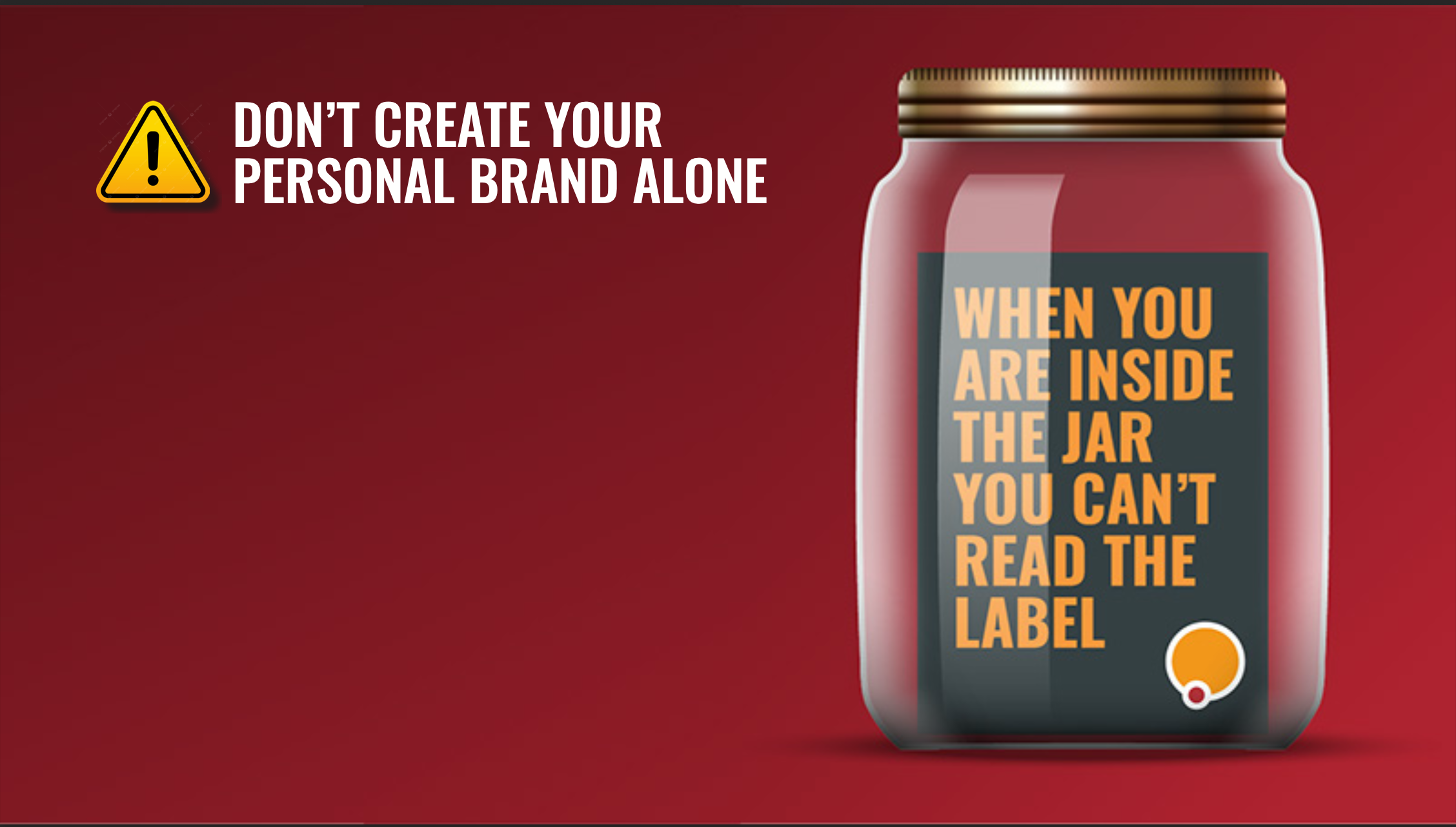
It’s one of those lines that sounds simple at first… until you sit with it
We are often the least objective observers of ourselves.
The experiences that shaped us can feel ordinary because we lived them.
The strengths that come naturally to us can feel unremarkable because we use them every day.
And the stories that explain why we care about our work often stay hidden because we assume everyone else already understands them.
But from the outside, those same experiences can look very different.
What feels routine to you may be the very thing others find most compelling.
What you dismiss as “just part of the job” might actually be the moment that reveals your leadership, resilience, or perspective.
That’s why feedback matters.
And why perspective matters.
Because clarity about your reputation rarely comes from self-reflection alone.
It often emerges through conversation… when someone else notices a pattern you hadn’t seen, or connects dots between experiences you hadn’t thought to link together.
This is where community becomes powerful.
Spaces like the 29k Club act as mirrors.
They create environments where professionals can test ideas, share stories, and receive honest perspective from people who understand the journey.
And sometimes, all it takes is one conversation for someone to say:
"You know, the thing you just described… that's actually what you're known for."
Those moments help people see the label on the jar a little more clearly.
Reputation Is a Mountain Climb
Building a career… and a reputation… is a lot like climbing a mountain.
When we start out, most of our attention is fixed on the summit.
The promotion.
The leadership role.
The moment when things finally feel like they’ve “worked out.”
But anyone who has climbed a mountain knows the summit is rarely reached in one dramatic leap.
Progress happens slowly.
Step by step.
Conversation by conversation.
Project by project.
Most of the climb feels ordinary while you’re in it.
There are long stretches where it’s hard to tell whether you’re moving forward at all.
That’s why Giles offered a simple but powerful reminder during the session:
Every now and then, pause.
Turn around.
Look at the view.
Because the landscape behind you often tells a different story.
The skills you’ve developed.
The relationships you’ve built.
The problems you’ve learned to solve.
These are the footholds that quietly shape your reputation.
From the outside, people can often see that progress more clearly than you can.
And sometimes the most motivating thing you can do isn’t to stare harder at the summit.
It’s to recognise just how far you’ve already climbed.
The Three Cs: Clarity → Confidence → Courage
Clarity creates confidence.
Confidence creates courage.
Courage allows you to show up consistently.
And consistency builds trust.
Eventually people begin advocating for you… even when you’re not in the room.
Try This: The “I Help” Exercise
During the session, Giles invited members to try a simple positioning exercise.
Complete this sentence:
I help [audience]
to [result]
so they can [benefit].
Notice something important.
This isn’t about listing services.
It’s about describing impact.
For example:
“I help ambitious professionals navigate the unwritten rules of career progression so they can build clarity, confidence, and career momentum.”
This kind of statement does two important things.
It tells people who you’re here for.
And it signals the transformation you help create.
Clarity attracts the right people.
And gently filters out the wrong ones.
Both are useful when building a reputation that lasts.
A Note on AI
In a world where AI tools can now generate posts, bios, and brand statements in seconds, it’s tempting to outsource this work entirely.
And to be clear… AI can be a useful tool.
It can help you shape ideas, organise your thinking, and overcome the blank page when you're trying to articulate something important.
Used well, it can accelerate the process of turning thoughts into words.
But there’s a limit to what it can do.
AI relies on patterns.
Your story relies on experience.
The moments that shape a distinctive personal brand… the challenges you’ve navigated, the values you’ve developed, the reasons you care about your work… come from lived experience.
Those are things no algorithm can fully understand.
As Giles put it during the session:
“AI can do an okay job. But you don’t want your brand to be okay. You want it to be great.”
AI can support your thinking.
But it can’t replace the human insight that comes from reflection, conversation, and perspective.
The stories that make people trust you… the moments that reveal why you care about your work… still have to come from you.
Three Questions That Clarify Your Brand
Towards the end of the session, Giles offered a simple compass for career alignment.
Three deceptively simple questions:
What do you love doing?
What are you good at?
What will someone pay you for?
Individually, these questions are interesting.
Together, they become powerful.
Because many professionals spend years operating in only one or two of these circles.
Some people are doing work they’re very good at, but don’t particularly enjoy anymore.
Others pursue work they love, but struggle to translate that passion into something valued in the marketplace.
And many talented people sit quietly in roles where they are highly capable, yet the value of their work isn’t clearly recognised.
When those three elements overlap… passion, capability, and value… something shifts.
Work begins to feel more purposeful.
Your reputation becomes clearer.
And people begin to understand where you create impact.
For professionals navigating complex organisations or unfamiliar career environments, this clarity can be transformative.
It helps answer questions like:
Where should I focus my energy?
What should I become known for?
And which opportunities are actually aligned with the future I want to build?
When those three answers begin to align, you’re not just building a brand.
You’re building direction.
Why This Matters
Many professionals assume reputation builds itself.
That if they work hard, deliver results, and keep their heads down long enough, the right people will eventually notice.
Sometimes they do.
Often they don’t.
In reality, opportunities inside organisations rarely move purely on effort alone. They move through signals… the signals people associate with your name when decisions are being made.
Professionals with strong reputational signals are more likely to receive:
leadership visibility
stretch opportunities
promotion sponsorship
Not necessarily because they are more capable.
But because their value is easier for others to recognise and articulate.
When someone can quickly answer questions like:
“What does this person stand for?”
“What are they particularly good at?”
“Where do they create impact?”
your name begins to travel further than your job title.
And that’s when reputation starts to do something powerful.
It begins opening doors before you even reach them.
The Black Sherpa 29k Club Difference
The 29k Club exists to help professionals access the unwritten rules of career progression.
The pillars are simple:
Clarity. Confidence. Community.
And each masterclass adds another tool for the climb.
A Leadership Challenge
Ask yourself:
Who do I want to help most?
What story explains why I care about this work?
What would people say about my reputation if I left the room today?
Every professional already has a brand.
The question is whether it’s intentional or accidental.
When who you are, what you care about, and who you serve align… That’s when your reputation begins working for you.
Climb steady 🖤
I’m Yam – Founder of The Black Sherpa
Founder | Strategist | Speaker | Host of The Black Sherpa Podcast
I founded The Black Sherpa to create a world where talent rises on merit and no one’s potential is held back by bias or barriers.
Through bold strategy, storytelling, and our flagship community, The 29k Club - I help professionals grow with confidence and support leaders to build cultures that truly live their values.
Let’s connect and build a future where inclusion powers performance, and leadership reflects the world we serve.