
How to Use AI Well at Work (Without Hype or Slop)
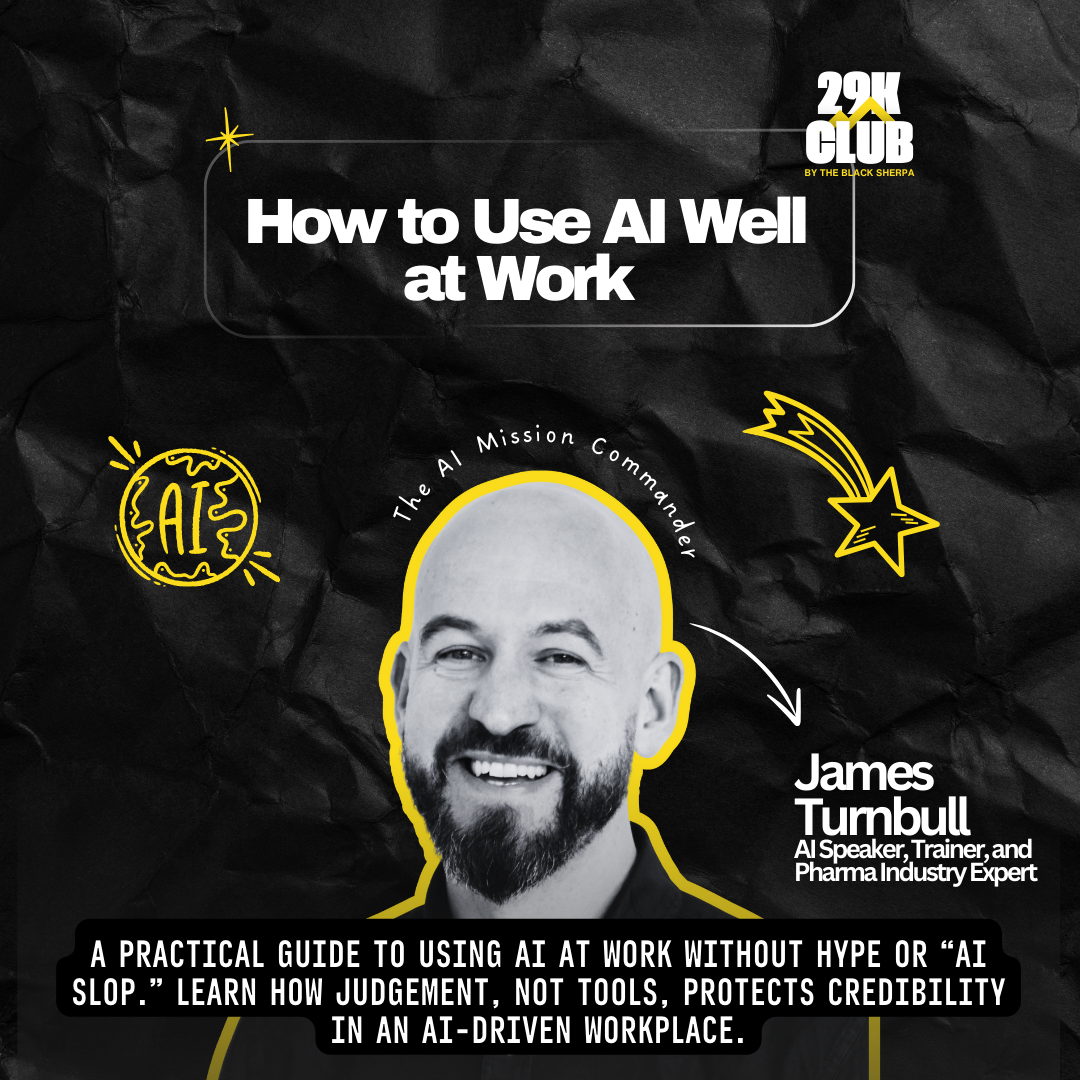
James Turnbull - AI practitioner, technologist, and founder of Camino - A Black Sherpa 29k Club Masterclass
How to use it well, stay credible, and decide what not to outsource
“AI isn’t replacing your job”
“It only gets you about 80% of the way”
“If you don’t choose what not to outsource, the work will just expand”
This wasn’t another session about the latest tools.
It was a masterclass about judgement… and what happens to judgement when powerful technology enters already stretched, politicised workplaces.
By the end of this session, one thing was clear:
AI doesn’t make work easier by default. It makes your thinking more visible.
And that’s why this conversation matters.
The uncomfortable truth we don’t say out loud
AI isn’t creating inequality at work.
It’s revealing it.
Between:
people who can think clearly under pressure
and people who outsource their thinking too early
Between:
leaders who use tools to extend judgement
and those who use them to avoid it
This masterclass, led by James Turnbull, cut through the noise to explore what AI is actually doing to work, credibility, and confidence.
Not in theory.
In practice.
A room full of talent… and one question that stopped it
At one point, someone asked:
“How do we make sure that using AI doesn’t make us less sharp?”
The room went quiet.
Not because it was a bad question… but because it was the question many people were thinking and few felt confident enough to ask.
That pause mattered.
Because beneath the excitement, experimentation, and productivity hacks was a shared, unspoken tension:
If I lean on this too much… what happens to me?
AI isn’t magic. It’s a new colleague
One of the most useful mental models James shared was deceptively simple:
Treat AI like a new hire who’s just read the entire internet.
It’s knowledgeable… but context-blind.
Fast… but naïve.
Helpful… but not accountable.
This reframing unlocked a shift in how people thought about prompts, trust, and responsibility.
You wouldn’t ask a brand-new colleague:
to make final decisions without context
to speak on your behalf without review
to represent you without guidance
So why do that with AI?
The Vanilla Slice Framework: How AI actually creates value
James introduced a framework that stuck… partly because it was funny, partly because it was accurate.
AI adoption, he argued, has three layers:
1. Individual capability (The top layer)
How you use AI day-to-day:
thinking partner
drafting support
sense-checker
idea generator
This is where most people stop.
2. Productivity & value (The middle layer)
Using AI to do things you couldn’t do before:
personalise at scale
translate complex content
create new experiences
unlock insight from existing material
This is where organisations start to see return.
3. Governance & judgement (The base layer)
Guardrails, ethics, review, responsibility.
Not exciting.
But without it, everything above collapses.
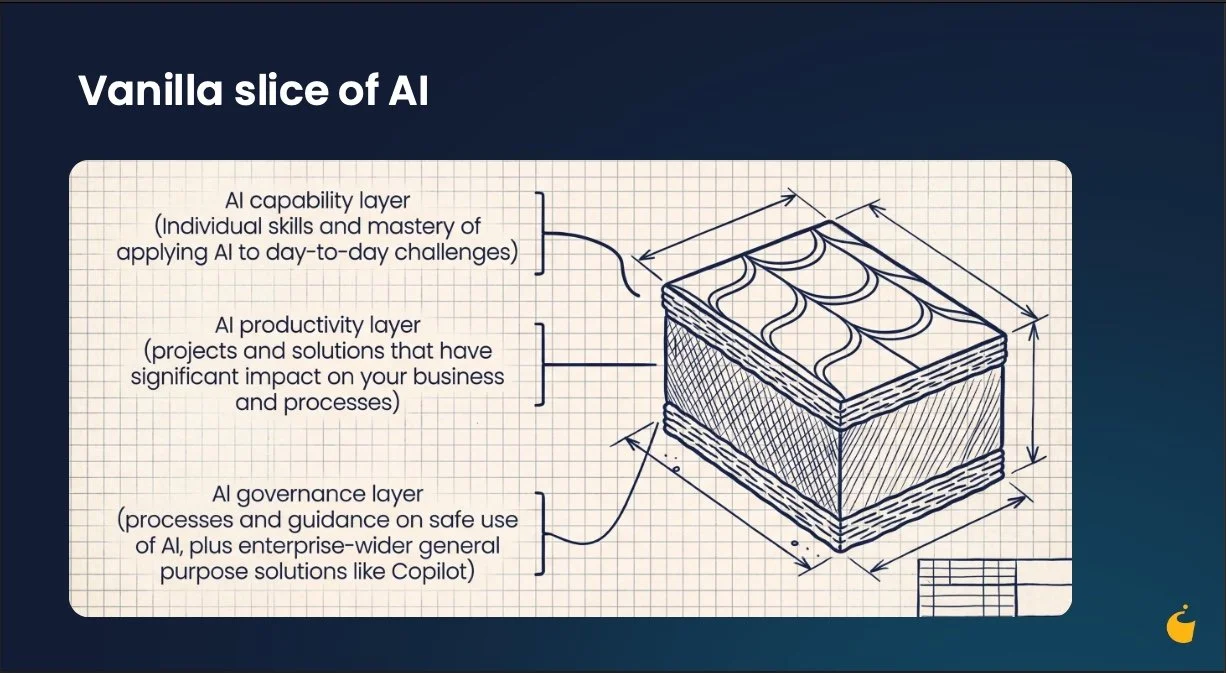
The point wasn’t that everyone needs to master all three.
It was this:
If you skip the bottom layer, the top layers become risky fast.
Why “Prompt Engineering” is overrated
One of the most reassuring insights of the session:
You don’t need to be clever with prompts.
You need to be generous with context.
James shared example after example showing that:
vague questions get generic answers
rich context gets relevant thinking
Doctors who pasted full case notes into AI got better outcomes than those who asked generic questions.
Professionals who shared past emails got responses that matched their voice.
The skill isn’t wording.
It’s framing.
The 80% Rule (And why chasing perfection backfires)
Another moment that resonated:
“AI will only ever get you about 80% of the way.”
Trying to squeeze the final 20% out of the tool often wastes more time than it saves.
The real leverage comes from:
letting AI do the heavy lifting
then finishing the work yourself
That last 20%?
That’s where taste, judgement, and credibility live.
AI Slop: The Hidden Cost of Speed
This is the part of the AI conversation that rarely gets named.
When people don’t stop at 80%, when speed becomes the goal and judgement gets outsourced, something else creeps in:
Content that:
looks finished
sounds confident
but says very little
Long emails that don’t land.
Slides that feel polished but empty.
Summaries that replace thinking instead of sharpening it.
AI slop spreads quietly… especially in high-pressure environments where “getting something out” is rewarded more than “getting it right”.
And here’s the uncomfortable truth:
AI slop doesn’t just lower quality.
It erodes credibility.
People may not know why something feels off, but they feel it. Trust thins. Signal gets lost in noise.
This is why judgement matters more, not less, in an AI-enabled workplace.
Choosing when to slow down, review, or finish the thinking yourself isn’t inefficiency… it’s leadership.
Jevons Paradox: Why AI makes us busier, not better
One of the most powerful ideas in the session came almost quietly: Jevons Paradox.
Originally observed in the 19th century, it describes a counterintuitive truth:
When something becomes more efficient, we don’t use less of it… we use more.
Applied to AI, the implications are huge.
As tasks become faster:
expectations rise
workloads expand
response times shrink
availability becomes assumed
Efficiency doesn’t create space on its own.
It creates pressure to fill the space.
This explains why so many professionals feel busier despite “time-saving” tools.
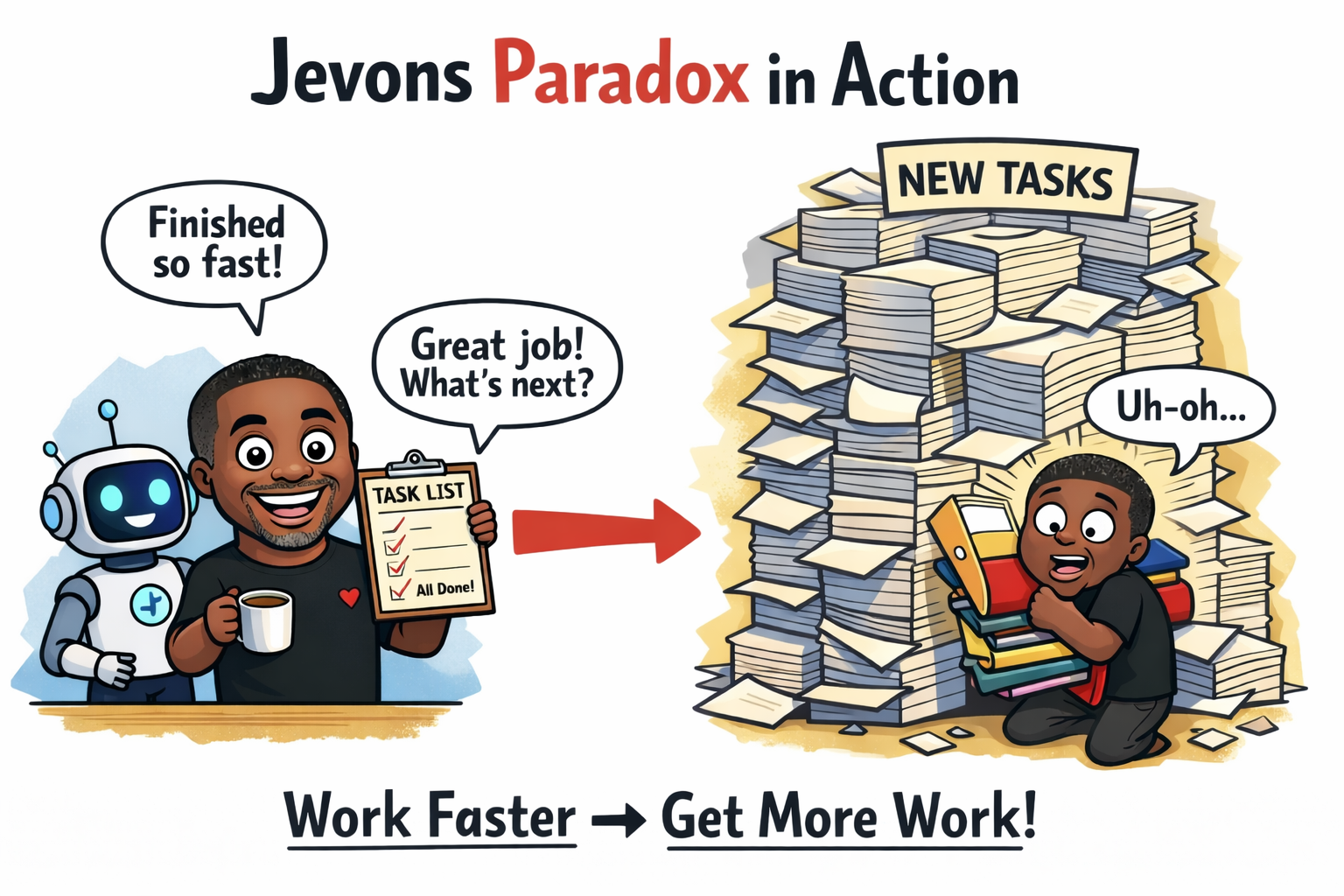
AI makes work faster. Humans decide what fills the space.
AI won’t slow work down for you.
You have to choose what not to replace.
Used intentionally, AI frees people for deeper, more human work.
Used blindly, it just accelerates the treadmill.
Identity, credibility, and the hidden stakes
This part matters… especially for underrepresented professionals.
For people who’ve had to be:
more prepared
more careful
more credible
AI doesn’t automatically level the playing field.
In some environments, it raises the bar… because judgement, not output, becomes the differentiator.
If everyone can produce:
slides
summaries
drafts
Then what stands out is:
how you frame the problem
what you prioritise
when you push back
where you apply human insight
AI doesn’t replace credibility.
It exposes whether you have it.
Practical takeaways you can use this week
For Individuals
Use AI as a thinking partner, not a replacement
Give context before asking questions
Stop at 80%… finish the work yourself
Notice when speed is replacing judgement
For Leaders
Reward quality, not just speed
Set norms for review and accountability
Decide what shouldn’t be automated
Create space to talk about uncertainty, not just tools
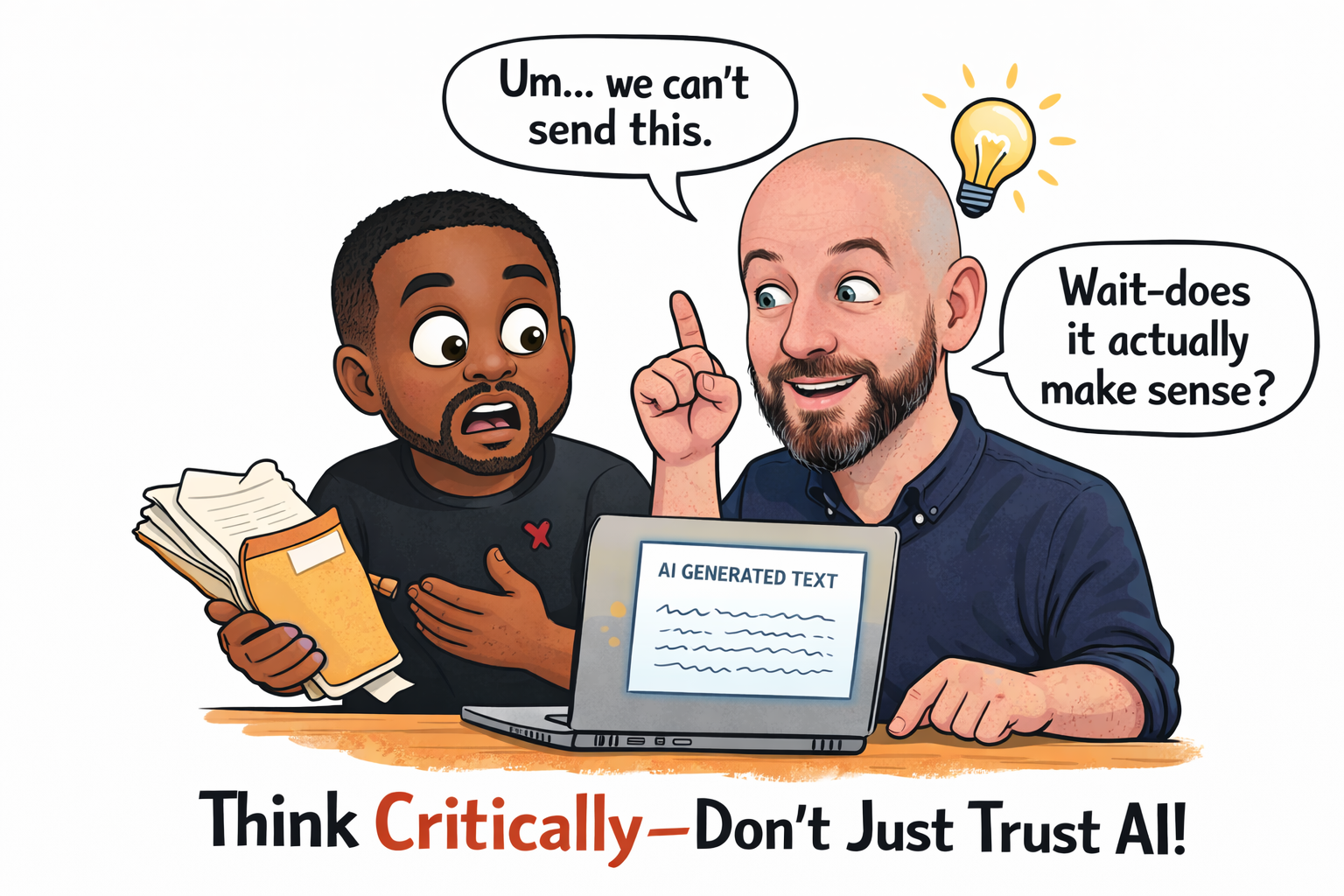
Efficiency without judgement creates slop
Why this conversation matters
Unchecked AI creates:
noise instead of insight
speed without direction
output without ownership
But used well, it creates:
clarity
confidence
better conversations about work
This is exactly why The Black Sherpa 29k Club exists… to give ambitious, under represented professionals the thinking space most workplaces don’t.
Not more information.
Better judgement.
The Leadership Challenge
Before you reach for the next tool, pause and ask yourself:
Where am I using AI to avoid thinking rather than sharpen it?
Where has speed quietly replaced judgement… and started to create slop?
In a world shaped by Jevons Paradox, what am I willing to not fill the space with?
Now make it concrete.
This week, decide one thing you will no longer outsource… even if AI could do it faster.
Finish the thinking yourself.
Protect the signal.
Because if AI is increasing your output but lowering your signal, you’re not saving time… you’re creating slop.
Tools don’t build leaders. Judgement does.
AI will only accelerate what you already bring to the table… clarity or confusion.
Climb steady 🖤
Psst…
If this blog resonated, there’s a room you’d probably enjoy.
Adventures 2.0 is where we have these AI conversations properly… real use cases, real judgement, no hype.
I’m proud to be collaborating with Camino again next year.
🗓 30 April 2026 → adventuresinpharma.com
Save your seat. Bring your thinking.
I’m Yam – Founder of The Black Sherpa
Founder | Strategist | Speaker | Host of The Black Sherpa Podcast
I founded The Black Sherpa to create a world where talent rises on merit and no one’s potential is held back by bias or barriers.
Through bold strategy, storytelling, and our flagship community, The 29k Club - I help professionals grow with confidence and support leaders to build cultures that truly live their values.
Let’s connect and build a future where inclusion powers performance, and leadership reflects the world we serve.