
The Edge of Change: Lead Like You Mean It
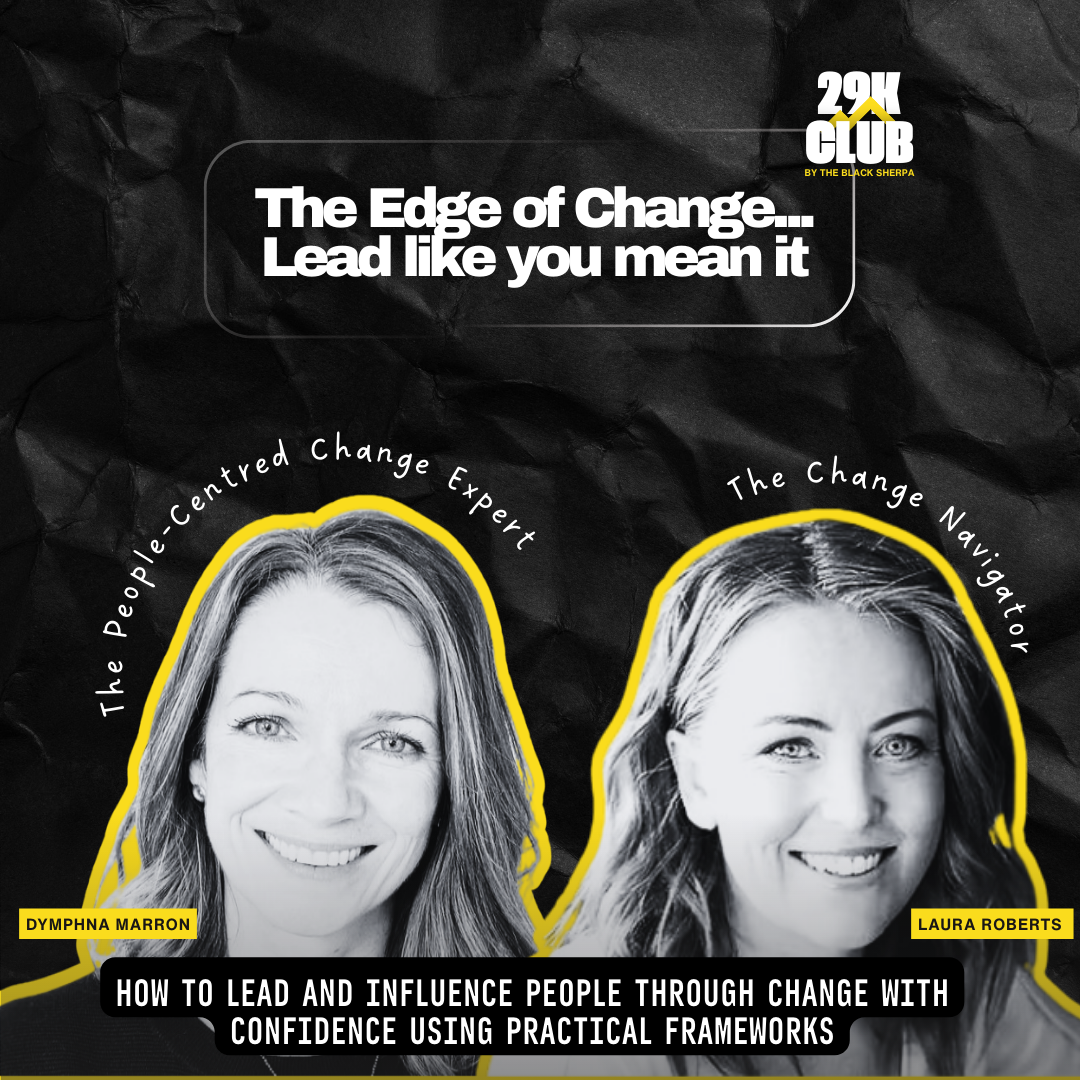
A Black Sherpa masterclass with change experts Laura Roberts & Dymphna Marron, Trapeze Consulting
Learn the psychology of transition, decode ADKAR, and build leadership credibility… with insights from a live case study on building the 29k Club
There are moments in a session where time slows… where someone names an experience so universal that the entire room goes still.
This masterclass on change leadership had several of those moments.
“Change is constant… but transition is personal.”
“It feels like panic… especially when you can’t see the hands waiting on the other side.”
“Talent is everywhere. Access isn’t.”
We weren't just exploring frameworks.
We were exploring human experience… the emotional and psychological terrain of navigating work, life, identity, and opportunity in a world that never sits still.
This session was led by Dymphna Marron and Laura Roberts, the co-founders of Trapeze Consulting… a newly established practice built on decades of collective change leadership experience.
I’ve worked with Dymphna before in my corporate life, back when I had the budget to bring in some of the best in the industry. I saw firsthand how she could steady a room, reframe complexity, and make leaders feel both challenged and held.
This was my first time working with Laura… and within minutes, I understood exactly why she and Dymphna chose to build a business together. Her thinking is sharp, elegant and deeply human. You can feel the rigour behind her frameworks, but also the warmth in how she delivers them. Even on a first encounter, she brings the presence of someone who doesn’t just teach change… she understands it.
Both of them joined our community for this masterclass as an act of generosity, not invoice. And the value they brought… the clarity, the humour, the psychological insight was extraordinary.
What follows is a synthesis of the session, the lessons they shared, the work we did together, and the reflections I’ve made since… written not to sell anything, but to equip you.
My hope is this helps you navigate your own transitions with more clarity, confidence and self-understanding.
The moment the room shifted: “Change vs. Transition”
We began with a distinction that is simple in theory but profound in practice:
Change is external. Transition is internal.
Change is the restructure, reorg, new system, new job, new strategy, new leader.
Transition is the psychological journey: the uncertainty, letting go, fear, hope, confusion, identity disruption, and emotional turbulence.
As Laura put it:
“Organisations manage change. Humans experience transitions.”
To make this real, they introduced Bridges’ Transition Model, and you could feel the room soften as people recognised themselves in it.
1. Endings
Letting go of old expectations, familiar rhythms, relationships, and parts of your identity.
2. The Neutral Zone
The messy, disorienting middle.
The trapeze moment.
You’ve released one bar… but haven’t yet grabbed the next.
Someone in the group described it perfectly:
“It feels like panic.”
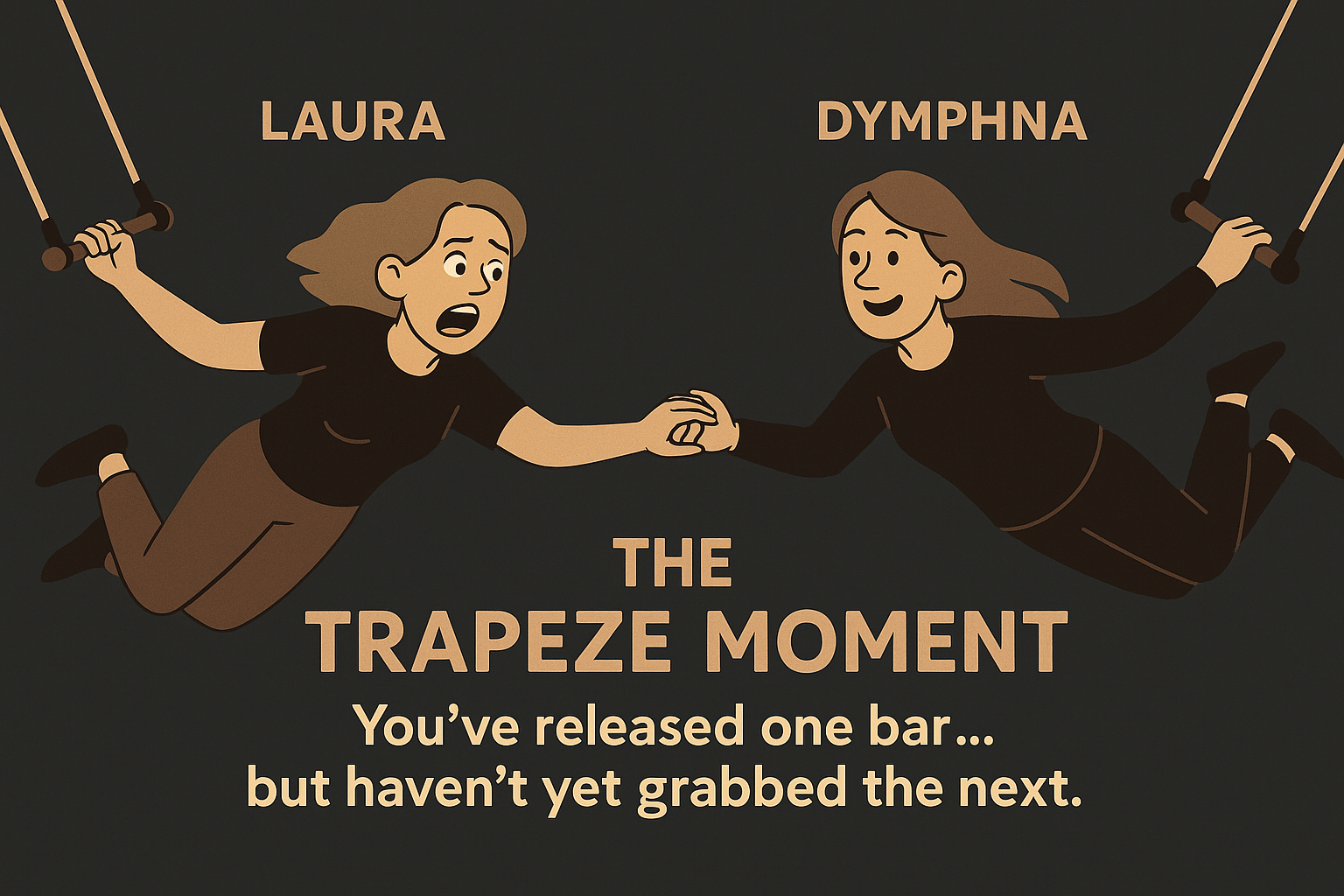
Dymphna, with her usual mix of humour and precision, added:
“It’s really panic if you can’t see the hands waiting on the other side.”
3. New Beginnings
The point where clarity returns, confidence rebuilds, and movement becomes possible again.
This framing alone reshaped how many of us think about change.
A live case study: Building my case for change in public
One of the most powerful parts of the session came when Laura and Dymphna asked me… live, unrehearsed… to articulate my Case for Change behind the work I’m doing.
This framework is simple but potent. It asks four questions:
1. Why are we changing?
2. What, exactly, is changing?
3. What happens if we don’t change?
4. What happens if we do?
Answering these questions honestly, in front of the community itself, was stretching and clarifying.
Here’s the distilled version of what emerged:
1. Why change? Because ambition isn’t the challenge… lack of access is.
Most professionals are not held back by a deficit of capability.
They are held back by a deficit of access:
access to insider context
access to social learning
access to visibility and advocacy
access to sponsors, not just mentors
access to the unwritten rules that turn good into visible
The world of work is moving faster than organisational development structures can respond.
People feel this imbalance every day:
AI redefining roles
restructures becoming routine
budgets shrinking
managers overwhelmed
opportunities narrowing rather than widening
The greatest career challenges are no longer skill gaps.
They are context gaps.
And the painful truth is:
Talent is everywhere. Access isn’t.
This is the root problem.
2. What is changing? The source, speed, and structure of career development.
Growth is shifting:
from employer-led → to self-initiated
from isolated learning → to collective intelligence
from content consumption → to context application
from mentorship → to sponsorship
from passive programmes → to community-powered progression
from privilege → to proximity
This isn’t a theory.
It’s happening in real time… people can feel it, even if they haven’t named it yet.
3. What happens if we don’t change? Potential is lost… everywhere.
If nothing changes:
talented people stay invisible
mid-career professionals fall into organisational gaps
organisations lose future leaders
confidence erodes under repeated uncertainty
inclusion becomes episodic, not embedded
innovation slows
The cost is not just personal.
It is industry-wide.
4. What happens if we do change? Opportunity flows through people, not privilege.
If we intervene consciously:
clarity increases
confidence stabilises
visibility becomes engineered
professionals progress faster
organisations gain stronger talent pipelines
and community becomes a multiplier of capability
This is not just transformation for individuals… It is transformation for ecosystems.
ADKAR: The five steps that make change stick
Then came ADKAR: a framework widely used in global change management.
It breaks change into five sequential steps:
A: Awareness
“Why is this needed?”
D: Desire
“Why would I want to do this?”
K: Knowledge
“How do I do it?”
A: Ability
“Can I execute this in my real context?”
R: Reinforcement
“What ensures I don’t slip back?”
Applying ADKAR to my work revealed a truth I hadn’t fully articulated:
I was strong in Awareness, Desire, Knowledge and Ability… but the missing link was Reinforcement.
Laura’s reflection cut through:
“It’s not enough to change people’s experience inside the room.
The story has to live outside the room too.”
Reinforcement is:
repeated messaging
visible success stories
shared rituals
consistent action
social proof
community accountability
It’s the difference between a moment and a movement.
How I’m applying these learnings (And how you can too)
As a founder, I walk a fine line between performing clarity and actually having clarity.
This session deepened the latter.
Here’s what I’m applying… not as a pitch, but as an example of how you can use these frameworks too.
1. Clarity: Making the path unmistakable
People don’t get stuck because they lack talent.
People get stuck because they lack visibility of the path.
I’m tightening:
the “You Are Here → Next Step” roadmap
quicker entry points into applied learning
clearer articulation of what success looks like
more structured tools that reduce friction
Your application:
Where do people need clearer direction from you?
2. Confidence: Turning courage into a weekly habit
Confidence doesn’t come from thinking.
It comes from repetitions.
I’m building:
more low-stakes practice
more script testing
more behavioural reps
more immediate feedback loops
Your application:
Where could micro-practice give you more courage?
3. Community: Engineering proximity to accelerate progress
Proximity builds advantage.
Not by accident… by design.
I’m adding:
visibility moments
peer advocacy structures
cross-group introductions
shared rituals of reinforcement
Your application:
Who needs to be in closer proximity for progress to happen?
Why this matters now more than ever
We are navigating a world where:
AI is redefining roles faster than job descriptions can keep up
organisational restructuring has become routine
middle managers are carrying emotional loads they are untrained for
hybrid work has reduced visibility
budgets are shrinking
inclusion is slipping from practice to PR
In this landscape:
change literacy is a career skill
transition intelligence is a leadership capability
community stabilises uncertainty
and access, not ambition, determines acceleration
This is the new reality… whether organisations acknowledge it or not.
Laura and Dymphna’s expertise gives people a language and a framework to navigate this reality with confidence.
After the session: A moment that stayed with me
When the group logged off and it was just the three of us, we had a moment of quiet reflection.
We talked about:
the emotional honesty people brought
the depth of questions
the hunger for frameworks that fit modern work
the power of community in moments of uncertainty
Laura said something I’m still thinking about:
“People don’t resist change.
They resist change when they can’t see themselves in the future you’re inviting them into.”
That one sentence refocused everything.
Your Leadership Challenge
1. Where are you in the transition right now… Ending, Neutral Zone, or New Beginning?
2. Which ADKAR stage is your bottleneck?
Awareness? Desire? Knowledge? Ability? Reinforcement?
3. Who around you is navigating change… and how could you be the steady hand they reach for?
These aren’t academic questions.
They are leadership questions… for right now.
If you ever get the chance to learn from Dymphna Marron and Laura Roberts, take it.
Their thinking is rigorous.
Their delivery is human.
Their generosity is real.
And their ability to make sense of uncertainty, without losing humour or humanity, is something every leader should experience.
Climb steady 🖤
I’m Yam – Founder of The Black Sherpa
Founder | Strategist | Speaker | Host of The Black Sherpa Podcast
I founded The Black Sherpa to create a world where talent rises on merit and no one’s potential is held back by bias or barriers.
Through bold strategy, storytelling, and our flagship community, The 29k Club - I help professionals grow with confidence and support leaders to build cultures that truly live their values.
Let’s connect and build a future where inclusion powers performance, and leadership reflects the world we serve.